Krueck Nils C, Ahmadia Gabby N, Possingham Hugh P, Riginos Cynthia, Treml Eric A, Mumby Peter J
Marine Spatial Ecology Lab and Australian Research Council Centre of Excellence for Coral Reef Studies, The University of Queensland, St Lucia Campus, Brisbane, Queensland, Australia.
School of Biological Sciences, The University of Queensland, St Lucia Campus, Brisbane, Queensland, Australia.
PLoS Biol. 2017 Jan 5;15(1):e2000537. doi: 10.1371/journal.pbio.2000537. eCollection 2017 Jan.
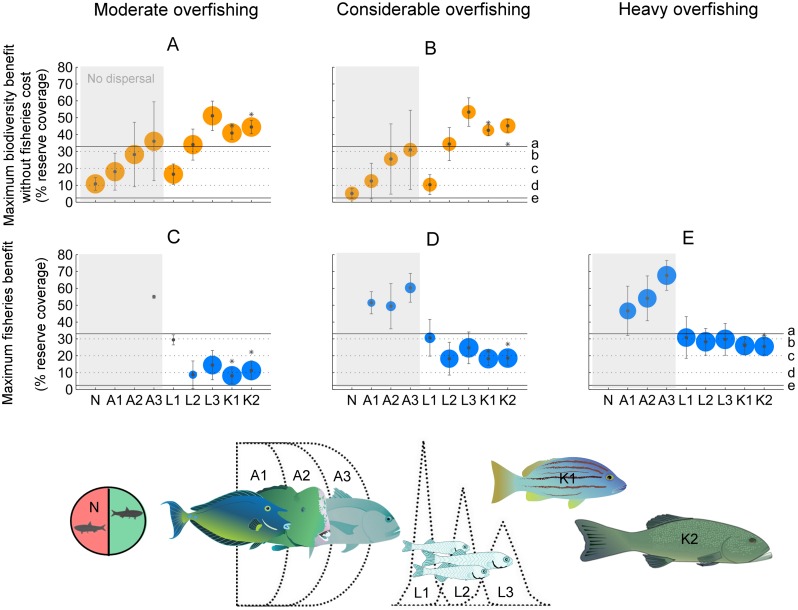
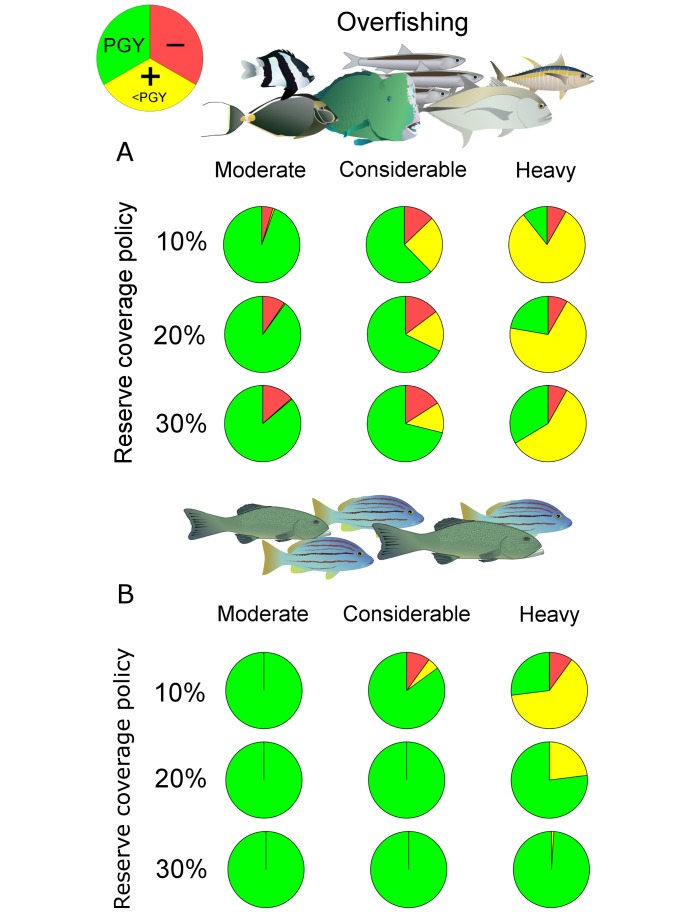
Overfishing threatens the sustainability of coastal marine biodiversity, especially in tropical developing countries. To counter this problem, about 200 governments worldwide have committed to protecting 10%-20% of national coastal marine areas. However, associated impacts on fisheries productivity are unclear and could weaken the food security of hundreds of millions of people who depend on diverse and largely unregulated fishing activities. Here, we present a systematic theoretic analysis of the ability of reserves to rebuild fisheries under such complex conditions, and we identify maximum reserve coverages for biodiversity conservation that do not impair long-term fisheries productivity. Our analysis assumes that fishers have no viable alternative to fishing, such that total fishing effort remains constant (at best). We find that realistic reserve networks, which protect 10%-30% of fished habitats in 1-20 km wide reserves, should benefit the long-term productivity of almost any complex fishery. We discover a "rule of thumb" to safeguard against the long-term catch depletion of particular species: individual reserves should export 30% or more of locally produced larvae to adjacent fishing grounds. Specifically on coral reefs, where fishers tend to overexploit species whose dispersal distances as larvae exceed the home ranges of adults, decisions on the size of reserves needed to meet the 30% larval export rule are unlikely to compromise the protection of resident adults. Even achieving the modest Aichi Target 11 of 10% "effective protection" can then help rebuild depleted catch. However, strictly protecting 20%-30% of fished habitats is unlikely to diminish catch even if overfishing is not yet a problem while providing greater potential for biodiversity conservation and fishery rebuilding if overfishing is substantial. These findings are important because they suggest that doubling or tripling the only globally enforced marine reserve target will benefit biodiversity conservation and higher fisheries productivity where both are most urgently needed.
过度捕捞威胁着沿海海洋生物多样性的可持续性,尤其是在热带发展中国家。为应对这一问题,全球约200个政府已承诺保护10%-20%的国家沿海海洋区域。然而,其对渔业生产力的相关影响尚不清楚,可能会削弱数亿依赖多样化且基本不受管制的捕鱼活动的人们的粮食安全。在此,我们针对在这种复杂条件下保护区重建渔业的能力进行了系统的理论分析,并确定了在不损害长期渔业生产力的情况下实现生物多样性保护的最大保护区覆盖率。我们的分析假设渔民除了捕鱼没有可行的替代选择,因此总捕捞努力量最多保持不变。我们发现,在1-20公里宽的保护区内保护10%-30%的捕捞栖息地的现实保护区网络,应该会使几乎任何复杂渔业的长期生产力受益。我们发现了一条“经验法则”来防止特定物种的长期捕捞量减少:单个保护区应向相邻渔场输出30%或更多的本地产出幼体。特别是在珊瑚礁地区,渔民往往过度捕捞那些幼体扩散距离超过成体活动范围的物种,根据30%幼体输出规则来确定所需保护区大小的决策不太可能损害对本地成体的保护。即便仅实现适度的10%“有效保护”的爱知目标11,也有助于重建枯竭的捕捞量。然而,即使尚未出现过度捕捞问题,严格保护20%-30%的捕捞栖息地也不太可能减少捕捞量,而如果过度捕捞严重,这将为生物多样性保护和渔业重建提供更大潜力。这些发现很重要,因为它们表明将唯一全球强制实施的海洋保护区目标提高一倍或两倍,将有利于在最急需的地方实现生物多样性保护和更高的渔业生产力。