Ayala Francisco, Calderón-López Ana, Delgado-Gosálbez Juan Carlos, Parra-Sánchez Sergio, Pomares-Noguera Carlos, Hernández-Sánchez Sergio, López-Valenciano Alejandro, De Ste Croix Mark
Sports Research Centre, Miguel Hernández University of Elche, Alicante, Spain.
Department of Pathology and Surgery, Physiotherapy Area, Miguel Hernández University of Elche, Alicante, Spain.
PLoS One. 2017 Jan 6;12(1):e0169660. doi: 10.1371/journal.pone.0169660. eCollection 2017.
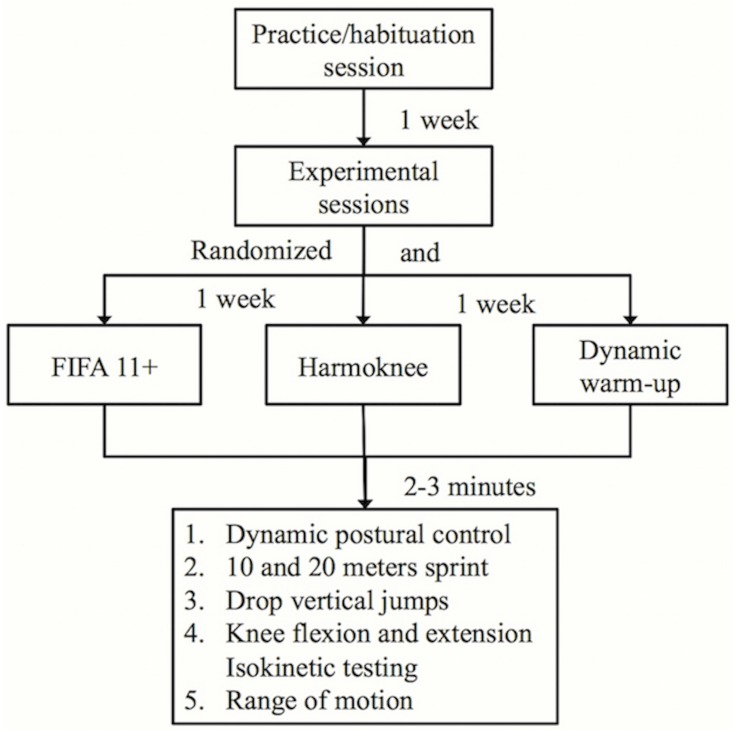
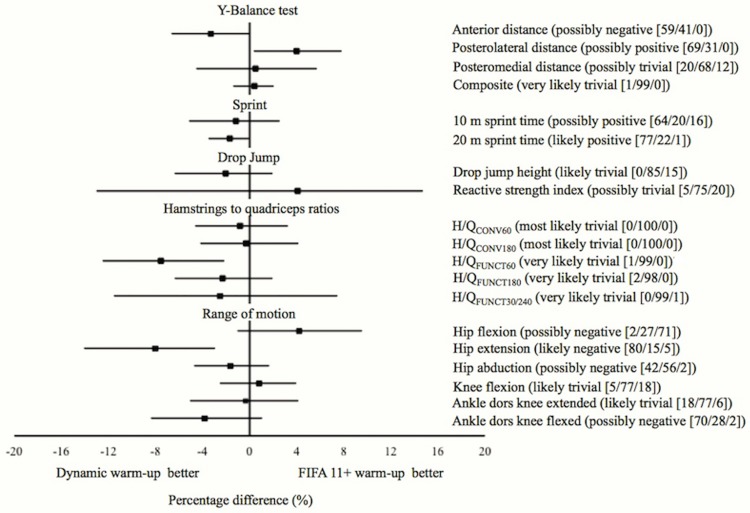
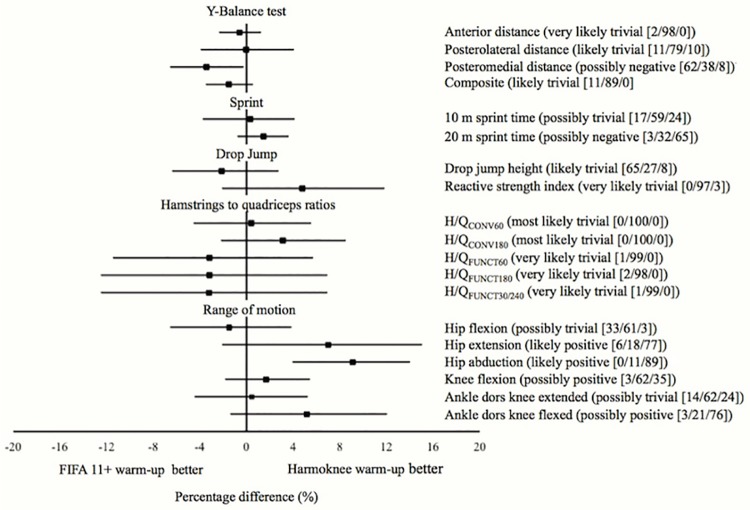
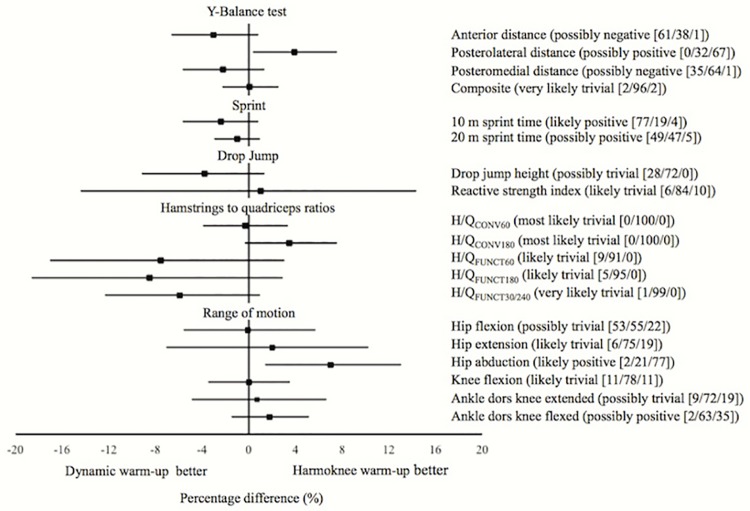
No studies have analysed the acute effects of the FIFA 11+ and Harmoknee warm-up programmes on major physical performance measures. The aim of this study was to analyse the acute (post-exercise) effects of the FIFA 11+, Harmoknee and dynamic warm-up routines on several physical performance measures in amateur football players. A randomized, crossover and counterbalanced study design was used to address the purpose of this study. A total of sixteen amateur football players completed the following protocols in a randomized order on separate days: a) FIFA 11+; b) Harmoknee; and c) dynamic warm-up (DWU). In each experimental session, 19 physical performance measures (joint range of motion, hamstring to quadriceps [H/Q] strength ratios, dynamic postural control, 10 and 20 m sprint times, jump height and reactive strength index) were assessed. Measures were compared via a magnitude-based inference analysis. The results of this study showed no main effects between paired comparisons (FIFA 11+ vs. DWU, Harmoknee vs. DWU and Harmoknee vs. FIFA 11+) for joint range of motions, dynamic postural control, H/Q ratios, jumping height and reactive strength index measures. However, significant main effects (likely effects with a probability of >75-99%) were found for 10 (1.7%) and 20 (2.4%) m sprint times, demonstrating that both the FIFA 11+ and Harmoknee resulted in slower sprint times in comparison with the DWU. Therefore, neither the FIFA 11+ nor the Harmoknee routines appear to be preferable to dynamic warm-up routines currently performed by most football players prior to training sessions and matches.
尚无研究分析国际足联11+热身方案和Harmoknee热身方案对主要身体机能指标的急性影响。本研究的目的是分析国际足联11+热身方案、Harmoknee热身方案和动态热身程序对业余足球运动员多项身体机能指标的急性(运动后)影响。本研究采用随机、交叉和平衡的研究设计来实现这一目的。共有16名业余足球运动员在不同日期以随机顺序完成了以下方案:a)国际足联11+热身方案;b)Harmoknee热身方案;c)动态热身(DWU)。在每个实验环节中,评估了19项身体机能指标(关节活动范围、腘绳肌与股四头肌[H/Q]力量比、动态姿势控制、10米和20米短跑时间、跳跃高度和反应力量指数)。通过基于量级的推断分析对各项指标进行比较。本研究结果表明,在关节活动范围、动态姿势控制、H/Q比值、跳跃高度和反应力量指数指标的配对比较中(国际足联11+与DWU、Harmoknee与DWU、Harmoknee与国际足联11+),未发现主要影响。然而,在10米(1.7%)和20米(2.4%)短跑时间方面发现了显著的主要影响(可能影响,概率>75-99%),这表明与DWU相比,国际足联11+和Harmoknee热身方案都会导致短跑时间变慢。因此,国际足联11+热身方案和Harmoknee热身方案似乎都不比目前大多数足球运动员在训练和比赛前进行的动态热身程序更具优势。