Teklu Gebreyohans Gebru, Hailu Teweldemedhn Gebretinsae, Eshetu Gebremedhin Romha
Department of Animal Sciences, College of Agriculture, Aksum University, Shire Campus, Shire, Ethiopia.
Department of Animal Production and Technology, College of Agriculture and Environmental Science, Adigrat University, Adigrat, Ethiopia.
PLoS Negl Trop Dis. 2017 Jan 6;11(1):e0005271. doi: 10.1371/journal.pntd.0005271. eCollection 2017 Jan.
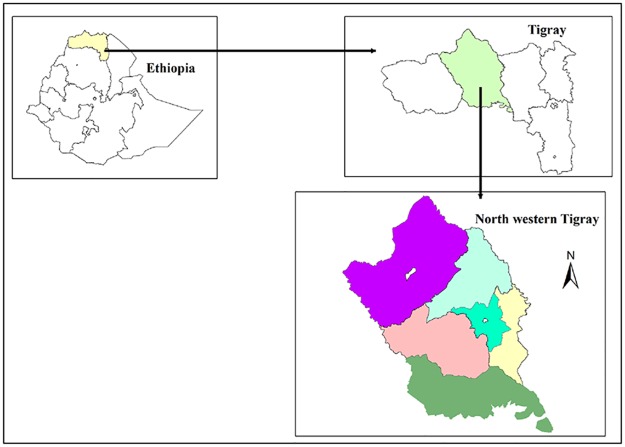
Rabies is a fatal zoonotic disease that has been known in Ethiopia for centuries in society as "Mad Dog Disease". It is an important disease with veterinary and public health significance in the North western zone of Tigray where previous studies have not been conducted. Frequent occurrence of outbreaks in the area led the researchers to carry out a four year retrospective study to estimate the incidence of human rabies exposure in Northwestern Tigray, Ethiopia.
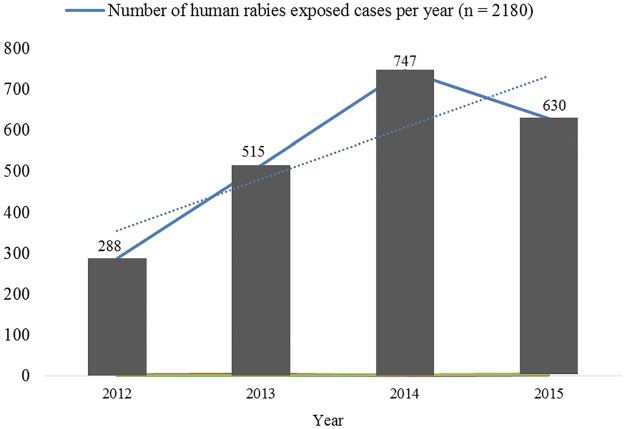
A referent study was conducted on human rabies exposure cases recorded from 2012 to 2015 at Suhul hospital, Shire Endaselase, Northwestern Tigray, Ethiopia. Exposure cases included in this research constituted victims bitten by unprovoked dogs and who received post exposure prophylaxis (PEP) at the hospital. Two thousand one hundred eighty human rabies exposure cases retrieved from the rabies case database were included in this study.
The majority of the exposed cases were males (1363/2180, 63%). Age wise, the most exposed age group was ≥15 years in all the study years: 166 (58%), 335 (65%), 492 (66%) and 394 (63%) in 2012, 2013, 2014 and 2015, respectively. Similarly, exposure cases for human rabies increased with age in both males and females across the study years. The incidence of human rabies exposure cases calculated per 100,000 populations was 35.8, 63.0, 89.8 and 73.1 in 2012, 2013, 2014 and 2015, respectively. Binary logistic regression analysis revealed that being male was a risk for human rabies exposure in all the study years.
The study discovered the highest annual human rabies exposure incidence in Ethiopia. This suggests an urgent need for synergistic efforts of human and animal health sectors to implement prevention and control strategies in this area.
狂犬病是一种致命的人畜共患病,在埃塞俄比亚,几个世纪以来社会上一直将其称为“疯狗病”。在提格雷州西北部,这是一种具有兽医和公共卫生意义的重要疾病,此前尚未在此开展过相关研究。该地区狂犬病疫情频繁爆发,促使研究人员开展了一项为期四年的回顾性研究,以估算埃塞俄比亚提格雷州西北部人类狂犬病暴露的发病率。
对2012年至2015年期间在埃塞俄比亚提格雷州西北部希雷恩达塞拉塞的苏胡尔医院记录的人类狂犬病暴露病例进行了一项对照研究。本研究纳入的暴露病例包括被无故咬伤且在医院接受过暴露后预防(PEP)的受害者。从狂犬病病例数据库中检索出的2180例人类狂犬病暴露病例纳入了本研究。
大多数暴露病例为男性(1363/2180,63%)。从年龄来看,在所有研究年份中,暴露最多的年龄组均为≥15岁:2012年、2013年、2014年和2015年分别为166例(58%)、335例(65%)、492例(66%)和394例(63%)。同样,在整个研究年份中,男性和女性的人类狂犬病暴露病例数均随年龄增长而增加。按每10万人口计算的人类狂犬病暴露病例发病率在2012年、2013年、2014年和2015年分别为35.8、63.0、89.8和73.1。二元逻辑回归分析显示,在所有研究年份中,男性都是人类狂犬病暴露的一个风险因素。
该研究发现埃塞俄比亚人类狂犬病暴露的年度发病率最高。这表明迫切需要人类和动物卫生部门协同努力在该地区实施预防和控制策略。