Oguoma Victor M, Nwose Ezekiel U, Ulasi Ifeoma I, Akintunde Adeseye A, Chukwukelu Ekene E, Bwititi Phillip T, Richards Ross S, Skinner Timothy C
School of Psychological and Clinical Sciences, Charles Darwin University, Darwin, NT, 0909, Australia.
School of Community Health, Charles Sturt University, Orange, NSW, Australia.
BMC Public Health. 2017 Jan 6;17(1):36. doi: 10.1186/s12889-016-3910-3.
Diabetes is a risk factor for cardiovascular diseases (CVDs) and there are reports of increasing prevalence of prediabetes in Nigeria. This study therefore characterised CVDs risk factors in subjects with impaired fasting glucose (IFG) and diabetes.
Data from 4 population-based cross-sectional studies on 2447 apparently healthy individuals from 18 - 89 years were analysed. Anthropometric, blood pressure and biochemical parameters were collected and classified. Individuals with IFG (prediabetes) and diabetes were merged each for positive cases of dyslipidaemia, high blood pressure (HBP) or obesity. Optimal Discriminant and Hierarchical Optimal Classification Tree Analysis (HO-CTA) were employed.
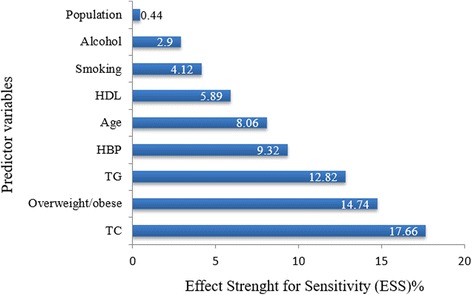
Overall prevalence of IFG and diabetes were 5.8% (CI: 4.9 - 6.7%) and 3.1% (CI: 2.4 - 3.8%), respectively. IFG co-morbidity with dyslipidaemia (5.0%; CI: 4.1 - 5.8%) was the highest followed by overweight/obese (3.1%; CI: 2.5 - 3.8%) and HBP (1.8%; CI: 1.3 - 2.4%). The predicted age of IFG or diabetes and their co-morbidity with other CVD risk factors were between 40 - 45 years. Elevated blood level of total cholesterol was the most predictive co-morbid risk factor among IFG and diabetes subjects. Hypertriglyceridaemia was an important risk factor among IFG-normocholesterolaemic-overweight/obese individuals.
The higher prevalence of co-morbidity of CVD risk factors with IFG than in diabetes plus the similar age of co-morbidity between IFG and diabetes highlights the need for risk assessment models for prediabetes and education of individuals at risk about factors that mitigate development of diabetes and CVDs.
糖尿病是心血管疾病(CVD)的一个风险因素,且有报道称尼日利亚糖尿病前期的患病率在上升。因此,本研究对空腹血糖受损(IFG)和糖尿病患者的心血管疾病风险因素进行了特征分析。
分析了来自4项基于人群的横断面研究的数据,这些研究涉及2447名年龄在18至89岁之间的表面健康个体。收集并分类了人体测量学、血压和生化参数。将IFG(糖尿病前期)和糖尿病患者分别合并为血脂异常、高血压(HBP)或肥胖的阳性病例。采用了最优判别和分层最优分类树分析(HO-CTA)。
IFG和糖尿病的总体患病率分别为5.8%(CI:4.9 - 6.7%)和3.1%(CI:2.4 - 3.8%)。IFG与血脂异常的合并症发生率最高(5.0%;CI:4.1 - 5.8%),其次是超重/肥胖(3.1%;CI:2.5 - 3.8%)和HBP(1.8%;CI:1.3 - 2.4%)。IFG或糖尿病及其与其他CVD风险因素合并症的预测年龄在40至45岁之间。总胆固醇水平升高是IFG和糖尿病患者中最具预测性的合并症风险因素。高甘油三酯血症是IFG-正常胆固醇血症-超重/肥胖个体中的一个重要风险因素。
CVD风险因素与IFG的合并症患病率高于糖尿病,且IFG和糖尿病的合并症年龄相似,这凸显了需要建立糖尿病前期风险评估模型,并对有风险的个体进行教育,使其了解减轻糖尿病和CVD发生的因素。