Zanghi Brian M
Nestlé Purina Research , St Louis, MO , USA.
Front Vet Sci. 2016 Dec 19;3:111. doi: 10.3389/fvets.2016.00111. eCollection 2016.
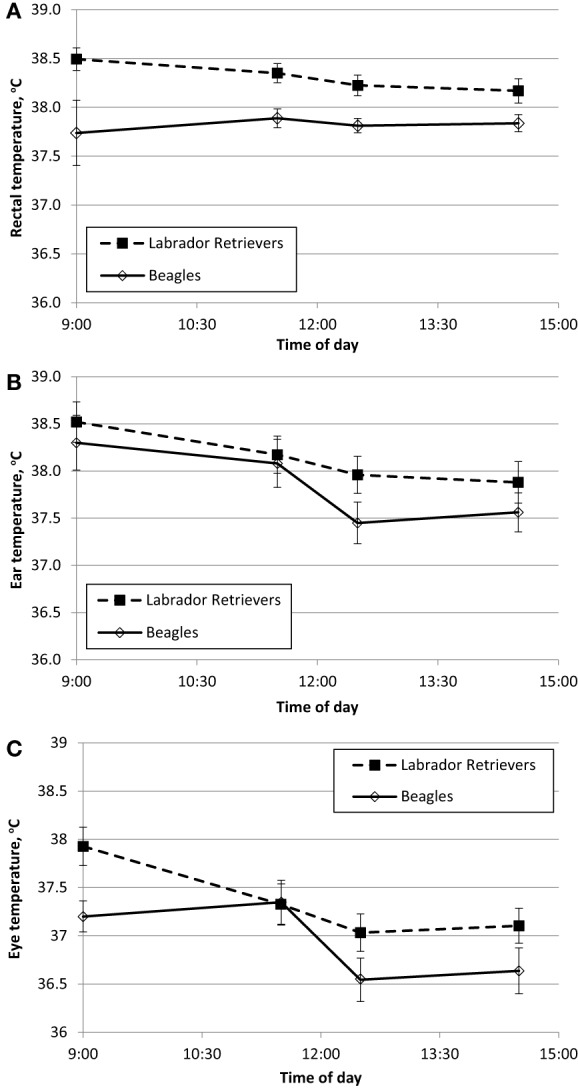
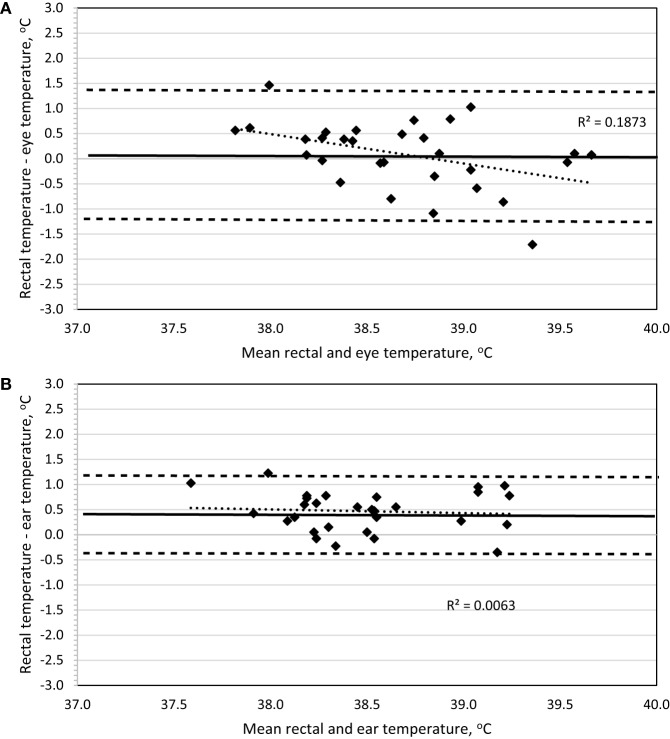
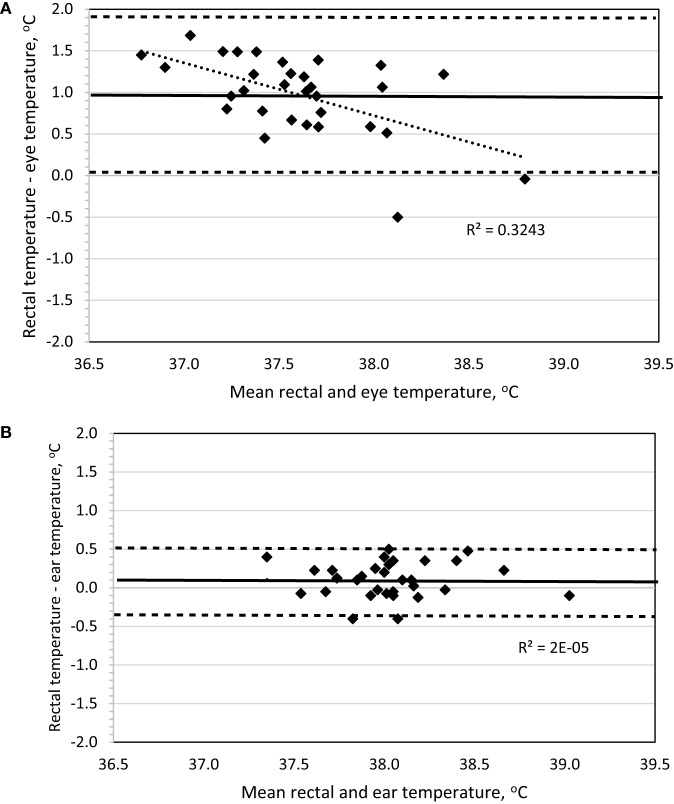
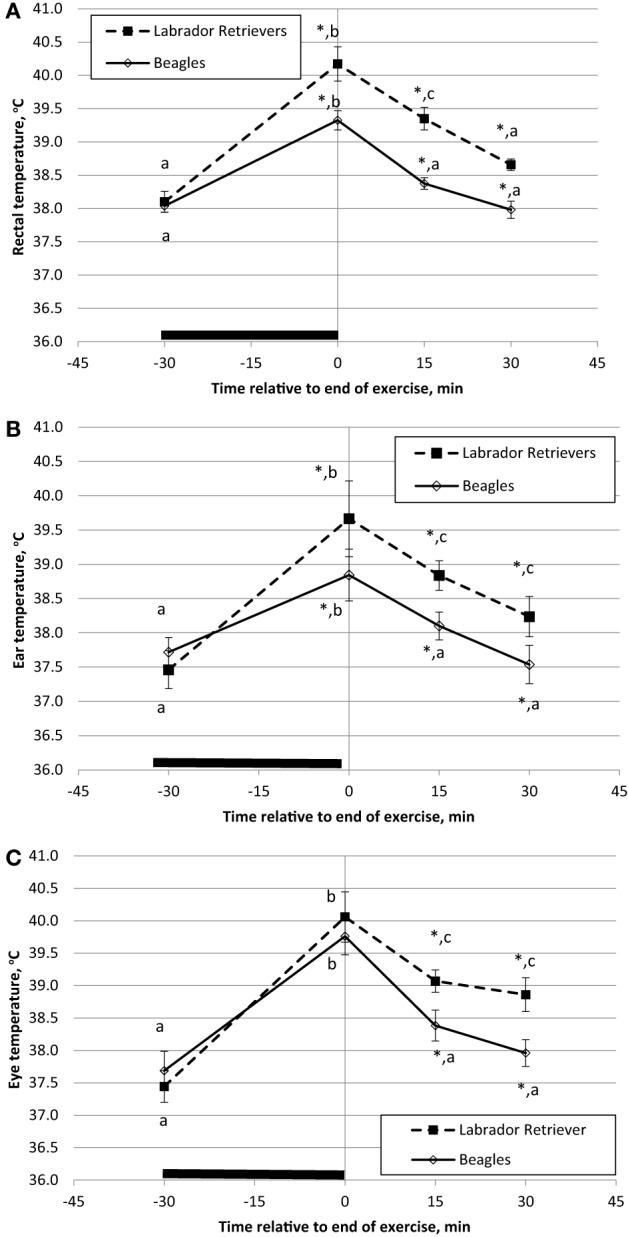
Rectal body temperature (BT) has been documented in exercising dogs to monitor thermoregulation, heat stress risk, and performance during physical activity. Eye (BT) and ear (BT) temperature measured with infrared thermography (IRT) were compared to rectal (BT) temperature as the reference method and assess alternative sites to track hyperthermia, possibly to establish BT IRT as a passive and non-contact method. BT measures were recorded at 09:00, 11:30, 12:30, and 02:30 from Labrador Retrievers ( = 16) and Beagles ( = 16) while sedentary and with 30-min play-exercise (pre- and 0, 15, 30-min post-exercise). Total exercise locomotor activity counts were recorded to compare relative intensity of play-exercise between breeds. BT, BT, and BT were measured within 5 min of the target time. Each BT method was analyzed by analysis of variance for main effects of breed and time. Method differences were compared using Bland-Altman plots and linear regression. Sedentary BT differed by breed for BT ( < 0.0001), BT ( < 0.0001), and BT ( = 0.06) with Labs having on average 0.3-0.8°C higher BT compared to Beagles. Readings also declined over time for BT ( < 0.0001) and BT ( < 0.0001), but not for BT ( = 0.63) for both breeds. Total exercise (30-min) activity counts did not differ ( = 0.53) between breeds. Time and breed interaction was significant in response to exercise for both BT and BT ( = 0.035 and = 0.005, respectively), with a marginal interaction ( = 0.09) for BT. All the three methods detected hyperthermia with Labs having a higher increase compared to Beagles. Both BT and BT were significantly ( < 0.0001) related to BT in all dogs with sedentary or exercise activity. The relationship between BT and BT improved when monitoring exercise hyperthermia ( = 0.674) versus measures at rest ( = 0.381), whereas BT was significantly related to BT regardless of activity ( = 0.615-0.735). Although BT readings were significantly related, method bias ( < 0.02) was observed for BT to slightly underestimate BT, whereas no bias was observed between BT and BT. This study demonstrates that IRT technology effectively measures both ear and eye temperature and enables effective monitoring of BT changes at rest, with exercise, and between breeds. However, ear, and not eye, temperature is a better reflection of rectal temperature.
已记录运动犬的直肠体温(BT),以监测体温调节、热应激风险及身体活动期间的表现。将通过红外热成像(IRT)测量的眼部(BT)和耳部(BT)温度与作为参考方法的直肠(BT)温度进行比较,并评估用于追踪体温过高的替代部位,可能是为了将BT IRT确立为一种被动且非接触式的方法。在09:00、11:30、12:30和02:30记录拉布拉多猎犬(n = 16)和比格犬(n = 16)在静息状态下以及进行30分钟游戏运动时(运动前以及运动后0、15、30分钟)的BT测量值。记录总的运动活动计数,以比较不同品种间游戏运动的相对强度。在目标时间的5分钟内测量BT、BT和BT。通过方差分析对品种和时间的主效应分析每种BT方法。使用Bland-Altman图和线性回归比较方法差异。静息BT在品种间对于BT(P < 0.0001)、BT(P < 0.0001)和BT(P = 0.06)存在差异,拉布拉多猎犬的BT平均比比格犬高0.3 - 0.8°C。两种品种的BT(P < 0.0001)和BT(P < 0.0001)读数也随时间下降,但BT(P = 0.63)没有下降。两个品种间总的运动(30分钟)活动计数没有差异(P = 0.53)。对于BT和BT,时间和品种的交互作用在运动反应中显著(分别为P = 0.035和P = 0.005),对于BT存在边缘交互作用(P = 0.09)。所有三种方法都检测到体温过高,拉布拉多猎犬的体温升高幅度比比格犬大。在所有静息或运动活动的犬中,BT和BT均与BT显著相关(P < 0.0001)。与静息测量值(P = 0.381)相比,监测运动性体温过高时BT与BT的关系有所改善(P = 0.674),而无论活动状态如何,BT均与BT显著相关(P = 0.615 - 0.735)。尽管BT读数显著相关,但观察到BT存在方法偏差(P < 0.02),略微低估BT,而BT和BT之间未观察到偏差。本研究表明,IRT技术能有效测量耳部和眼部温度,并能有效监测静息、运动时以及不同品种间的BT变化。然而,耳部而非眼部温度更能反映直肠温度。