Paul Rahul, Hawkins Samuel H, Balagurunathan Yoganand, Schabath Matthew B, Gillies Robert J, Hall Lawrence O, Goldgof Dmitry B
Department of Computer Science and Engineering, University of South Florida, Tampa, Florida.
Department of Cancer Imaging and Metabolism, H. Lee Moffitt Cancer Center & Research Institute, Tampa, Florida.
Tomography. 2016 Dec;2(4):388-395. doi: 10.18383/j.tom.2016.00211.
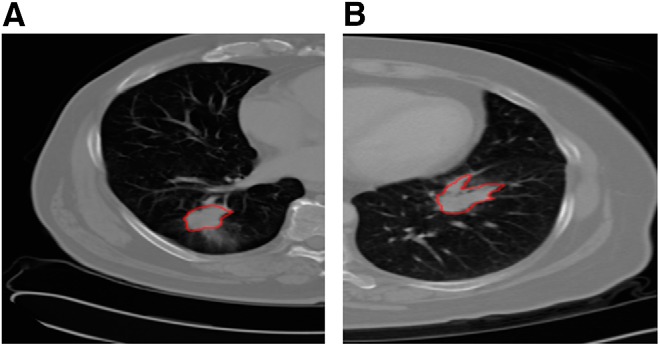
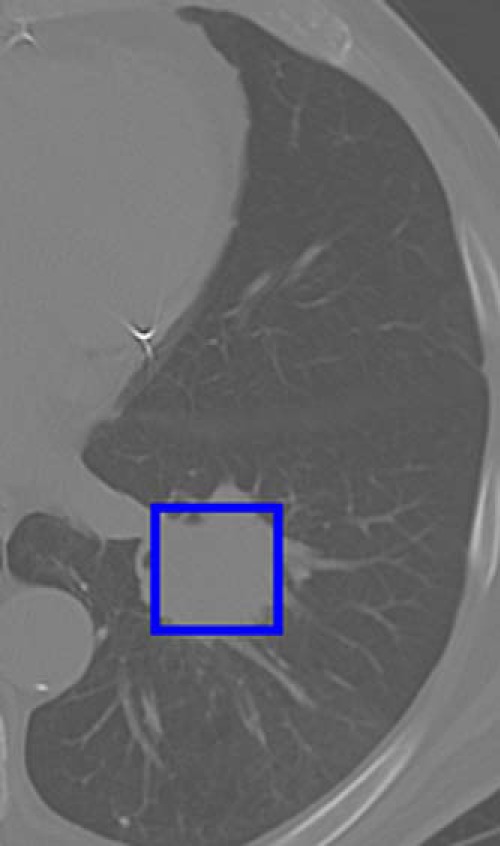
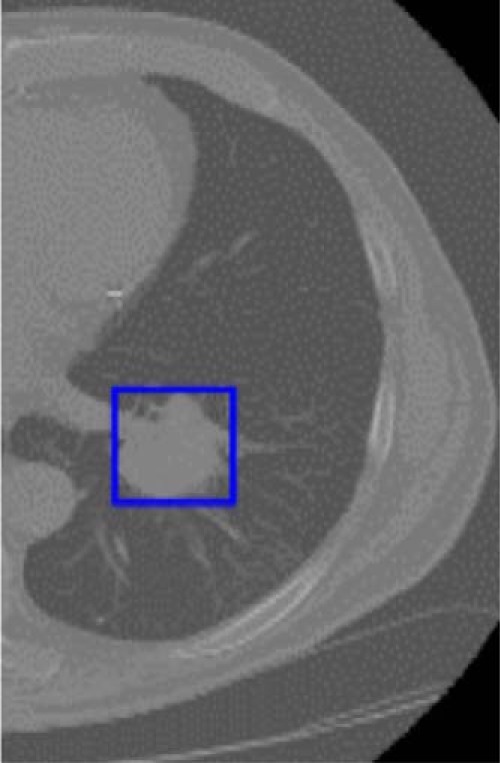
Lung cancer is the most common cause of cancer-related deaths in the USA. It can be detected and diagnosed using computed tomography images. For an automated classifier, identifying predictive features from medical images is a key concern. Deep feature extraction using pretrained convolutional neural networks (CNNs) has recently been successfully applied in some image domains. Here, we applied a pretrained CNN to extract deep features from 40 computed tomography images, with contrast, of non-small cell adenocarcinoma lung cancer, and combined deep features with traditional image features and trained classifiers to predict short- and long-term survivors. We experimented with several pretrained CNNs and several feature selection strategies. The best previously reported accuracy when using traditional quantitative features was 77.5% (area under the curve [AUC], 0.712), which was achieved by a decision tree classifier. The best reported accuracy from transfer learning and deep features was 77.5% (AUC, 0.713) using a decision tree classifier. When extracted deep neural network features were combined with traditional quantitative features, we obtained an accuracy of 90% (AUC, 0.935) with the 5 best post-rectified linear unit features extracted from a vgg-f pretrained CNN and the 5 best traditional features. The best results were achieved with the symmetric uncertainty feature ranking algorithm followed by a random forests classifier.
肺癌是美国癌症相关死亡的最常见原因。它可以通过计算机断层扫描图像进行检测和诊断。对于自动分类器而言,从医学图像中识别预测特征是一个关键问题。最近,使用预训练卷积神经网络(CNN)进行深度特征提取已成功应用于一些图像领域。在此,我们应用预训练的CNN从40张非小细胞腺癌肺癌的增强计算机断层扫描图像中提取深度特征,并将深度特征与传统图像特征相结合,训练分类器以预测短期和长期存活者。我们试验了几种预训练的CNN和几种特征选择策略。使用传统定量特征时,先前报道的最佳准确率为77.5%(曲线下面积[AUC],0.712),这是由决策树分类器实现的。使用决策树分类器,迁移学习和深度特征报道的最佳准确率为77.5%(AUC,0.713)。当将提取的深度神经网络特征与传统定量特征相结合时,我们使用从vgg-f预训练CNN中提取的5个最佳修正线性单元后特征和5个最佳传统特征,获得了90%的准确率(AUC,0.935)。使用对称不确定性特征排序算法和随机森林分类器取得了最佳结果。