Department of Radiology and Nuclear Medicine, Radboud University Medical Center, Nijmegen, Netherlands.
Department of Nuclear Medicine, Erasmus Medical Center, Rotterdam, Netherlands.
Sci Rep. 2017 Jan 9;7:39800. doi: 10.1038/srep39800.
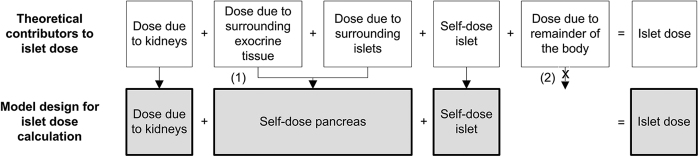
Radiolabeled exendin is used for non-invasive quantification of beta cells in the islets of Langerhans in vivo. High accumulation of radiolabeled exendin in the islets raised concerns about possible radiation-induced damage to these islets in man. In this work, islet absorbed doses resulting from exendin-imaging were calculated by combining whole organ dosimetry with small scale dosimetry for the islets. Our model contains the tissues with high accumulation of radiolabeled exendin: kidneys, pancreas and islets. As input for the model, data from a clinical study (radiolabeled exendin distribution in the human body) and from a preclinical study with Biobreeding Diabetes Prone (BBDP) rats (islet-to-exocrine uptake ratio, beta cell mass) were used. We simulated In-exendin and Ga-exendin absorbed doses in patients with differences in gender, islet size, beta cell mass and radiopharmaceutical uptake in the kidneys. In all simulated cases the islet absorbed dose was small, maximum 1.38 mGy for Ga and 66.0 mGy for In. The two sources mainly contributing to the islet absorbed dose are the kidneys (33-61%) and the islet self-dose (7.5-57%). In conclusion, all islet absorbed doses are low (<70 mGy), so even repeated imaging will hardly increase the risk on diabetes.
放射性标记的 exendin 用于在体内非侵入性地定量胰岛中的β细胞。放射性标记的 exendin 在胰岛中的高积累引起了对这些胰岛在人体内可能受到辐射损伤的关注。在这项工作中,通过将整体器官剂量测定与胰岛的小规模剂量测定相结合,计算了 exendin 成像导致的胰岛吸收剂量。我们的模型包含放射性标记的 exendin 高积累的组织:肾脏、胰腺和胰岛。作为模型的输入,使用了来自临床研究(放射性标记的 exendin 在人体中的分布)和用 Biobreeding Diabetes Prone (BBDP) 大鼠进行的临床前研究的数据(胰岛与外分泌摄取比,β细胞质量)。我们模拟了性别、胰岛大小、β细胞质量和肾脏中放射性药物摄取不同的患者中的 In-exendin 和 Ga-exendin 吸收剂量。在所有模拟的情况下,胰岛吸收剂量都很小,最大 Ga 为 1.38 mGy,In 为 66.0 mGy。对胰岛吸收剂量贡献最大的两个来源是肾脏(33-61%)和胰岛自身剂量(7.5-57%)。总之,所有胰岛吸收剂量都很低(<70 mGy),因此即使重复成像也几乎不会增加患糖尿病的风险。