Sheehan Kate L, Esswein Samuel T, Dorr Brian S, Yarrow Greg K, Johnson Ron J
Scripps Institution of Oceanography University of California San Diego La Jolla CA USA; Department of Forestry and Environmental Conservation Clemson University Clemson SC USA.
Department of Forestry and Environmental Conservation Clemson University Clemson SC USA.
Ecol Evol. 2016 Dec 20;7(1):409-418. doi: 10.1002/ece3.2620. eCollection 2017 Jan.
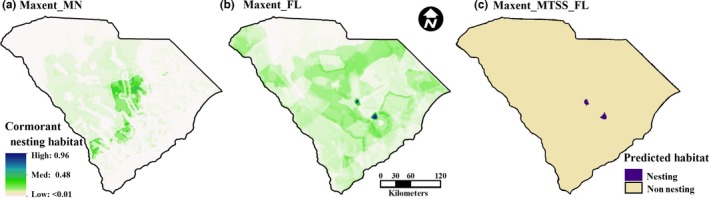
When organisms with similar phenotypes have conflicting management and conservation initiatives, approaches are needed to differentiate among subpopulations or discrete groups. For example, the eastern metapopulation of the double-crested cormorant () has a migratory phenotype that is culled because they are viewed as a threat to commercial and natural resources, whereas resident birds are targeted for conservation. Understanding the distinct breeding habitats of resident versus migratory cormorants would aid in identification and management decisions. Here, we use species distribution models (SDM: Maxent) of cormorant nesting habitat to examine the eastern metapopulation and the predicted breeding sites of its phenotypes. We then estimate the phenotypic identity of breeding colonies of cormorants where management plans are being developed. We transferred SDMs trained on data from resident bird colonies in Florida and migratory bird colonies in Minnesota to South Carolina in an effort to identify the phenotype of breeding cormorants there based on the local landscape characteristics. Nesting habitat characteristics of cormorant colonies in South Carolina more closely resembled those of the Florida phenotype than those of birds of the Minnesota phenotype. The presence of the resident phenotype in summer suggests that migratory and resident cormorants will co-occur in South Carolina in winter. Thus, there is an opportunity for separate management strategies for the two phenotypes in that state. We found differences in nesting habitat characteristics that could be used to refine management strategies and reduce human conflicts with abundant winter migrants and, at the same time, conserve less common colonies of resident cormorants. The models we use here show potential for advancing the study of geographically overlapping phenotypes with differing conservation and management priorities.
当具有相似表型的生物面临相互冲突的管理和保护措施时,就需要采取方法来区分亚种群或离散群体。例如,双冠鸬鹚()的东部复合种群具有迁徙表型,因其被视为对商业和自然资源的威胁而遭到捕杀,而留鸟则是保护的目标。了解留鸟与迁徙鸬鹚不同的繁殖栖息地,将有助于识别和做出管理决策。在此,我们使用鸬鹚筑巢栖息地的物种分布模型(SDM:最大熵模型)来研究东部复合种群及其表型的预测繁殖地点。然后,我们估计正在制定管理计划的鸬鹚繁殖群体的表型特征。我们将基于佛罗里达州留鸟群体和明尼苏达州候鸟群体数据训练的SDM应用于南卡罗来纳州,以便根据当地景观特征识别那里繁殖鸬鹚的表型。南卡罗来纳州鸬鹚群体的筑巢栖息地特征与佛罗里达表型的更为相似,而与明尼苏达表型的鸟类不同。夏季留鸟表型的存在表明,迁徙鸬鹚和留鸟冬季将在南卡罗来纳州共存。因此,该州有机会针对这两种表型采取不同的管理策略。我们发现筑巢栖息地特征存在差异,可用于优化管理策略,减少人类与大量冬季候鸟的冲突,同时保护不太常见的留鸟群体。我们在此使用的模型显示出推进对具有不同保护和管理优先级的地理重叠表型研究的潜力。