Hajek Peter, Przulj Dunja, Phillips Anna, Anderson Rebecca, McRobbie Hayden
Health and Lifestyle Research Unit, Queen Mary University of London, 2 Stayner's Road, London, E1 4AH, UK.
Psychopharmacology (Berl). 2017 Mar;234(5):773-779. doi: 10.1007/s00213-016-4512-6. Epub 2017 Jan 9.
Delivering nicotine in the way smokers seek is likely to be the key factor in e-cigarette (EC) success in replacing cigarettes. We examined to what degree different types of EC mimic nicotine intake from cigarettes.
Twelve participants ('dual users' of EC and cigarettes) used their own brand cigarette and nine different EC brands. Blood samples were taken at baseline and at 2-min intervals for 10 min and again at 30 min.
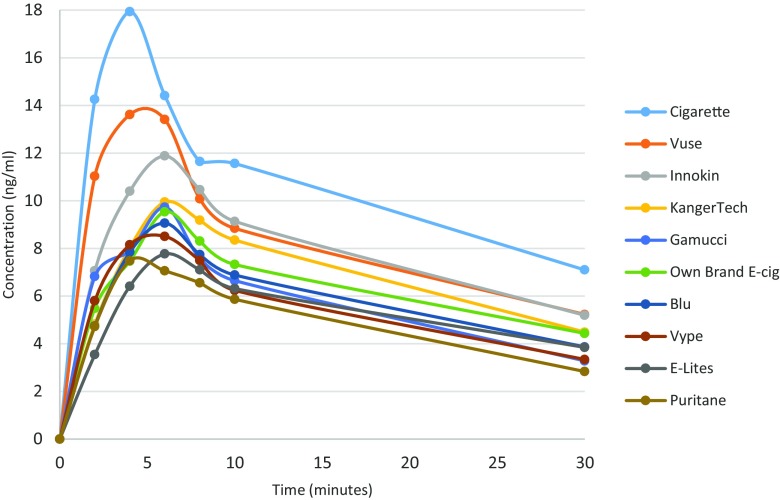
Eleven smokers provided usable data. None of the EC matched cigarettes in nicotine delivery (C = 17.9 ng/ml, T = 4 min and AUC = 315 ng/ml/min). The EC with 48 mg/ml nicotine generated the closest PK profile (C = 13.6 ng/ml, T = 4 min, AUC = 245 ng/ml/min), followed by a third generation EC using 20 mg/ml nicotine (C = 11.9 ng/ml, T = 6 min, AUC = 232 ng/ml/min), followed by the tank system using 20 mg/ml nicotine (C = 9.9 ng/ml, T = 6 min, AUC = 201 ng/ml/min). Cig-a-like PK values were similar, ranging from C 7.5 to 9.7 ng/ml, T 4-6 min, and AUC 144 to 173 ng/ml/min. Moderate differences in e-liquid nicotine concentrations had little effect on nicotine delivery, e.g. the EC with 24 mg/ml cartridge had the same PK profile as ECs with 16 mg/ml cartridges. Using similar strength e-liquid, the tank EC provided significantly more nicotine than cig-a-like ECs.
EC brands we tested do not deliver nicotine as efficiently as cigarettes, but newer EC products deliver nicotine more efficiently than cig-a-like brands. Moderate variations in nicotine content of e-liquid have little effect on nicotine delivery. Smokers who are finding cig-a-like EC unsatisfactory should be advised to try more advanced systems.
以吸烟者所期望的方式输送尼古丁可能是电子烟在替代香烟方面取得成功的关键因素。我们研究了不同类型的电子烟在多大程度上模拟了从香烟中摄取尼古丁的情况。
12名参与者(同时使用电子烟和香烟的“双重使用者”)使用他们自己品牌的香烟和9种不同品牌的电子烟。在基线时、每隔2分钟采集血样,持续10分钟,然后在30分钟时再次采集。
11名吸烟者提供了可用数据。没有一种电子烟在尼古丁输送方面能与香烟相匹配(香烟:C = 17.9纳克/毫升,T = 4分钟,AUC = 315纳克/毫升/分钟)。尼古丁含量为48毫克/毫升的电子烟产生了最接近的药代动力学曲线(C = 13.6纳克/毫升,T = 4分钟,AUC = 245纳克/毫升/分钟),其次是使用20毫克/毫升尼古丁的第三代电子烟(C = 11.9纳克/毫升,T = 6分钟,AUC = 232纳克/毫升/分钟),然后是使用20毫克/毫升尼古丁的储液罐系统(C = 9.9纳克/毫升,T = 6分钟,AUC = 201纳克/毫升/分钟)。类香烟的药代动力学值相似,C值在7.5至9.7纳克/毫升之间,T值在4至6分钟之间,AUC值在144至173纳克/毫升/分钟之间。电子烟液中尼古丁浓度的适度差异对尼古丁输送影响不大,例如,尼古丁含量为24毫克/毫升烟弹的电子烟与尼古丁含量为16毫克/毫升烟弹的电子烟具有相同的药代动力学曲线。使用强度相似的电子烟液时,储液罐式电子烟比类香烟式电子烟提供的尼古丁明显更多。
我们测试的电子烟品牌输送尼古丁的效率不如香烟,但较新的电子烟产品输送尼古丁的效率比类香烟品牌更高。电子烟液中尼古丁含量的适度变化对尼古丁输送影响不大。对于那些对类香烟式电子烟不满意的吸烟者,建议他们尝试更先进的系统。