Wagener Theodore L, Floyd Evan L, Stepanov Irina, Driskill Leslie M, Frank Summer G, Meier Ellen, Leavens Eleanor L, Tackett Alayna P, Molina Neil, Queimado Lurdes
Department of Pediatrics, University of Oklahoma Health Sciences Center, Oklahoma City, Oklahoma, USA.
Oklahoma Tobacco Research Center, University of Oklahoma Health Sciences Center, Oklahoma City, Oklahoma, USA.
Tob Control. 2017 Mar;26(e1):e23-e28. doi: 10.1136/tobaccocontrol-2016-053041. Epub 2016 Oct 11.
Electronic cigarettes' (e-cigarettes) viability as a public health strategy to end smoking will likely be determined by their ability to mimic the pharmacokinetic profile of a cigarette while also exposing users to significantly lower levels of harmful/potentially harmful constituents (HPHCs). The present study examined the nicotine delivery profile of third- (G3) versus second-generation (G2) e-cigarette devices and their users' exposure to nicotine and select HPHCs compared with cigarette smokers.
30 participants (10 smokers, 9 G2 and 11 G3 users) completed baseline questionnaires and provided exhaled carbon monoxide (eCO), saliva and urine samples. Following a 12-hour nicotine abstinence, G2 and G3 users completed a 2-hour vaping session (ie, 5 min, 10-puff bout followed by ad libitum puffing for 115 min). Blood samples, subjective effects, device characteristics and e-liquid consumption were assessed.
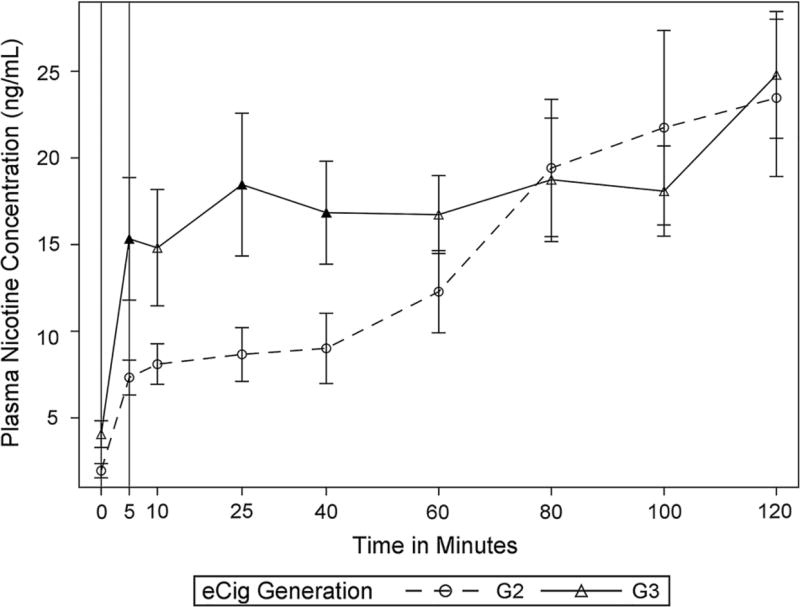
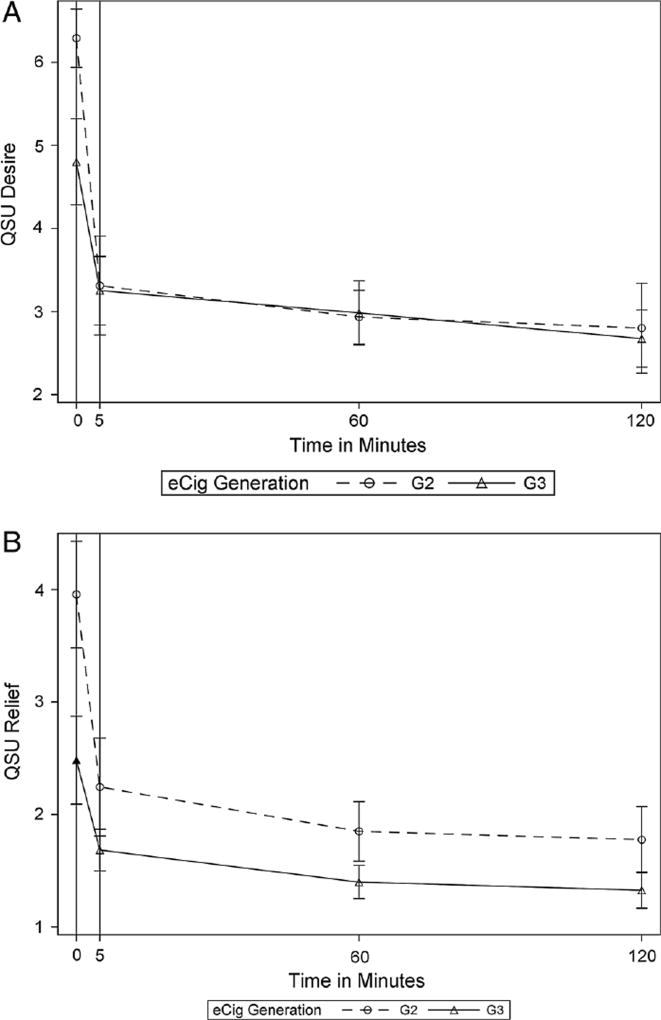
Smokers, G2 and G3 users had similar baseline levels of cotinine, but smokers had 4 and 7 times higher levels of eCO (p<0.0001) and total 4-(Methylnitrosamino)-1-(3-pyridyl)-1-butanol (i.e., NNAL, p<0.01), respectively, than G2 or G3 users. Compared with G2s, G3 devices delivered significantly higher power to the atomiser, but G3 users vaped e-cigarette liquids with significantly lower nicotine concentrations. During the vaping session, G3 users achieved significantly higher plasma nicotine concentrations than G2 users following the first 10 puffs (17.5 vs 7.3 ng/mL, respectively) and at 25 and 40 min of ad libitum use. G3 users consumed significantly more e-liquid than G2 users. Vaping urges/withdrawal were reduced following 10 puffs, with no significant differences between device groups.
Under normal use conditions, both G2 and G3 devices deliver cigarette-like amounts of nicotine, but G3 devices matched the amount and speed of nicotine delivery of a conventional cigarette. Compared with cigarettes, G2 and G3 e-cigarettes resulted in significantly lower levels of exposure to a potent lung carcinogen and cardiovascular toxicant. These findings have significant implications for understanding the addiction potential of these devices and their viability/suitability as aids to smoking cessation.
电子烟作为一种终结吸烟的公共卫生策略的可行性,可能取决于其模仿香烟药代动力学特征的能力,同时还能使使用者接触到显著更低水平的有害/潜在有害成分(HPHCs)。本研究考察了第三代(G3)与第二代(G2)电子烟设备的尼古丁递送特征,以及与吸烟者相比,其使用者对尼古丁和特定HPHCs的暴露情况。
30名参与者(10名吸烟者、9名G2使用者和11名G3使用者)完成了基线调查问卷,并提供了呼出一氧化碳(eCO)、唾液和尿液样本。在12小时尼古丁戒断后,G2和G3使用者完成了一次2小时的吸电子烟过程(即5分钟,每次10口抽吸,随后自由抽吸115分钟)。评估了血样、主观效应、设备特征和电子烟液消耗量。
吸烟者、G2和G3使用者的可替宁基线水平相似,但吸烟者的eCO水平分别比G2或G3使用者高4倍和7倍(p<0.0001),4-(甲基亚硝胺基)-1-(3-吡啶基)-1-丁醇(即NNAL,p<0.01)的总水平也分别比G2或G3使用者高4倍和7倍。与G2相比,G3设备向雾化器输送的功率显著更高,但G3使用者抽吸的电子烟液尼古丁浓度显著更低。在吸电子烟过程中,G3使用者在前10口抽吸后(分别为17.5 ng/mL和7.3 ng/mL)以及自由使用25分钟和40分钟时,血浆尼古丁浓度显著高于G2使用者。G3使用者消耗的电子烟液比G2使用者显著更多。1