Hathi Payal, Haque Sabrina, Pant Lovey, Coffey Diane, Spears Dean
r.i.c.e., a research institute for compassionate economics, New Delhi, India.
World Bank Water and Sanitation Program, Washington, DC, USA.
Demography. 2017 Feb;54(1):337-360. doi: 10.1007/s13524-016-0538-y.
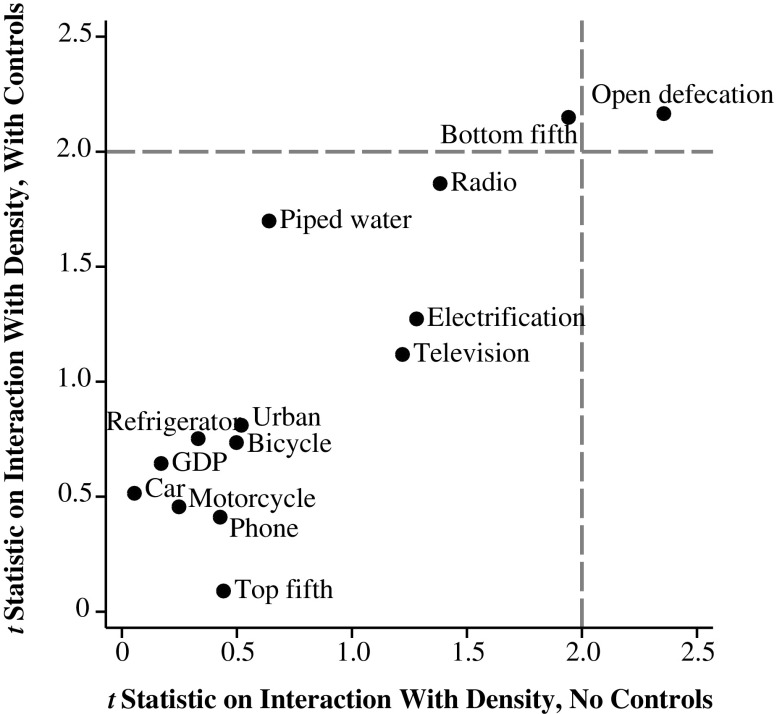
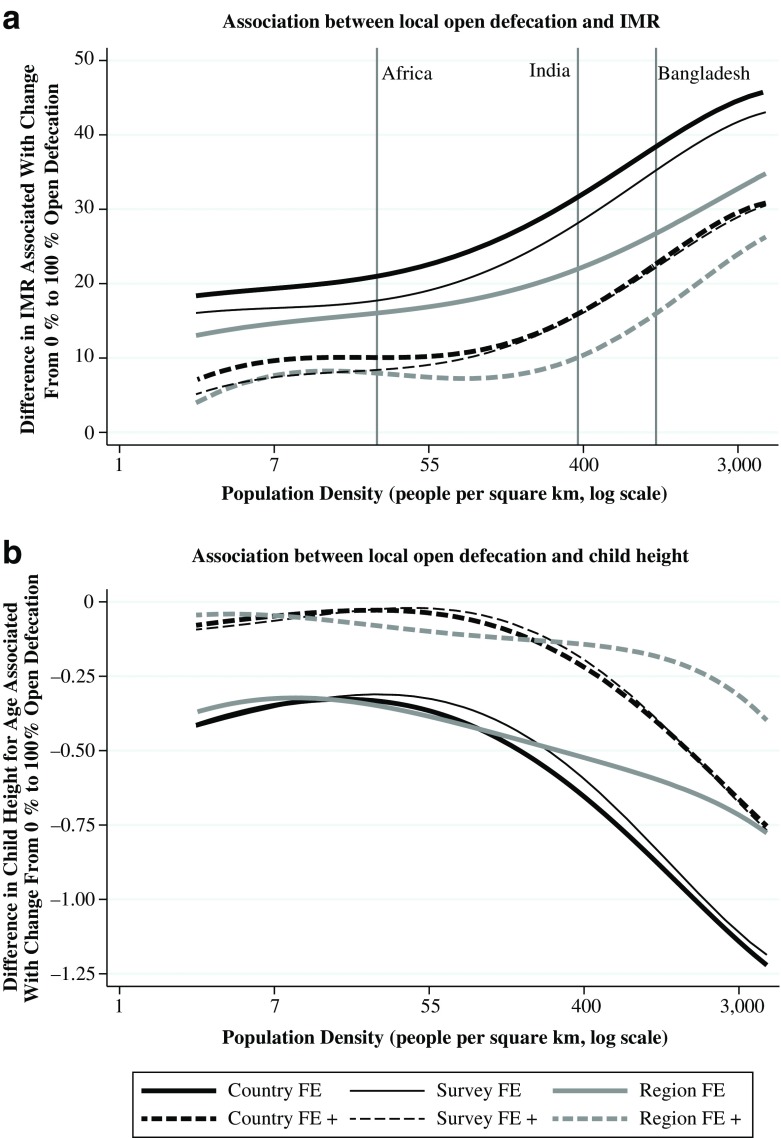
A long literature in demography has debated the importance of place for health, especially children's health. In this study, we assess whether the importance of dense settlement for infant mortality and child height is moderated by exposure to local sanitation behavior. Is open defecation (i.e., without a toilet or latrine) worse for infant mortality and child height where population density is greater? Is poor sanitation is an important mechanism by which population density influences child health outcomes? We present two complementary analyses using newly assembled data sets, which represent two points in a trade-off between external and internal validity. First, we concentrate on external validity by studying infant mortality and child height in a large, international child-level data set of 172 Demographic and Health Surveys, matched to census population density data for 1,800 subnational regions. Second, we concentrate on internal validity by studying child height in Bangladeshi districts, using a new data set constructed with GIS techniques that allows us to control for fixed effects at a high level of geographic resolution. We find a statistically robust and quantitatively comparable interaction between sanitation and population density with both approaches: open defecation externalities are more important for child health outcomes where people live more closely together.
人口统计学领域有大量文献探讨了居住地点对健康,尤其是儿童健康的重要性。在本研究中,我们评估了密集居住对婴儿死亡率和儿童身高的影响是否会因当地卫生行为而有所不同。在人口密度较大的地区,露天排便(即没有厕所或便池)对婴儿死亡率和儿童身高的影响是否更严重?卫生条件差是否是人口密度影响儿童健康结果的一个重要机制?我们使用新收集的数据集进行了两项互补分析,这两项分析代表了外部有效性和内部有效性之间权衡的两个点。首先,我们通过研究172项人口与健康调查的大型国际儿童层面数据集(与1800个国家以下地区的人口普查人口密度数据相匹配)中的婴儿死亡率和儿童身高来关注外部有效性。其次,我们通过研究孟加拉国各地区儿童的身高来关注内部有效性,使用通过地理信息系统(GIS)技术构建的新数据集,该数据集使我们能够在高地理分辨率水平上控制固定效应。我们发现,两种方法都显示出卫生条件与人口密度之间在统计上具有稳健性且在数量上具有可比性的相互作用:在人们居住更为密集的地方,露天排便的外部性对儿童健康结果更为重要。