Oviedo-Pastrana Misael, Méndez Nelson, Mattar Salim, Arrieta Germán, Gomezcaceres Luty
Universidad de Córdoba, Instituto de Investigaciones Biológicas del Trópico, Carrera 6 # 76-103, Montería, Córdoba Colombia.
Universidad de Córdoba, Instituto de Investigaciones Biológicas del Trópico, Carrera 6 # 76-103, Montería, Córdoba Colombia ; Clínica Salud Social SAS, Carrera 16 # 27A-74, Sincelejo, Colombia.
Arch Public Health. 2017 Jan 6;75:1. doi: 10.1186/s13690-016-0169-1. eCollection 2017.
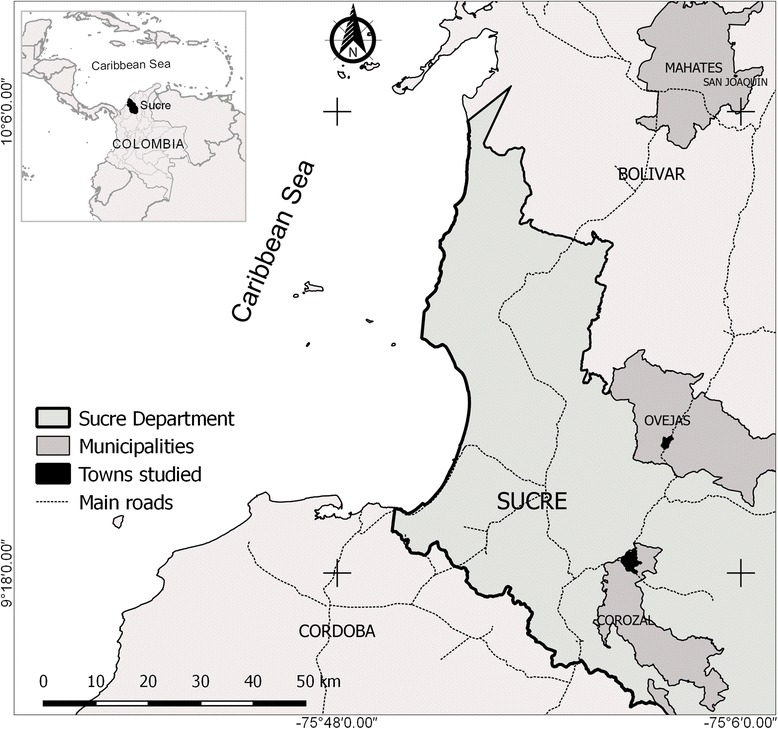
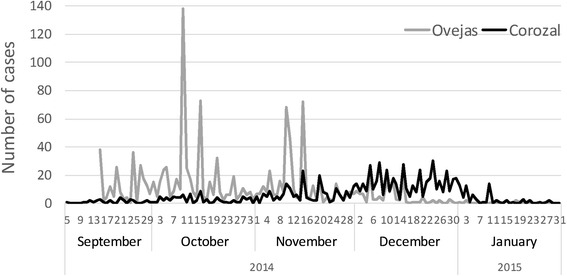
The first autochthonous Chikungunya virus transmission in Colombia was reported in September 2014. Three months later, every town in the Caribbean region was affected, including the bordering towns of Ovejas and Corozal, in the department of Sucre. The objective of the study was to analyze and compare the temporal dynamics of the outbreak of Chikungunya in two towns of the department of Sucre.
Households with suspicious cases with clinical symptomatology for Chikungunya were enrolled. In each house an epidemiological questionnaire was applied to collect economic and social information and methods for vector control.
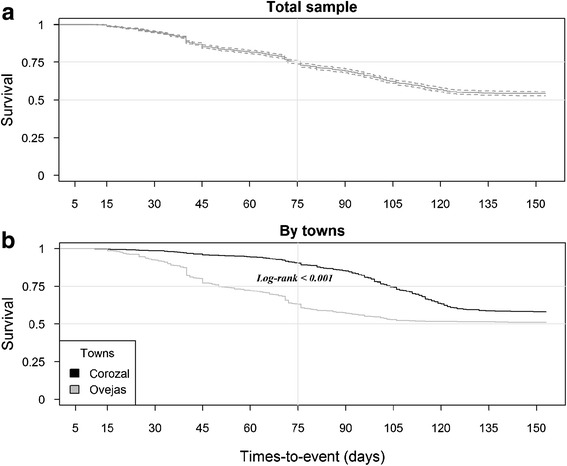
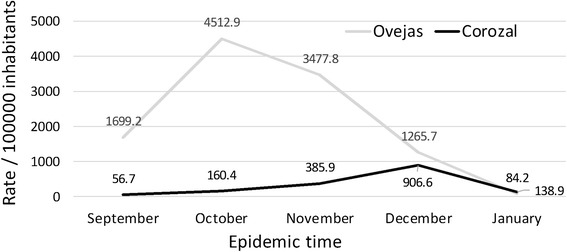
The study analyzed data collected between 09/01/2014 and 01/31/2015; 458 families in Corozal and 516 families in Ovejas were identified with Chikungunya cases. Estimated attack rates were 10,621 cases and 1640 cases per 100,000 inhabitants, in Ovejas and Corozal, respectively. The 75-day survival curve was 27.2% lower (0.632, CI = 0.614-0.651) in Ovejas than in Corozal (0.904, CI = 0.891-0.917). After 120 days, both curves showed a stable horizontal slope, close to a survival probability of 0.54, indicating the end of the epidemic period. The log-rank test ( = 94.6, 1fd, -value = 0.000) showed the improved survival of Chikungunya in the town of Corozal. The relative risk between the two towns was 0.863 (CI = 0.809-0.921; -value < 0.001).
The dynamics of the temporal distribution of CHIKV could be influenced by socioeconomic and preventable risk factors. Poor socioeconomic conditions such as the lack and poor efficiency of water supply and waste collection services could be determining factors in the proliferation of CHIKV. The survival analysis proved to be a suitable method for studying the presentation of CHIKV and can be applied to other prevalent vector-borne diseases such as the ZIKA and Dengue.
2014年9月,哥伦比亚报告了首例本土基孔肯雅病毒传播病例。三个月后,加勒比地区的每个城镇都受到了影响,包括苏克雷省的边境城镇奥韦哈斯和科罗萨尔。本研究的目的是分析和比较苏克雷省两个城镇基孔肯雅热疫情的时间动态。
纳入有基孔肯雅热临床症状可疑病例的家庭。在每户家庭中应用一份流行病学调查问卷,以收集经济和社会信息以及病媒控制方法。
该研究分析了2014年9月1日至2015年1月31日期间收集的数据;在科罗萨尔确定了458户家庭、在奥韦哈斯确定了516户家庭有基孔肯雅热病例。奥韦哈斯和科罗萨尔每10万居民的估计发病率分别为10621例和1640例。奥韦哈斯的75天生存曲线比科罗萨尔低27.2%(0.632,CI = 0.614 - 0.651)(科罗萨尔为0.904,CI = 0.891 - 0.917)。120天后,两条曲线均呈现稳定的水平斜率,接近0.54的生存概率,表明疫情期结束。对数秩检验(= 94.6,1fd,P值 = 0.000)显示基孔肯雅热在科罗萨尔镇的生存情况有所改善。两个城镇之间的相对风险为0.863(CI = 0.809 - 0.921;P值 < 0.001)。
基孔肯雅病毒时间分布的动态可能受社会经济和可预防风险因素的影响。社会经济条件差,如供水和垃圾收集服务缺乏及效率低下,可能是基孔肯雅病毒传播的决定性因素。生存分析被证明是研究基孔肯雅病毒表现的合适方法,并且可应用于其他流行的媒介传播疾病,如寨卡病毒病和登革热。