Viral Diseases Branch, Walter Reed Army institute of Research, Silver Spring, MD, USA.
Institute for Global Health and Translational Science, SUNY Upstate Medical University, Syracuse, NY, USA.
BMC Evol Biol. 2020 Feb 19;20(1):31. doi: 10.1186/s12862-020-1596-8.
In recent years, Ecuador and other South American countries have experienced an increase in arboviral diseases. A rise in dengue infections was followed by introductions of chikungunya and Zika, two viruses never before seen in many of these areas. Furthermore, the latest socioeconomic and political instability in Venezuela and the mass migration of its population into the neighboring countries has given rise to concerns of infectious disease spillover and escalation of arboviral spread in the region.
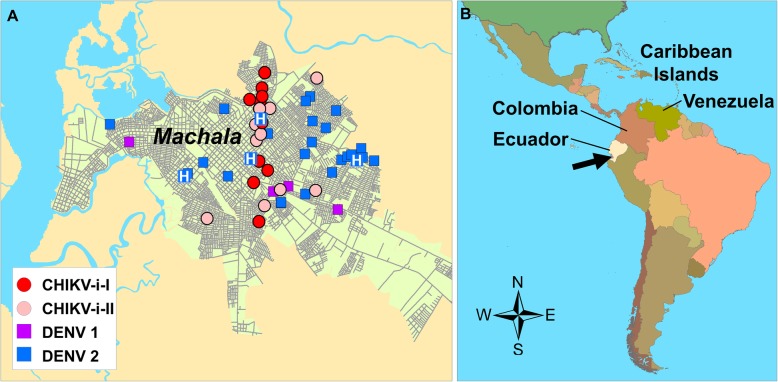
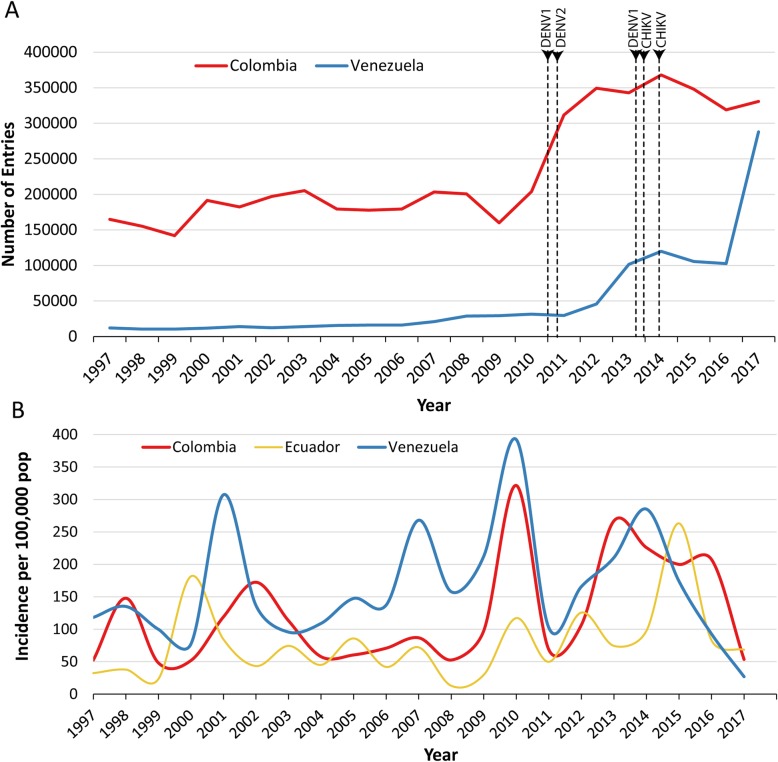
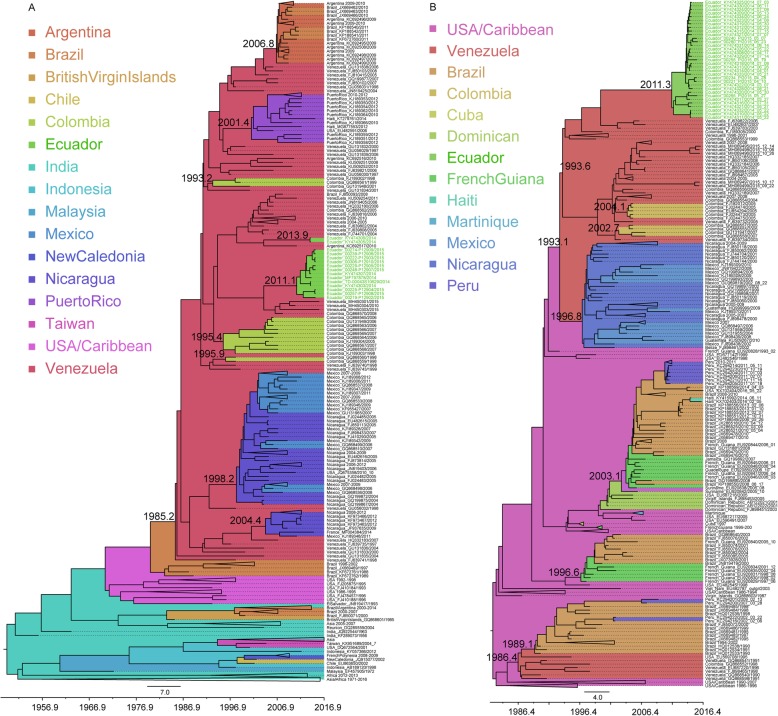
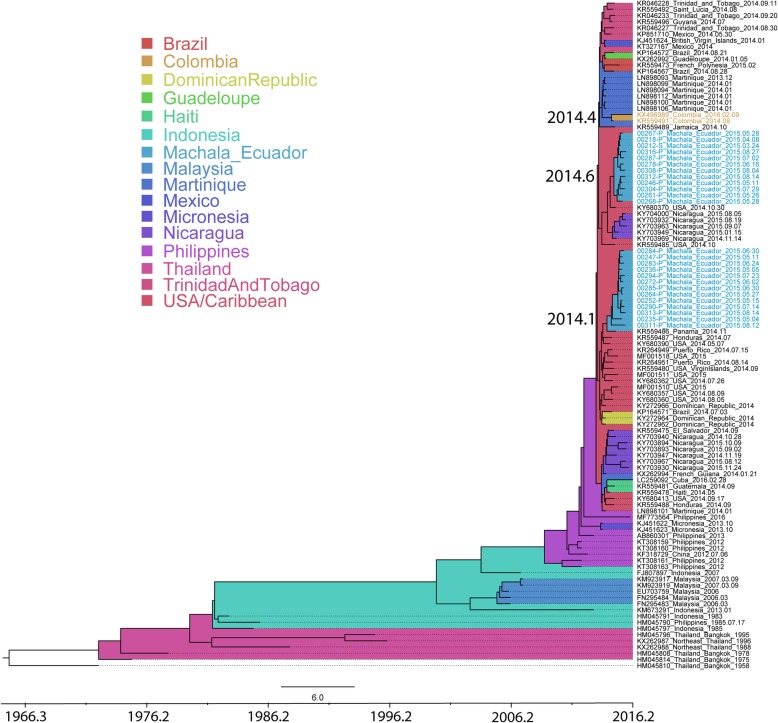
We performed phylogeographic analyses of dengue (DENV) and chikungunya (CHIKV) virus genomes sampled from a surveillance site in Ecuador in 2014-2015, along with genomes from the surrounding countries. Our results revealed at least two introductions of DENV, in 2011 and late 2013, that initially originated from Venezuela and/or Colombia. The introductions were subsequent to increases in the influx of Venezuelan and Colombian citizens into Ecuador, which in 2013 were 343% and 214% higher than in 2009, respectively. However, we show that Venezuela has historically been an important source of DENV dispersal in this region, even before the massive exodus of its population, suggesting already established paths of viral distribution. Like DENV, CHIKV was introduced into Ecuador at multiple time points in 2013-2014, but unlike DENV, these introductions were associated with the Caribbean. Our findings indicated no direct CHIKV connection between Ecuador, Colombia, and Venezuela as of 2015, suggesting that CHIKV was, at this point, not following the paths of DENV spread.
Our results reveal that Ecuador is vulnerable to arbovirus import from many geographic locations, emphasizing the need of continued surveillance and more diversified prevention strategies. Importantly, increase in human movement along established paths of viral dissemination, combined with regional outbreaks and epidemics, may facilitate viral spread and lead to novel virus introductions. Thus, strengthening infectious disease surveillance and control along migration routes and improving access to healthcare for the vulnerable populations is of utmost importance.
近年来,厄瓜多尔和其他南美国家的虫媒病毒病有所增加。登革热感染病例增加之后,基孔肯雅热和寨卡病毒相继传入,而这些地区以前从未出现过这两种病毒。此外,委内瑞拉最近的社会经济和政治动荡以及大量人口向邻国迁移,引发了人们对传染病溢出和该地区虫媒病毒传播加剧的担忧。
我们对 2014-2015 年厄瓜多尔一个监测点采集的登革热(DENV)和基孔肯雅热(CHIKV)病毒基因组以及来自周边国家的基因组进行了系统发育地理分析。结果显示,厄瓜多尔至少有两次 DENV 传入事件,分别发生在 2011 年和 2013 年末,最初源自委内瑞拉和/或哥伦比亚。这两次传入都发生在厄瓜多尔接收的委内瑞拉和哥伦比亚公民人数增加之后,与 2009 年相比,2013 年分别增加了 343%和 214%。然而,我们表明,即使在委内瑞拉人口大规模外流之前,委内瑞拉一直是该地区 DENV 传播的重要来源,这表明已经存在病毒传播的途径。与 DENV 不同,CHIKV 于 2013-2014 年多次传入厄瓜多尔,但与 DENV 不同的是,这些传入事件与加勒比地区有关。截至 2015 年,我们的研究结果表明,厄瓜多尔与哥伦比亚和委内瑞拉之间没有直接的 CHIKV 联系,这表明 CHIKV 目前并没有遵循 DENV 的传播途径。
我们的研究结果表明,厄瓜多尔容易从许多地理位置输入虫媒病毒,这强调了需要继续进行监测和采取更多样化的预防策略。重要的是,随着病毒传播途径上的人类流动增加,再加上区域暴发和流行,可能会促进病毒传播并导致新的病毒传入。因此,加强传染病监测和控制,改善弱势群体获得医疗保健的机会,对于保护这些地区免受传染病的影响至关重要。