Graduate School of Biomedical Engineering, University of New South Wales (UNSW) Australia, Sydney, Australia.
School of Art &Design, University of New South Wales (UNSW) Australia, Sydney, Australia.
Sci Rep. 2017 Jan 11;7:40396. doi: 10.1038/srep40396.
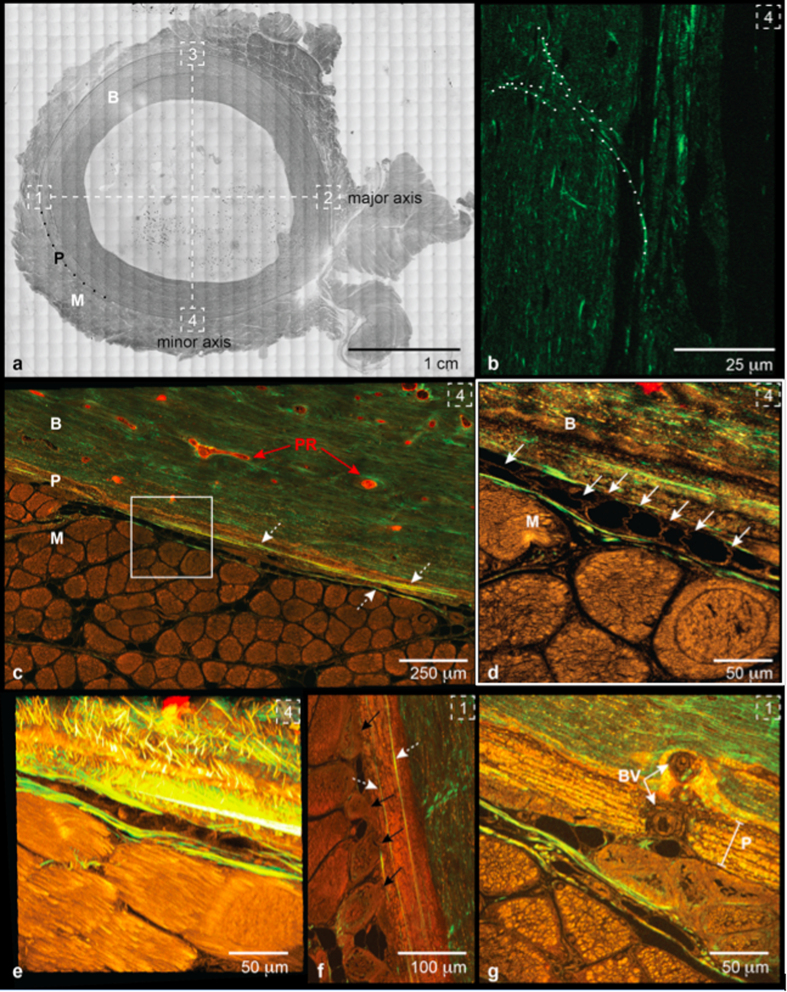
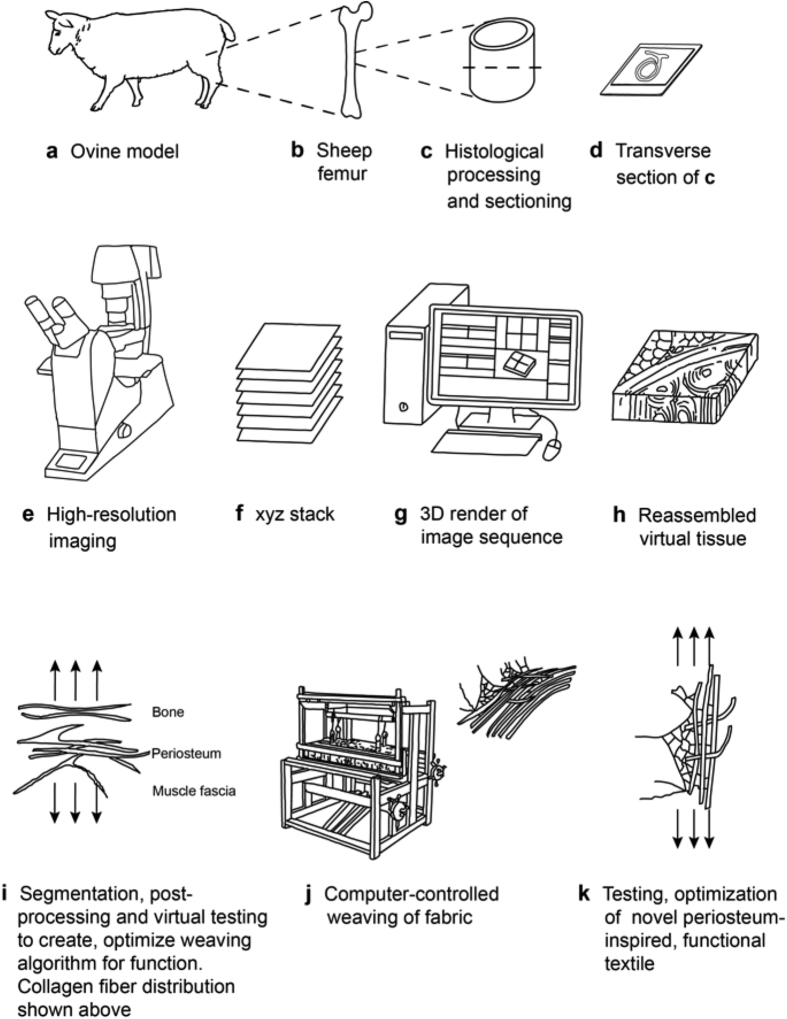
We are literally the stuff from which our tissue fabrics and their fibers are woven and spun. The arrangement of collagen, elastin and other structural proteins in space and time embodies our tissues and organs with amazing resilience and multifunctional smart properties. For example, the periosteum, a soft tissue sleeve that envelops all nonarticular bony surfaces of the body, comprises an inherently "smart" material that gives hard bones added strength under high impact loads. Yet a paucity of scalable bottom-up approaches stymies the harnessing of smart tissues' biological, mechanical and organizational detail to create advanced functional materials. Here, a novel approach is established to scale up the multidimensional fiber patterns of natural soft tissue weaves for rapid prototyping of advanced functional materials. First second harmonic generation and two-photon excitation microscopy is used to map the microscopic three-dimensional (3D) alignment, composition and distribution of the collagen and elastin fibers of periosteum, the soft tissue sheath bounding all nonarticular bone surfaces in our bodies. Then, using engineering rendering software to scale up this natural tissue fabric, as well as multidimensional weaving algorithms, macroscopic tissue prototypes are created using a computer-controlled jacquard loom. The capacity to prototype scaled up architectures of natural fabrics provides a new avenue to create advanced functional materials.
我们的身体组织和纤维实际上是由这些物质编织和纺制而成的。胶原蛋白、弹性蛋白和其他结构蛋白在空间和时间上的排列方式赋予了我们的组织和器官令人惊叹的弹性和多功能智能特性。例如,包绕身体所有非关节骨表面的软组织袖套——骨膜,由一种固有“智能”材料组成,在高冲击载荷下为硬骨提供额外的强度。然而,缺乏可扩展的自下而上的方法阻碍了利用智能组织的生物学、力学和组织细节来创建先进的功能材料。在这里,建立了一种新的方法来扩展天然软组织编织的多维纤维图案,以快速原型制作先进的功能材料。首先,利用二次谐波产生和双光子激发显微镜来绘制骨膜的微观三维(3D)胶原和弹性纤维的排列、组成和分布,骨膜是包绕我们身体所有非关节骨表面的软组织袖套。然后,使用工程渲染软件来扩展这种天然组织织物的比例,并使用多维编织算法,使用计算机控制的提花织机来创建宏观组织原型。对天然织物扩展结构进行原型设计的能力为创建先进功能材料提供了新途径。