Yang N, Liang Y, Yang P, Yang T, Jiang L
Department of Anesthesiology, The First Affiliated Hospital of Wenzhou Medical University, Wenzhou, Zhejiang Province, China.
Department of Pediatric Intensive Care Unit, The Second Affiliated Hospital of Wenzhou Medical University, Wenzhou, Zhejiang Province, China.
Braz J Med Biol Res. 2017 Jan 5;50(1):e5794. doi: 10.1590/1414-431X20165794.
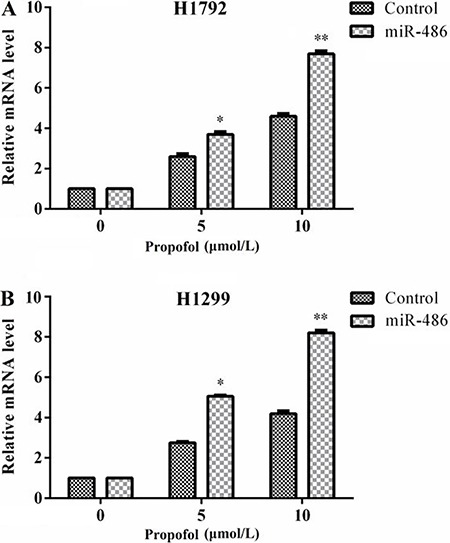
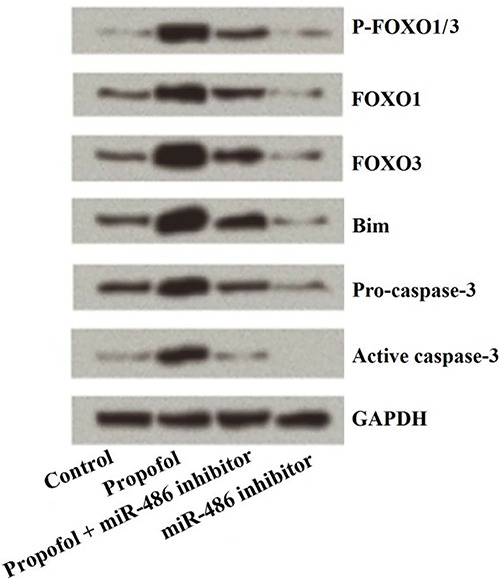
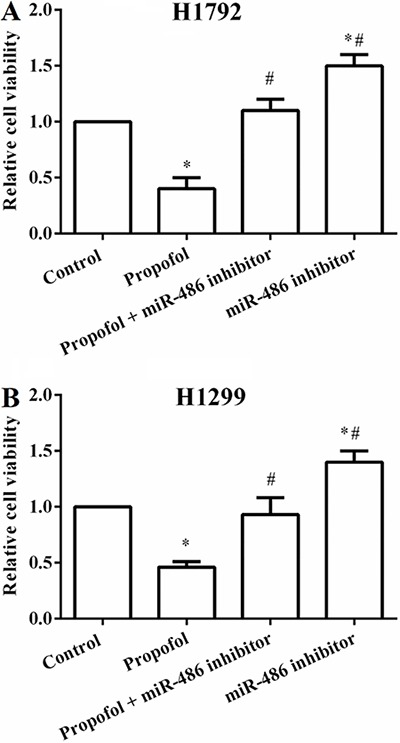
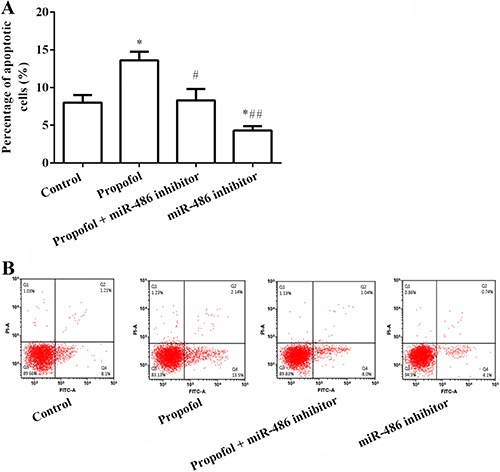
Propofol is a frequently used intravenous anesthetic agent. Recent studies show that propofol exerts a number of non-anesthetic effects. The present study aimed to investigate the effects of propofol on lung cancer cell lines H1299 and H1792 and functional role of microRNA (miR)-486 in these effects. H1299 and/or H1792 cells were treated with or without propofol and transfected or not with miR-486 inhibitor, and then cell viability and apoptosis were analyzed by 3-(4,5-dimethylthiazol-2-yl)-2,5-diphenyltetrazolium bromide (MTT) and flow cytometry. The expression of miR-486 was determined by quantitative real-time polymerase chain reaction (qRT-PCR) with or without propofol treatment. Western blot was performed to analyze the protein expression of Forkhead box, class O (FOXO) 1 and 3, Bcl-2 interacting mediator of cell death (Bim), and pro- and activated caspases-3. Results showed that propofol significantly increased the miR-486 levels in both H1299 and H1792 cells compared to untreated cells in a dose-dependent manner (P<0.05 or P<0.01). Propofol statistically decreased cell viability but increased the percentages of apoptotic cells and protein expressions of FOXO1, FOXO3, Bim, and pro- and activated caspases-3; however, miR-486 inhibitor reversed the effects of propofol on cell viability, apoptosis, and protein expression (P<0.05 or P<0.01). In conclusion, propofol might be an ideal anesthetic for lung cancer surgery by effectively inhibiting lung cancer cell viability and inducing cell apoptosis. Modulation of miR-486 might contribute to the anti-tumor activity of propofol.
丙泊酚是一种常用的静脉麻醉剂。最近的研究表明,丙泊酚具有多种非麻醉作用。本研究旨在探讨丙泊酚对肺癌细胞系H1299和H1792的影响以及微小RNA(miR)-486在这些影响中的功能作用。用或不用丙泊酚处理H1299和/或H1792细胞,并转染或不转染miR-486抑制剂,然后通过3-(4,5-二甲基噻唑-2-基)-2,5-二苯基四氮唑溴盐(MTT)和流式细胞术分析细胞活力和凋亡情况。通过定量实时聚合酶链反应(qRT-PCR)测定用或不用丙泊酚处理后miR-486的表达。进行蛋白质印迹分析叉头盒O类(FOXO)1和3、细胞死亡的Bcl-2相互作用介质(Bim)以及前体和活化的半胱天冬酶-3的蛋白质表达。结果显示,与未处理的细胞相比,丙泊酚以剂量依赖性方式显著增加H1299和H1792细胞中miR-486的水平(P<0.05或P<0.01)。丙泊酚在统计学上降低了细胞活力,但增加了凋亡细胞的百分比以及FOXO1、FOXO3、Bim和前体及活化的半胱天冬酶-3的蛋白质表达;然而,miR-486抑制剂逆转了丙泊酚对细胞活力、凋亡和蛋白质表达的影响(P<0.05或P<0.01)。总之,丙泊酚可能是肺癌手术的理想麻醉剂,因为它能有效抑制肺癌细胞活力并诱导细胞凋亡。miR-486的调节可能有助于丙泊酚的抗肿瘤活性。