Muela Henrique C S, Costa-Hong Valeria A, Yassuda Mônica S, Moraes Natália C, Memória Claudia M, Machado Michel F, Macedo Thiago A, Shu Edson B S, Massaro Ayrton R, Nitrini Ricardo, Mansur Alfredo J, Bortolotto Luiz A
Hypertension Unit, Heart Institute (Incor), University of São Paulo Medical School, São Paulo, Brazil
Department of Physiology, Faculty of Medicine, Agostinho Neto University, Luanda, Angola.
J Am Heart Assoc. 2017 Jan 11;6(1):e004579. doi: 10.1161/JAHA.116.004579.
Most evidence of target-organ damage in hypertension (HTN) is related to the kidneys and heart. Cerebrovascular and cognitive impairment are less well studied. Therefore, this study analyzed changes in cognitive function in patients with different stages of hypertension compared to nonhypertensive controls.
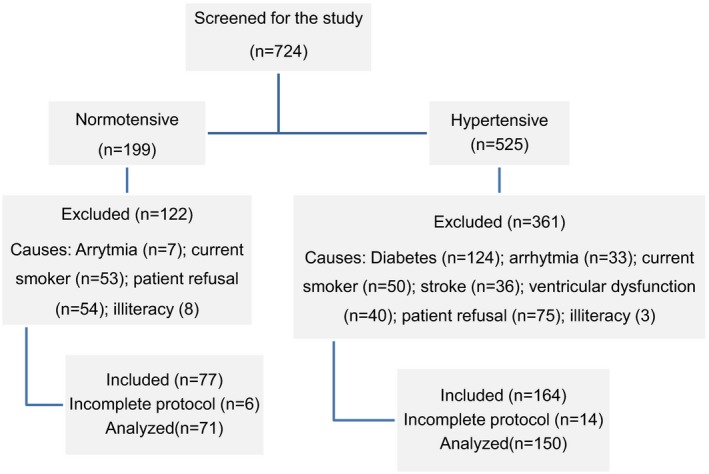
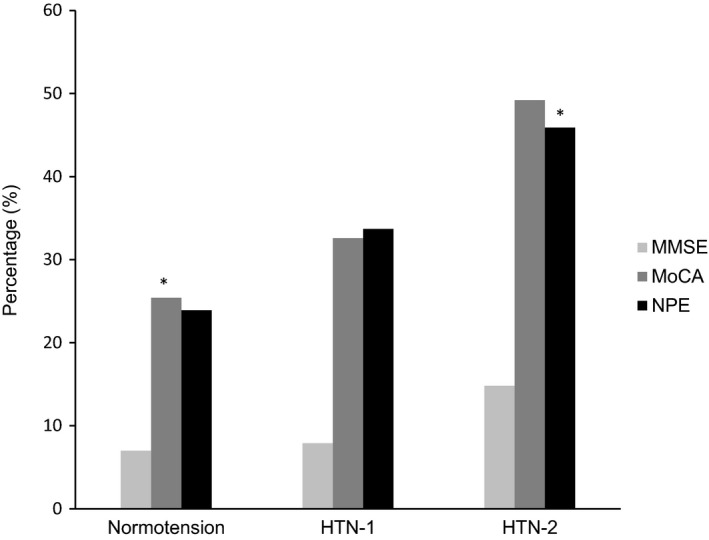
In a cross-sectional study, 221 (71 normotensive and 150 hypertensive) patients were compared. Patients with hypertension were divided into 2 stages according to blood pressure (BP) levels or medication use (HTN-1: BP, 140-159/90-99 or use of 1 or 2 antihypertensive drugs; HTN-2: BP, ≥160/100 or use of ≥3 drugs). Three groups were comparatively analyzed: normotension, HTN stage 1, and HTN stage 2. The Mini-Mental State Examination, Montreal Cognitive Assessment, and a validated comprehensive battery of neuropsychological tests that assessed 6 main cognitive domains were used to determine cognitive function. Compared to the normotension and HTN stage-1, the severe HTN group had worse cognitive performance based on Mini-Mental State Examination (26.8±2.1 vs 27.4±2.1 vs 28.0±2.0; P=0.004) or Montreal Cognitive Assessment (23.4±3.7 vs 24.9±2.8 vs 25.5±3.2; P<0.001). On the neuropsychological tests, patients with hypertension had worse performance in language, processing speed, visuospatial abilities, and memory. Age, hypertension stage, and educational level were the best predictors of cognitive impairment in patients with hypertension in different cognitive domains.
Cognitive impairment was more frequent in patients with hypertension, and this was related to hypertension severity.
高血压(HTN)患者靶器官损害的大多数证据与肾脏和心脏有关。对脑血管和认知功能损害的研究较少。因此,本研究分析了与非高血压对照组相比,不同高血压阶段患者认知功能的变化。
在一项横断面研究中,对221例患者(71例血压正常者和150例高血压患者)进行了比较。高血压患者根据血压(BP)水平或用药情况分为2个阶段(HTN-1:血压140 - 159/90 - 99或使用1或2种降压药物;HTN-2:血压≥160/100或使用≥3种药物)。对三组进行比较分析:血压正常组、高血压1期组和高血压2期组。使用简易精神状态检查表、蒙特利尔认知评估量表以及一套经过验证的全面神经心理学测试组合来评估6个主要认知领域,以确定认知功能。与血压正常组和高血压1期组相比,重度高血压组在简易精神状态检查表(26.8±2.1 vs 27.4±2.1 vs 28.0±2.0;P = 0.004)或蒙特利尔认知评估量表(23.4±3.7 vs 24.9±2.8 vs 25.5±3.2;P < 0.001)上的认知表现更差。在神经心理学测试中,高血压患者在语言、处理速度、视觉空间能力和记忆方面表现更差。年龄、高血压阶段和教育水平是不同认知领域高血压患者认知障碍的最佳预测因素。
高血压患者认知障碍更为常见,且这与高血压严重程度有关。