Aminde Leopold Ndemnge, Atem Jeannine A, Kengne Andre Pascal, Dzudie Anastase, Veerman J Lennert
The University of Queensland, School of Public Health, Herston, QLD 4006 Australia ; Non-communicable Diseases Unit, Clinical Research Education, Networking & Consultancy (CRENC), Douala, Cameroon.
Faculty of Health Sciences, University of Buea, Buea, Cameroon.
BMC Obes. 2017 Jan 7;4:1. doi: 10.1186/s40608-016-0139-8. eCollection 2017.
Obesity is currently a global health challenge driven by a mix of behavioural, environmental and genetic factors. Up to date population-based disease burden estimates are needed to guide successful prevention and control efforts in African countries. We investigated the prevalence and population attributable fractions of overweight and obesity in Buea, the Southwest region of Cameroon.
Data are from a community-based cross-sectional study involving randomly selected adults conducted in 2016. Body mass index (BMI) was categorized according to the WHO classification. Multivariable logistic regressions were used to investigate factors independently associated with obesity. Corresponding population attributable fractions were estimated.
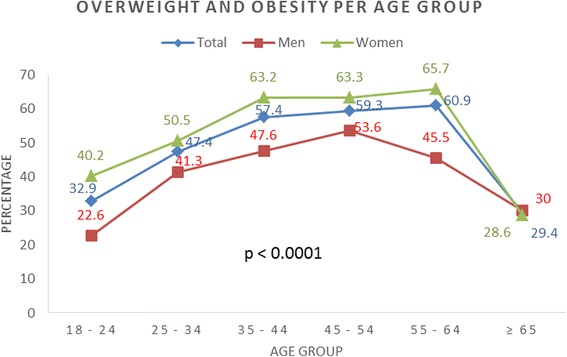
Among the 1,139 participants, age-standardized prevalence (95% CI) of overweight and obesity were; 36.5 (33.7-39.3) and 11.1 (9.3-12.9) percent respectively. Mean BMI was 25.3 ± 4.3 kg/m; women were heavier than men (25.8 vs. 24.4 kg/m; <0.0001). Factors associated with obesity were; female gender [odds ratio 3.20 (95% CI: 1.93-5.59)], age > 31 years [3.21 (1.86-5.28)] and being married [2.10 (1.60-3.51)]. At the population level; older age, being married, low level of education, high monthly income and physical inactivity accounted respectively for 11.9%, 21.8%, 11.6%, 6.4% and 8.7% of overweight and obesity among the women, while older age and being married explained 9.2% and 28.3% of overweight and obesity in men.
The prevalence of overweight and obesity in this semi-urban Cameroonian population is high, affecting over a third of individuals. Community-based interventions to control weight would need to take into account gender specificities and socio-economic status.
肥胖目前是一个全球性的健康挑战,由行为、环境和遗传因素共同驱动。需要最新的基于人群的疾病负担估计来指导非洲国家成功的预防和控制工作。我们调查了喀麦隆西南部地区布埃亚超重和肥胖的患病率及人群归因分数。
数据来自2016年进行的一项基于社区的横断面研究,该研究涉及随机选择的成年人。根据世界卫生组织的分类对体重指数(BMI)进行分类。使用多变量逻辑回归来调查与肥胖独立相关的因素。估计相应的人群归因分数。
在1139名参与者中,超重和肥胖的年龄标准化患病率(95%CI)分别为36.5(33.7 - 39.3)%和11.1(9.3 - 12.9)%。平均BMI为25.3±4.3kg/m²;女性比男性更重(25.8 vs. 24.4kg/m²;P<0.0001)。与肥胖相关的因素有:女性性别[比值比3.20(95%CI:1.93 - 5.59)]、年龄>31岁[3.21(1.86 - 5.28)]和已婚[2.10(1.60 - 3.51)]。在人群层面;年龄较大、已婚、教育程度低、月收入高和缺乏身体活动分别占女性超重和肥胖的11.9%、21.8%、11.6%、6.4%和8.7%,而年龄较大和已婚分别解释了男性超重和肥胖的9.2%和28.3%。
在这个喀麦隆半城市人群中,超重和肥胖的患病率很高,影响了超过三分之一的个体。基于社区的控制体重干预措施需要考虑性别特异性和社会经济地位。