Department of Psychiatry and Behavioral Neuroscience, University of Chicago, Chicago IL.
Department of Ophthalmology and Visual Sciences, University of Illinois at Chicago, Chicago IL.
Nicotine Tob Res. 2018 Jan 5;20(2):246-252. doi: 10.1093/ntr/ntw327.
Second generation electronic nicotine delivery systems (ENDS; also known as e-cigarettes, vaporizers or vape pens) are designed for a customized nicotine delivery experience and have less resemblance to regular cigarettes than first generation "cigalikes." The present study examined whether they generalize as a conditioned cue and evoke smoking urges or behavior in persons exposed to their use.
Data were analyzed in N = 108 young adult smokers (≥5 cigarettes per week) randomized to either a traditional combustible cigarette smoking cue or a second generation ENDS vaping cue in a controlled laboratory setting. Cigarette and e-cigarette urge and desire were assessed pre- and post-cue exposure. Smoking behavior was also explored in a subsample undergoing a smoking latency phase after cue exposure (N = 26).
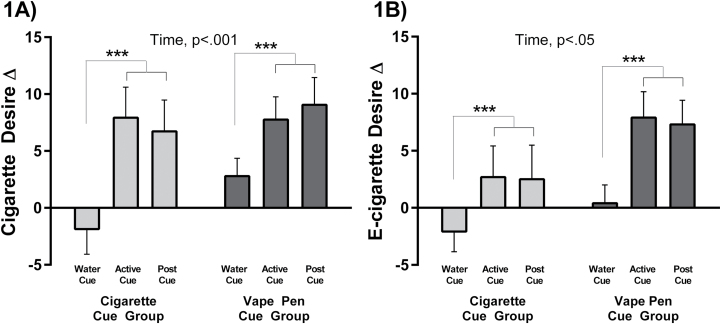
The ENDS vape pen cue evoked both urge and desire for a regular cigarette to a similar extent as that produced by the combustible cigarette cue. Both cues produced similar time to initiate smoking during the smoking latency phase. The ENDS vape pen cue elicited smoking urge and desire regardless of ENDS use history, that is, across ENDS naїve, lifetime or current users. Inclusion of past ENDS or cigarette use as covariates did not significantly alter the results.
These findings demonstrate that observation of vape pen ENDS use generalizes as a conditioned cue to produce smoking urge, desire, and behavior in young adult smokers. As the popularity of these devices may eventually overtake those of first generation ENDS cigalikes, exposure effects will be of increasing importance.
This study shows that passive exposure to a second generation ENDS vape pen cue evoked smoking urge, desire, and behavior across a range of daily and non-daily young adult smokers. Smoking urge and desire increases after vape pen exposure were similar to those produced by exposure to a first generation ENDS cigalike and a combustible cigarette, a known potent cue. Given the increasing popularity of ENDS tank system products, passive exposures to these devices will no doubt increase, and may contribute to tobacco use in young adult smokers.
第二代电子尼古丁输送系统(ENDS;也称为电子烟、蒸气器或 vape 笔)旨在提供定制化的尼古丁输送体验,与第一代“cigalike”香烟相比,它们与普通香烟的相似之处更少。本研究旨在检验它们是否可以作为一种条件线索,在接触它们使用的人中引起吸烟欲望或行为。
在控制实验室环境下,将 108 名年轻成年吸烟者(每周≥5 支香烟)随机分配到传统可燃香烟吸烟线索或第二代 ENDS 蒸气器吸烟线索。在暴露于线索之前和之后,评估香烟和电子烟的吸烟欲望和渴望。在暴露于线索后(N = 26)的亚样本中还探讨了吸烟行为。
ENDS 蒸气器笔线索引起了对普通香烟的类似程度的吸烟欲望和渴望,就像可燃香烟线索一样。这两个线索在吸烟潜伏期内都产生了类似的开始吸烟的时间。无论 ENDS 使用史如何,即无论在 ENDS 新手、终身或当前使用者中,ENDS 蒸气器笔线索都引起了吸烟欲望和渴望。将过去的 ENDS 或香烟使用作为协变量包括在内并没有显著改变结果。
这些发现表明,观察蒸气器笔 ENDS 的使用可以作为一种条件线索,在年轻成年吸烟者中产生吸烟欲望、渴望和行为。随着这些设备的普及度可能最终超过第一代 ENDS cigalike,暴露效应将变得越来越重要。
本研究表明,被动暴露于第二代 ENDS 蒸气器笔线索会引起一系列日常和非日常年轻成年吸烟者的吸烟欲望、渴望和行为。蒸气器笔暴露后吸烟欲望和渴望的增加与第一代 ENDS cigalike 和可燃香烟暴露产生的相似,这是一种已知的强效线索。考虑到 ENDS 罐系统产品的日益普及,对这些设备的被动暴露无疑会增加,并且可能导致年轻成年吸烟者吸烟。