Karuza Elisabeth A, Balewski Zuzanna Z, Hamilton Roy H, Medaglia John D, Tardiff Nathan, Thompson-Schill Sharon L
Department of Psychology, University of Pennsylvania, Philadelphia PA, USA.
Department of Neurology, University of Pennsylvania, Philadelphia PA, USA.
Front Hum Neurosci. 2016 Dec 27;10:665. doi: 10.3389/fnhum.2016.00665. eCollection 2016.
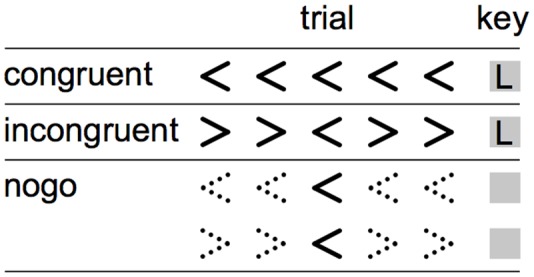
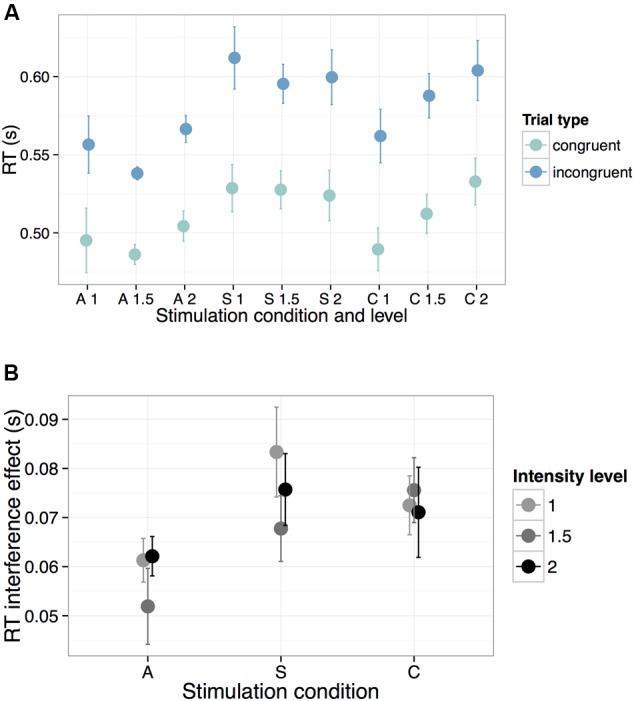
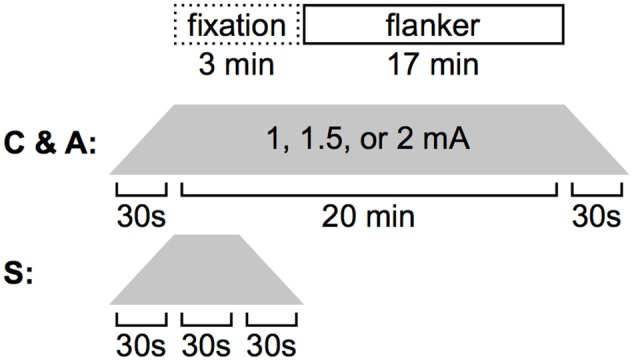
In the cognitive domain, enormous variation in methodological approach prompts questions about the generalizability of behavioral findings obtained from studies of transcranial direct current stimulation (tDCS). To determine the impact of common variations in approach, we systematically manipulated two key stimulation parameters-current polarity and intensity-and assessed their impact on a task of inhibitory control (the Eriksen Flanker). Ninety participants were randomly assigned to one of nine experimental groups: three stimulation conditions (anode, sham, cathode) crossed with three intensity levels (1.0, 1.5, 2.0 mA). As participants performed the Flanker task, stimulation was applied over left dorsolateral prefrontal cortex (DLPFC; electrode montage: F3-RSO). The behavioral impact of these manipulations was examined using mixed effects linear regression. Results indicate a significant effect of stimulation condition (current polarity) on the magnitude of the interference effect during the Flanker; however, this effect was specific to the comparison between anodal and sham stimulation. Inhibitory control was therefore improved by anodal stimulation over the DLPFC. In the present experimental context, no reliable effect of stimulation intensity was observed, and we found no evidence that inhibitory control was impeded by cathodal stimulation. Continued exploration of the stimulation parameter space, particularly with more robustly powered sample sizes, is essential to facilitating cross-study comparison and ultimately working toward a reliable model of tDCS effects.
在认知领域,方法学方法的巨大差异引发了关于经颅直流电刺激(tDCS)研究中行为学发现的可推广性的问题。为了确定方法中常见变化的影响,我们系统地操纵了两个关键刺激参数——电流极性和强度,并评估了它们对抑制控制任务(埃里克森侧翼任务)的影响。90名参与者被随机分配到九个实验组之一:三种刺激条件(阳极、假刺激、阴极)与三种强度水平(1.0、1.5、2.0 mA)交叉组合。当参与者执行侧翼任务时,在左侧背外侧前额叶皮层(DLPFC;电极蒙太奇:F3-RSO)施加刺激。使用混合效应线性回归检查这些操作的行为影响。结果表明,刺激条件(电流极性)对侧翼任务期间干扰效应的大小有显著影响;然而,这种效应仅限于阳极刺激与假刺激之间的比较。因此,DLPFC上的阳极刺激改善了抑制控制。在本实验背景下,未观察到刺激强度的可靠效应,并且我们没有发现阴极刺激会阻碍抑制控制的证据。继续探索刺激参数空间,特别是采用更强大的样本量,对于促进跨研究比较并最终建立一个可靠的tDCS效应模型至关重要。