Vienna University of Economics and Business, Welthandeslplatz 1 1, 1020 Vienna, Austria.
Wittgenstein Centre for Demography and Human Capital, Welthandelsplatz 2 2, 1020 Vienna, Austria.
Sci Rep. 2017 Jan 16;7:40678. doi: 10.1038/srep40678.
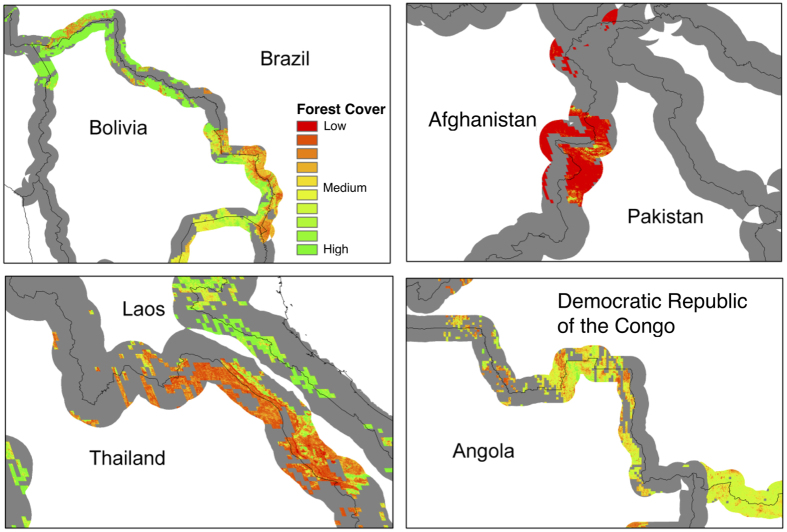
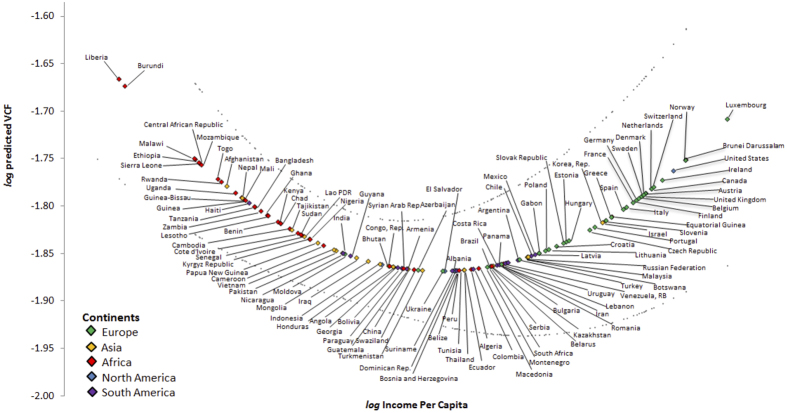
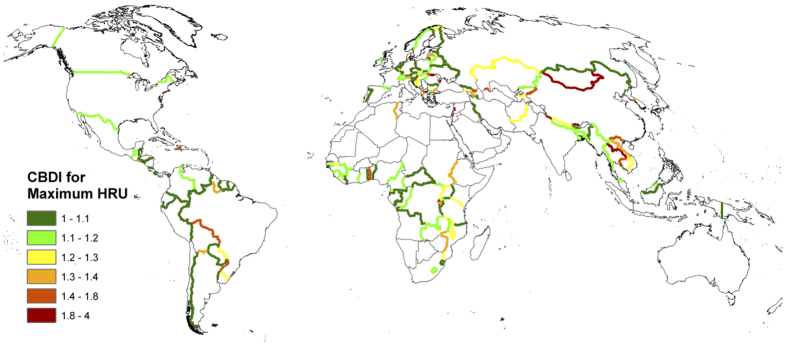
Ongoing deforestation is a pressing, global environmental issue with direct impacts on climate change, carbon emissions, and biodiversity. There is an intuitive link between economic development and overexploitation of natural resources including forests, but this relationship has proven difficult to establish empirically due to both inadequate data and convoluting geo-climactic factors. In this analysis, we use satellite data on forest cover along national borders in order to study the determinants of deforestation differences across countries. Controlling for trans-border geo-climactic differences, we find that income per capita is the most robust determinant of differences in cross-border forest cover. We show that the marginal effect of per capita income growth on forest cover is strongest at the earliest stages of economic development, and weakens in more advanced economies, presenting some of the strongest evidence to date for the existence of at least half of an environmental Kuznets curve for deforestation.
持续的森林砍伐是一个紧迫的全球性环境问题,直接影响到气候变化、碳排放和生物多样性。经济发展与包括森林在内的自然资源的过度开发之间存在直观的联系,但由于数据不足和复杂的地理气候因素,这一关系在经验上很难确定。在这项分析中,我们使用了关于国家边界森林覆盖的卫星数据,以研究各国之间森林砍伐差异的决定因素。在控制跨境地理气候差异的情况下,我们发现人均收入是跨境森林覆盖差异的最有力决定因素。我们表明,人均收入增长对森林覆盖的边际效应在经济发展的早期阶段最强,在更发达的经济体中减弱,这为至少存在一半的森林砍伐环境库兹涅茨曲线提供了迄今为止最强有力的证据之一。