Donner Christian, Obermayer Klaus, Shimazaki Hideaki
Bernstein Center for Computational Neuroscience, Berlin, Germany.
Neural Information Processing Group, Department of Electrical Engineering and Computer Science, Technische Universität Berlin, Berlin, Germany.
PLoS Comput Biol. 2017 Jan 17;13(1):e1005309. doi: 10.1371/journal.pcbi.1005309. eCollection 2017 Jan.
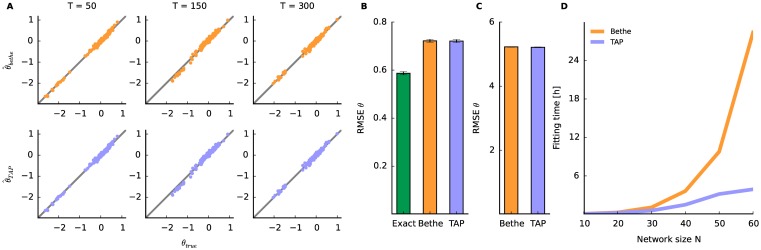
The models in statistical physics such as an Ising model offer a convenient way to characterize stationary activity of neural populations. Such stationary activity of neurons may be expected for recordings from in vitro slices or anesthetized animals. However, modeling activity of cortical circuitries of awake animals has been more challenging because both spike-rates and interactions can change according to sensory stimulation, behavior, or an internal state of the brain. Previous approaches modeling the dynamics of neural interactions suffer from computational cost; therefore, its application was limited to only a dozen neurons. Here by introducing multiple analytic approximation methods to a state-space model of neural population activity, we make it possible to estimate dynamic pairwise interactions of up to 60 neurons. More specifically, we applied the pseudolikelihood approximation to the state-space model, and combined it with the Bethe or TAP mean-field approximation to make the sequential Bayesian estimation of the model parameters possible. The large-scale analysis allows us to investigate dynamics of macroscopic properties of neural circuitries underlying stimulus processing and behavior. We show that the model accurately estimates dynamics of network properties such as sparseness, entropy, and heat capacity by simulated data, and demonstrate utilities of these measures by analyzing activity of monkey V4 neurons as well as a simulated balanced network of spiking neurons.
统计物理学中的模型,如伊辛模型,为表征神经群体的静态活动提供了一种便捷的方法。对于体外切片或麻醉动物的记录,可能会出现这种神经元的静态活动。然而,对清醒动物的皮质回路活动进行建模更具挑战性,因为放电率和相互作用都可能根据感觉刺激、行为或大脑的内部状态而变化。以前对神经相互作用动力学进行建模的方法存在计算成本问题;因此,其应用仅限于十几个神经元。在这里,通过将多种解析近似方法引入神经群体活动的状态空间模型,我们能够估计多达60个神经元的动态成对相互作用。更具体地说,我们将伪似然近似应用于状态空间模型,并将其与贝叶斯或TAP平均场近似相结合,从而使模型参数的顺序贝叶斯估计成为可能。大规模分析使我们能够研究刺激处理和行为背后神经回路宏观特性的动态变化。我们表明,该模型通过模拟数据准确估计了网络特性(如稀疏性、熵和热容量)的动态变化,并通过分析猴子V4神经元的活动以及一个模拟的脉冲神经元平衡网络,展示了这些测量方法的实用性。