Wanjohi Milka, Griffiths Paula, Wekesah Frederick, Muriuki Peter, Muhia Nelson, Musoke Rachel N, Fouts Hillary N, Madise Nyovani J, Kimani-Murage Elizabeth W
African Population and Health Research Center (APHRC), Nairobi, Kenya.
Centers for Global Health and Human Development; Loughborough University, Loughborough, UK ; MRC/Wits Developmental Pathways for Health Research Unit, Faculty of Health Sciences, University of the Witwatersrand, Johannesburg, South Africa.
Int Breastfeed J. 2017 Jan 11;12:5. doi: 10.1186/s13006-016-0092-7. eCollection 2016.
Despite numerous interventions promoting optimal breastfeeding practices in Kenya, pockets of suboptimal breastfeeding practices are documented in Kenya's urban slums. This paper describes cultural and social beliefs and practices that influence breastfeeding in two urban slums in Nairobi, Kenya.
Qualitative data were collected in Korogocho and Viwandani slums through 10 focus group discussions and 19 in-depth interviews with pregnant, breastfeeding women and community health volunteers and 11 key-informant interviews with community leaders. Interviews were audiotaped, transcribed verbatim, coded in NVIVO and analyzed thematically.
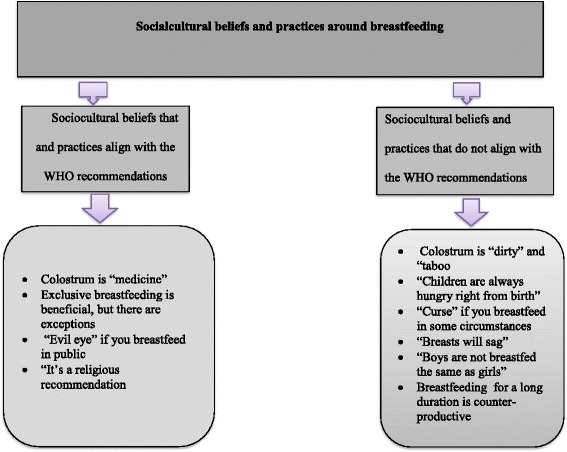
Social and cultural beliefs and practices that result to suboptimal breastfeeding practices were highlighted including; considering colostrum as 'dirty' or 'curdled milk', a curse 'bad omen' associated with breastfeeding while engaging in extra marital affairs, a fear of the 'evil eye' (malevolent glare which is believed to be a curse associated with witchcraft) when breastfeeding in public and breastfeeding being associated with sagging breasts. Positive social and cultural beliefs were also identified including the association of breast milk with intellectual development and good child health. The beliefs and practices were learnt mainly from spouses, close relatives and peers.
Interventions promoting behavior change with regards to breastfeeding should focus on dispelling the beliefs and practices that result to suboptimal breastfeeding practices and to build on the positive ones, while involving spouses and other family members as they are important sources of information on breastfeeding.
ISRCTN83692672: December 2013 (retrospectively registered).
尽管肯尼亚采取了众多干预措施来推广最佳母乳喂养做法,但该国城市贫民窟中仍存在一些母乳喂养做法不理想的情况。本文描述了影响肯尼亚内罗毕两个城市贫民窟母乳喂养的文化和社会观念及做法。
通过在科罗戈乔和维万达尼贫民窟进行10次焦点小组讨论、对孕妇、哺乳期妇女及社区健康志愿者进行19次深入访谈,以及对社区领袖进行11次关键信息人访谈来收集定性数据。访谈进行了录音,逐字转录,在NVIVO中编码并进行主题分析。
突出了导致不理想母乳喂养做法的社会和文化观念及做法,包括:将初乳视为“脏的”或“凝结的牛奶”;在婚外情时母乳喂养会带来诅咒“不祥之兆”;在公共场合母乳喂养时害怕“邪眼”(一种被认为与巫术相关的恶意目光);以及认为母乳喂养会导致乳房下垂。也确定了积极的社会和文化观念,包括母乳与智力发育及儿童健康良好的关联。这些观念和做法主要是从配偶、近亲及同龄人那里学到的。
促进母乳喂养行为改变的干预措施应侧重于消除导致不理想母乳喂养做法的观念和做法,并基于积极的观念和做法,同时让配偶和其他家庭成员参与,因为他们是母乳喂养信息的重要来源。
ISRCTN83692672:2013年12月(追溯注册)。