Department of Control Science and Engineering, Tongji University, Shanghai, 201804, China.
Institute of Chinese Materia Medica, China Academy of Chinese Medical Science, Beijing, 100700, China.
Sci Rep. 2017 Jan 18;7:40652. doi: 10.1038/srep40652.
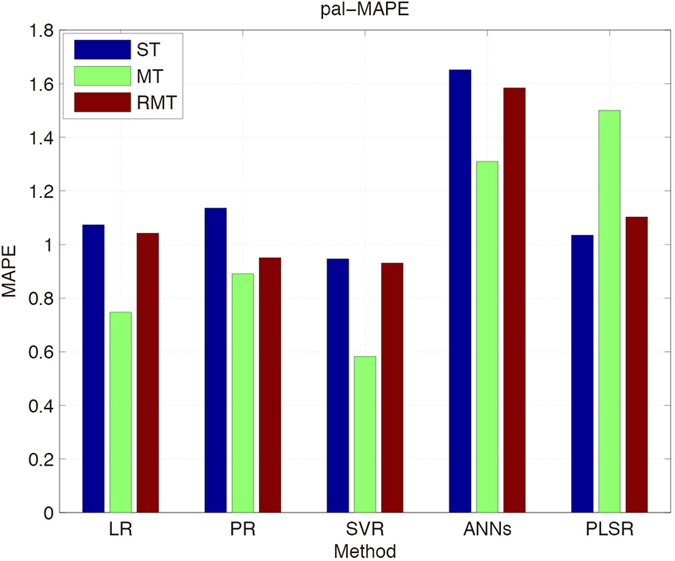
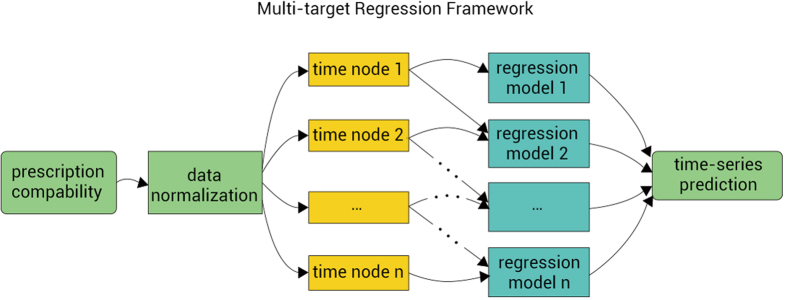
Excavating from small samples is a challenging pharmacokinetic problem, where statistical methods can be applied. Pharmacokinetic data is special due to the small samples of high dimensionality, which makes it difficult to adopt conventional methods to predict the efficacy of traditional Chinese medicine (TCM) prescription. The main purpose of our study is to obtain some knowledge of the correlation in TCM prescription. Here, a novel method named Multi-target Regression Framework to deal with the problem of efficacy prediction is proposed. We employ the correlation between the values of different time sequences and add predictive targets of previous time as features to predict the value of current time. Several experiments are conducted to test the validity of our method and the results of leave-one-out cross-validation clearly manifest the competitiveness of our framework. Compared with linear regression, artificial neural networks, and partial least squares, support vector regression combined with our framework demonstrates the best performance, and appears to be more suitable for this task.
从小样本中挖掘是一个具有挑战性的药代动力学问题,可以应用统计方法。药代动力学数据的特殊性在于其小样本的高维度,这使得传统方法难以预测中药(TCM)处方的疗效。我们研究的主要目的是获得一些关于 TCM 处方相关性的知识。在这里,提出了一种名为多目标回归框架的新方法来解决疗效预测问题。我们利用不同时间序列值之间的相关性,并将前一时间的预测目标添加为特征来预测当前时间的值。进行了几项实验来测试我们方法的有效性,留一法交叉验证的结果清楚地表明了我们框架的竞争力。与线性回归、人工神经网络和偏最小二乘法相比,支持向量回归与我们的框架结合使用表现出了最佳性能,似乎更适合这项任务。