Key Laboratory of Medical Molecular Virology (MOE/MOH) and Institutes of Biomedical Sciences, Shanghai Medical College, Fudan University, Shanghai 200032, People's Republic of China.
Microbiology Laboratory, Shanghai Municipal Center for Disease Control and Prevention, Shanghai 200336, People's Republic of China.
Sci Rep. 2017 Jan 18;7:40783. doi: 10.1038/srep40783.
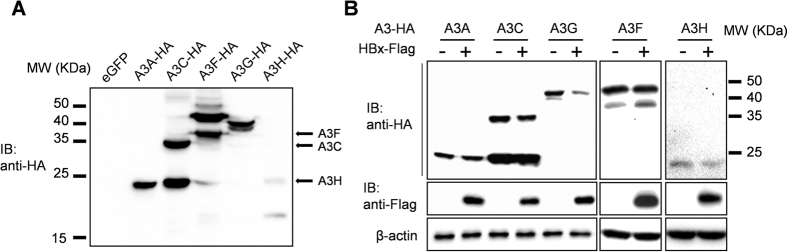
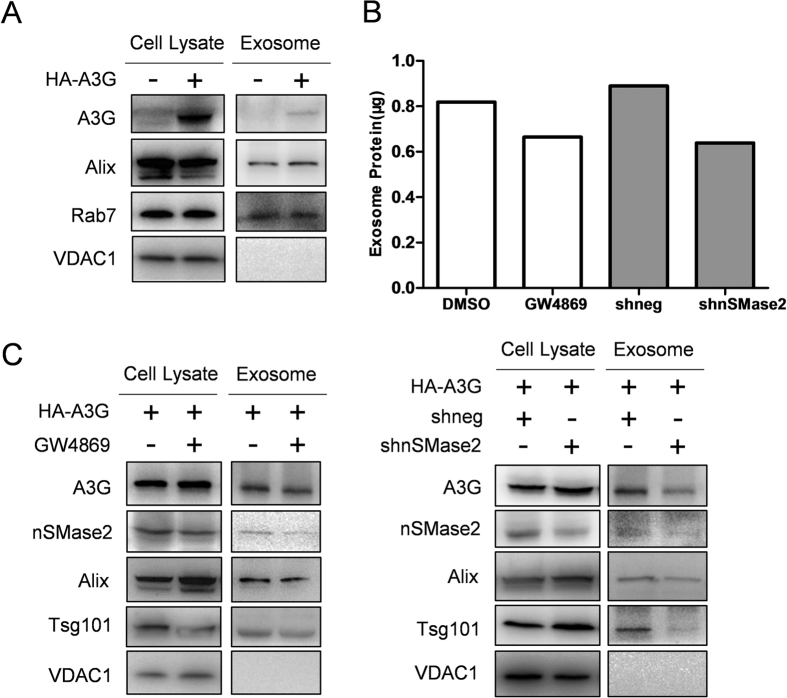
The apolipoprotein B mRNA editing catalytic polypeptide-like (APOBEC) family proteins bind RNA and single-stranded DNA, and create C-to-U base modifications through cytidine deaminase activity. APOBEC3G restricts human immunodeficiency virus 1 (HIV-1) infection by creating hypermutations in proviral DNA, while HIV-1-encoded vif protein antagonizes such restriction by targeting APOBEC3G for degradation. APOBEC3G also inhibits hepatitis B virus (HBV): APOBEC3G co-expression inhibits HBV replication and evidences exist indicating APOBEC3G-mediated HBV hypermutations in patients. HBV encodes a small non-structural X protein (HBx) with a recognized activating effect on HBV life cycle. In this work, we report the discovery that HBx selectively and dose-dependently decreases the protein level of co-expressed APOBEC3G in transfected Huh-7 cells. The effect was shown to take place post-translationally, but does not rely on protein degradation via proteasome or lysosome. Further work demonstrated that intracellular APOBEC3G is normally exported via exosome secretion and inhibition of exosome biogenesis causes retention of intracellular APOBEC3G. Finally, HBx co-expression specifically enhanced externalization of APOBEC3G via exosomes, resulting in decrease of intracellular APOBEC3G protein level. These data suggest the possibility that in addition to other mechanisms, HBx-mediated activation of HBV might also involve antagonizing of intracellular restriction factor APOBEC3G through promotion of its export.
载脂蛋白 B mRNA 编辑酶催化多肽样(APOBEC)家族蛋白结合 RNA 和单链 DNA,并通过胞嘧啶脱氨酶活性在 RNA 和单链 DNA 上创建 C 到 U 的碱基修饰。APOBEC3G 通过在原病毒 DNA 上创建超突变来限制人类免疫缺陷病毒 1(HIV-1)感染,而 HIV-1 编码的 vif 蛋白通过靶向 APOBEC3G 进行降解来拮抗这种限制。APOBEC3G 还抑制乙型肝炎病毒(HBV):APOBEC3G 的共表达抑制 HBV 复制,并且存在证据表明 APOBEC3G 介导的 HBV 超突变在患者中存在。HBV 编码一种小的非结构 X 蛋白(HBx),其对 HBV 生命周期具有公认的激活作用。在这项工作中,我们报告发现 HBx 选择性地和剂量依赖性地降低转染的 Huh-7 细胞中共同表达的 APOBEC3G 的蛋白水平。该效应发生在翻译后,但不依赖于通过蛋白酶体或溶酶体进行的蛋白降解。进一步的工作表明,细胞内 APOBEC3G 通常通过外泌体分泌进行输出,并且抑制外泌体发生会导致细胞内 APOBEC3G 的保留。最后,HBx 的共表达特异性增强了 APOBEC3G 通过外泌体的外化,导致细胞内 APOBEC3G 蛋白水平降低。这些数据表明,除了其他机制之外,HBx 介导的 HBV 激活还可能涉及通过促进其输出来拮抗细胞内限制因子 APOBEC3G。