
厚叶巴豆中的二萜类化合物垂花巴豆素通过VEGF受体-2信号通路发挥抗血管生成作用。
Penduliflaworosin, a Diterpenoid from Croton crassifolius, Exerts Anti-Angiogenic Effect via VEGF Receptor-2 Signaling Pathway.
作者信息
Liang Yeyin, Zhang Yubo, Wang Guocai, Li Yaolan, Huang Weihuan
机构信息
Institute of Traditional Chinese Medicine and Natural Products, College of Pharmacy, Jinan University, Guangzhou 510632, China.
Key Laboratory of Regenerative Medicine, Ministry of Education, Jinan University, Guangzhou 510632, China.
出版信息
Molecules. 2017 Jan 13;22(1):126. doi: 10.3390/molecules22010126.
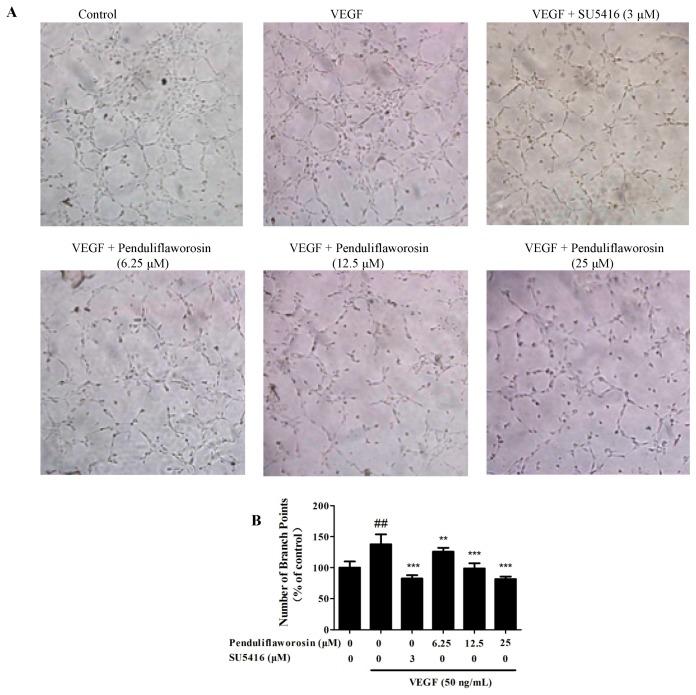
Anti-angiogenesis targeting vascular endothelial growth factor receptor-2 (VEGFR-2) has been considered as an important strategy for cancer therapy. Penduliflaworosin is a diterpenoid isolated from the plant . Our previous study showed that this diterpenoid possesses strong anti-angiogenic activity by inhibiting vessel formation in zebrafish. This study was conducted to further investigate the anti-angiogenic activity and mechanism of penduliflaworosin. Results revealed that penduliflaworosin significantly inhibited VEGF-induced angiogenesis processes including proliferation, invasion, migration, and tube formation of human umbilical vein endothelial cells (HUVECs). Moreover, it notably inhibited VEGF-induced sprout formation of aortic rings and blocked VEGF-induced vessel formation in mice. Western blotting studies showed that penduliflaworosin inhibited phosphorylation of the VEGF receptor-2 and its downstream signaling mediators in HUVECs, suggesting that the anti-angiogenic activity was due to an interference with the VEGF/VEGF receptor-2 pathway. In addition, molecular docking simulation indicated that penduliflaworosin could form hydrogen bonds within the ATP-binding region of the VEGF receptor-2 kinase unit. Finally, cytotoxicity assay showed that penduliflaworosin possessed little toxicity toward both cancer and normal cells. Taken together, our findings demonstrate that penduliflaworosin exerts its anti-angiogenic effect via the VEGF receptor-2 signaling pathway. The anti-angiogenic property and low cytotoxicity of penduliflaworosin suggest that it may be useful in cancer treatments.
靶向血管内皮生长因子受体-2(VEGFR-2)的抗血管生成已被视为癌症治疗的一项重要策略。悬垂花素是从该植物中分离出的一种二萜类化合物。我们之前的研究表明,这种二萜类化合物通过抑制斑马鱼血管形成具有很强的抗血管生成活性。本研究旨在进一步探究悬垂花素的抗血管生成活性及其机制。结果显示,悬垂花素显著抑制VEGF诱导的血管生成过程,包括人脐静脉内皮细胞(HUVECs)的增殖、侵袭、迁移和管腔形成。此外,它还显著抑制VEGF诱导的主动脉环芽生形成,并阻断VEGF诱导的小鼠血管形成。蛋白质印迹研究表明,悬垂花素抑制HUVECs中VEGF受体-2及其下游信号介质的磷酸化,这表明其抗血管生成活性是由于干扰了VEGF/VEGF受体-2途径。此外,分子对接模拟表明,悬垂花素可在VEGF受体-2激酶单元的ATP结合区域内形成氢键。最后,细胞毒性试验表明,悬垂花素对癌细胞和正常细胞的毒性都很小。综上所述,我们的研究结果表明,悬垂花素通过VEGF受体-2信号通路发挥其抗血管生成作用。悬垂花素的抗血管生成特性和低细胞毒性表明它可能对癌症治疗有用。




 Zotero 插件