Huss Anne R, Schumacher Loni L, Cochrane Roger A, Poulsen Elizabeth, Bai Jianfa, Woodworth Jason C, Dritz Steve S, Stark Charles R, Jones Cassandra K
Department of Grain Science and Industry, Kansas State University, Manhattan, Kansas, United States of America.
Department of Diagnostic Medicine/Pathobiology, Kansas State University, Manhattan, Kansas, United States of America.
PLoS One. 2017 Jan 18;12(1):e0169612. doi: 10.1371/journal.pone.0169612. eCollection 2017.
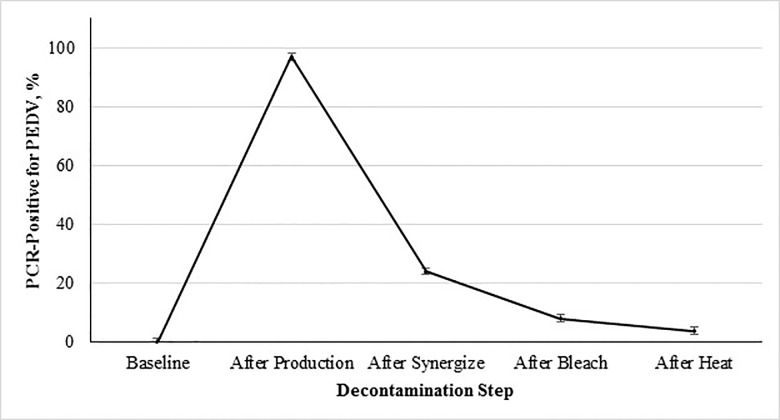
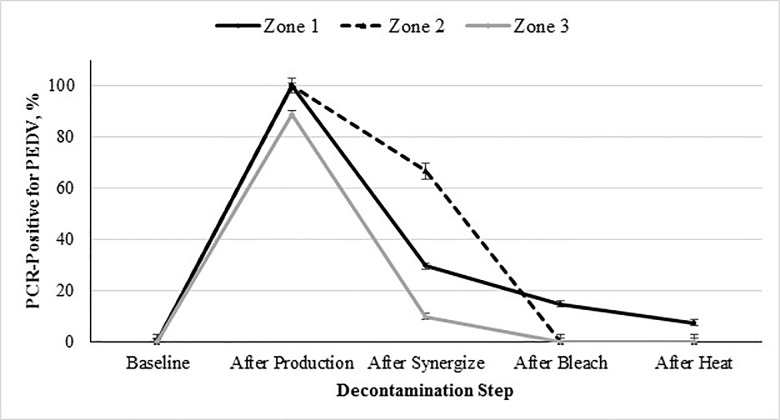
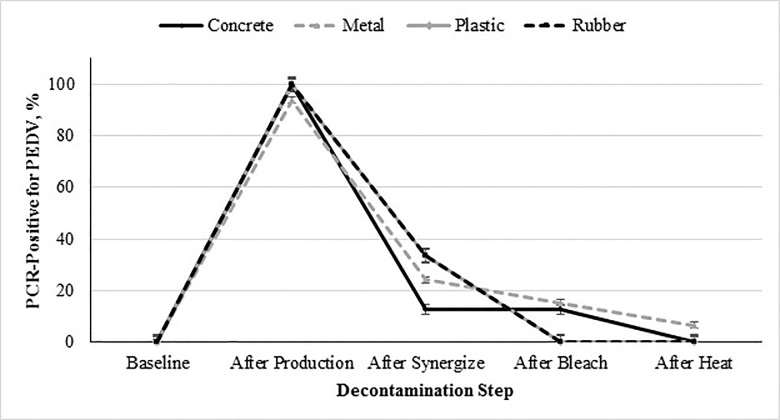
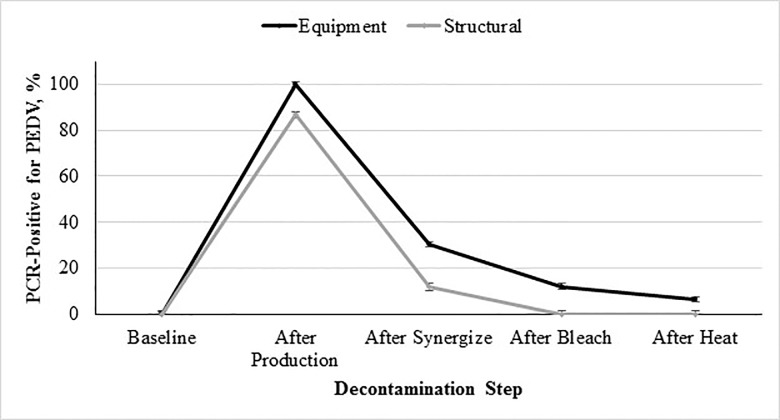
Porcine Epidemic Diarrhea Virus (PEDV) was the first virus of wide scale concern to be linked to possible transmission by livestock feed or ingredients. Measures to exclude pathogens, prevent cross-contamination, and actively reduce the pathogenic load of feed and ingredients are being developed. However, research thus far has focused on the role of chemicals or thermal treatment to reduce the RNA in the actual feedstuffs, and has not addressed potential residual contamination within the manufacturing facility that may lead to continuous contamination of finished feeds. The purpose of this experiment was to evaluate the use of a standardized protocol to sanitize an animal feed manufacturing facility contaminated with PEDV. Environmental swabs were collected throughout the facility during the manufacturing of a swine diet inoculated with PEDV. To monitor facility contamination of the virus, swabs were collected at: 1) baseline prior to inoculation, 2) after production of the inoculated feed, 3) after application of a quaternary ammonium-glutaraldehyde blend cleaner, 4) after application of a sodium hypochlorite sanitizing solution, and 5) after facility heat-up to 60°C for 48 hours. Decontamination step, surface, type, zone and their interactions were all found to impact the quantity of detectable PEDV RNA (P < 0.05). As expected, all samples collected from equipment surfaces contained PEDV RNA after production of the contaminated feed. Additionally, the majority of samples collected from non-direct feed contact surfaces were also positive for PEDV RNA after the production of the contaminated feed, emphasizing the potential role dust plays in cross-contamination of pathogen throughout a manufacturing facility. Application of the cleaner, sanitizer, and heat were effective at reducing PEDV genomic material (P < 0.05), but did not completely eliminate it.
猪流行性腹泻病毒(PEDV)是首个被广泛关注且可能通过牲畜饲料或饲料原料传播的病毒。目前正在制定排除病原体、防止交叉污染以及积极降低饲料和饲料原料致病负荷的措施。然而,迄今为止的研究主要集中在化学物质或热处理在降低实际饲料中RNA方面的作用,尚未涉及制造设施内可能导致成品饲料持续污染的潜在残留污染问题。本实验的目的是评估使用标准化方案对被PEDV污染的动物饲料制造设施进行消毒的效果。在生产接种了PEDV的猪日粮期间,在整个设施内采集环境拭子。为监测设施内病毒污染情况,在以下时间点采集拭子:1)接种前的基线期;2)接种饲料生产后;3)应用季铵盐 - 戊二醛混合清洁剂后;4)应用次氯酸钠消毒溶液后;5)设施升温至60°C并保持48小时后。去污步骤、表面、类型、区域及其相互作用均被发现会影响可检测到的PEDV RNA数量(P < 0.05)。正如预期的那样,在生产受污染饲料后,从设备表面采集的所有样本均含有PEDV RNA。此外,在生产受污染饲料后,从非直接接触饲料的表面采集的大多数样本的PEDV RNA检测结果也呈阳性,这突出了灰尘在整个制造设施内病原体交叉污染中可能发挥的作用。应用清洁剂、消毒剂和加热能有效降低PEDV基因组物质(P < 0.05),但并未将其完全消除。