Jennings Amy, MacGregor Alex, Spector Tim, Cassidy Aedín
Department of Nutrition and Preventive Medicine, Norwich Medical School, University of East Anglia, Norwich, United Kingdom; and.
Department of Twin Research and Genetic Epidemiology, Kings College London, London, United Kingdom.
Am J Clin Nutr. 2017 Mar;105(3):626-634. doi: 10.3945/ajcn.116.144394. Epub 2017 Jan 18.
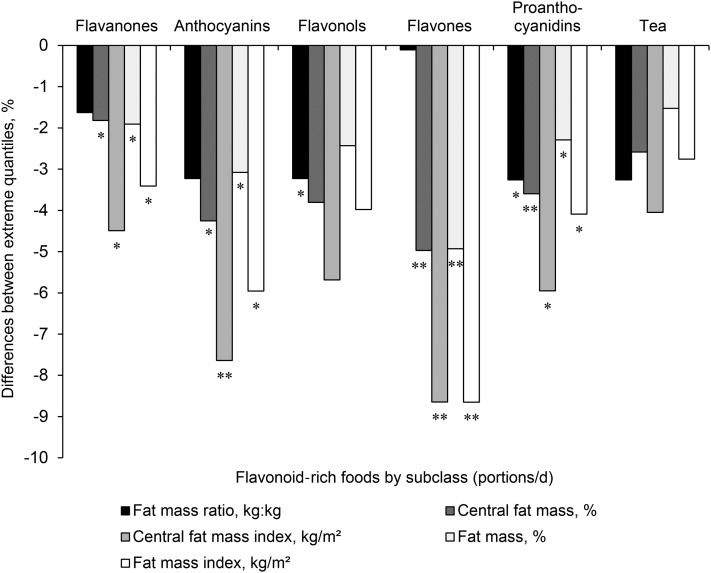
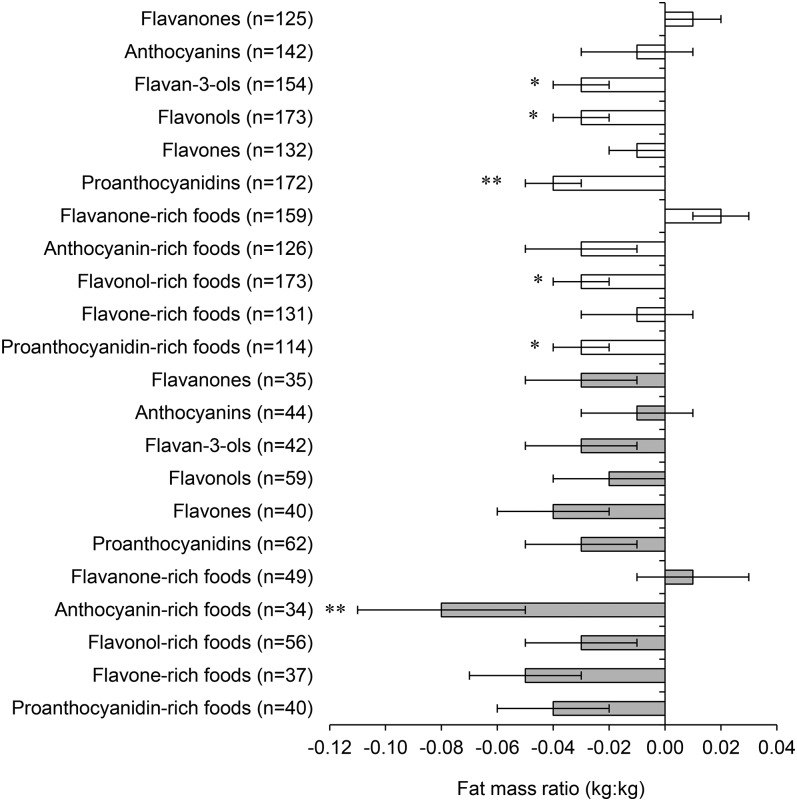
Although dietary flavonoid intake has been associated with less weight gain, there are limited data on its impact on fat mass, and to our knowledge, the contribution of genetic factors to this relation has not previously been assessed. We examined the associations between flavonoid intakes and fat mass. In a study of 2734 healthy, female twins aged 18-83 y from the TwinsUK registry, intakes of total flavonoids and 7 subclasses (flavanones, anthocyanins, flavan-3-ols, flavonols, flavones, polymers, and proanthocyanidins) were calculated with the use of food-frequency questionnaires. Measures of dual-energy X-ray absorptiometry-derived fat mass included the limb-to-trunk fat mass ratio (FMR), fat mass index, and central fat mass index. In cross-sectional multivariable analyses, higher intake of anthocyanins, flavonols, and proanthocyanidins were associated with a lower FMR with mean ± SE differences between extreme quintiles of -0.03 ± 0.02 (-trend = 0.02), -0.03 ± 0.02 (-trend = 0.03), and -0.05 ± 0.02 (-trend < 0.01), respectively. These associations were not markedly changed after further adjustment for fiber and total fruit and vegetable intakes. In monozygotic, intake-discordant twin pairs, twins with higher intakes of flavan-3-ols ( = 154, = 0.03), flavonols ( = 173, = 0.03), and proanthocyanidins ( = 172, < 0.01) had a significantly lower FMR than that of their co-twins with within-pair differences of 3-4%. Furthermore, in confirmatory food-based analyses, twins with higher intakes of flavonol-rich foods (onions, tea, and pears; = 0.01) and proanthocyanidin-rich foods (apples and cocoa drinks; = 0.04) and, in younger participants (aged <50 y) only, of anthocyanin-rich foods (berries, pears, grapes, and wine; = 0.01) had a 3-9% lower FMR than that of their co-twins. These data suggest that higher habitual intake of a number of flavonoids, including anthocyanins, flavan-3-ols, flavonols, and proanthocyanidins, are associated with lower fat mass independent of shared genetic and common environmental factors. Intervention trials are needed to further examine the effect of flavonoid-rich foods on body composition.
尽管膳食类黄酮摄入量与体重增加较少有关,但其对脂肪量影响的数据有限,据我们所知,此前尚未评估遗传因素对这种关系的作用。我们研究了类黄酮摄入量与脂肪量之间的关联。在一项对来自英国双胞胎登记处的2734名18 - 83岁健康女性双胞胎的研究中,使用食物频率问卷计算了总类黄酮和7个亚类(黄烷酮、花青素、黄烷 - 3 - 醇、黄酮醇、黄酮、聚合物和原花青素)的摄入量。双能X线吸收法测定的脂肪量指标包括肢体与躯干脂肪量比值(FMR)、脂肪量指数和中心脂肪量指数。在横断面多变量分析中,花青素、黄酮醇和原花青素摄入量较高与较低的FMR相关,极端五分位数之间的平均±标准误差异分别为 - 0.03 ± 0.02(-趋势 = 0.02)、- 0.03 ± 0.02(-趋势 = 0.03)和 - 0.05 ± 0.02(-趋势 < 0.01)。在进一步调整纤维以及水果和蔬菜总摄入量后,这些关联没有明显变化。在单卵双生、摄入量不一致的双胞胎对中,黄烷 - 3 - 醇摄入量较高的双胞胎(n = 154,P = 0.03)、黄酮醇摄入量较高的双胞胎(n = 173,P = 0.03)和原花青素摄入量较高的双胞胎(n = 172,P < 0.01)的FMR显著低于其双胞胎同胞,双胞胎对内部差异为3 - 4%。此外,在基于食物的验证性分析中,摄入富含黄酮醇食物(洋葱、茶和梨;P = 0.01)和富含原花青素食物(苹果和可可饮料;P = 0.04)的双胞胎,以及仅在较年轻参与者(年龄 < 50岁)中,摄入富含花青素食物(浆果、梨、葡萄和葡萄酒;P = 0.01)的双胞胎,其FMR比其双胞胎同胞低3 - 9%。这些数据表明,包括花青素、黄烷 - 3 - 醇、黄酮醇和原花青素在内的多种类黄酮的较高习惯性摄入量与较低的脂肪量相关,且独立于共同的遗传和共同环境因素。需要进行干预试验以进一步研究富含类黄酮食物对身体成分的影响。