Soberg Helene Lundgaard, Roe Cecilie, Brunborg Cathrine, von Steinbüchel Nicole, Andelic Nada
Department of Physical Medicine and Rehabilitation, Oslo University Hospital, Postbox 4950, Nydalen, 0424, Oslo, Norway.
Oslo Centre for Biostatistics and Epidemiology, Research Support Services, Oslo University Hospital, Oslo, Norway.
Health Qual Life Outcomes. 2017 Jan 19;15(1):14. doi: 10.1186/s12955-017-0589-9.
Consequences after Traumatic brain injury (TBI) affect the injured person's self-image and quality of life. The purpose was to assess the health related quality of life (HRQoL) at 12 months after a TBI in patients admitted to regional trauma centres, and to evaluate the metric properties of the Norwegian version of the Quality of Life After Brain Injury (QOLIBRI) questionnaire.
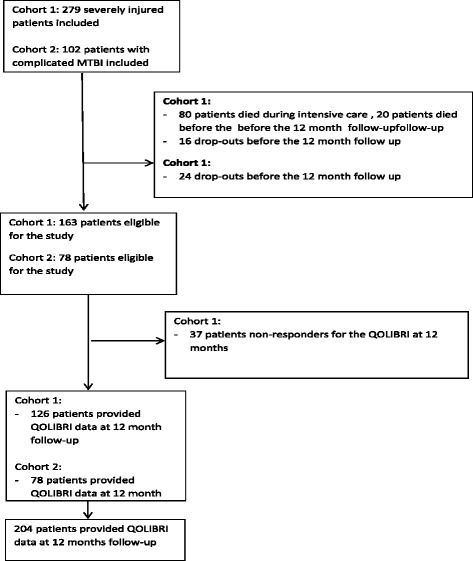
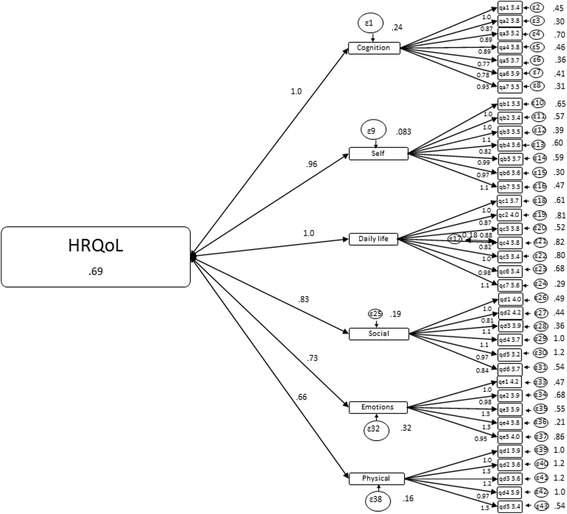
Two hundred four patients with TBI of all severities were included. HRQoL at 12 months post-injury was measured by the QOLIBRI. It has a total scale and 6 subscales (satisfied with Cognition, Self, Daily Life and Autonomy and Social Relationships, and bothered by Emotions and Physical Problems). Demographic and injury related data were registered. Disability was registered by Glasgow Outcome Scale Extended (GOSE) and Rivermead Post-Concussion Questionnaire, and mental health by Hospital Anxiety and Depression Scale. Descriptive statistics, internal consistency by Cronbach's alpha and Corrected Item-Total Correlations were calculated. Rasch analysis, Principal Component Analysis (PCA) and Structural Equation Modelling (SEM) were applied.
Mean age was 37.6 (SD 15.4) years; 72% were men, and 41% had higher education. Over 60% were severely injured. Mean Glasgow Coma Scale score was 9.3 (SD 4.5). According to the GOSE 5.9% had severe disability, 45.5% had moderate disability, and 48.5% had good recovery at 12 months post-injury. The QOLIBRI scales had a high internal consistency (α = 0.75-0.96), and only Physical Problems had an α < 0.85. In the Rasch analysis all subscales and their items fit the Rasch model, except for the depression item in the Emotion subscale. PCA and SEM analyses supported a six-factor structure in a second-order latent model. The QOLIBRI supports an underlying unidimensional HRQoL model. The SEM model fit statistics of the second-order model indicated a moderate fit to the observed data (CFI = 0.86, TLI = 0.85, RMSEA = 0.076, SRMR = 0.061, χ = 1315.76, df = 623, p-value < 0.001).
The Norwegian QOLIBRI has favourable psychometric properties, but there were some weaknesses related to its measurement properties of the total score when tested on a TBI population where many had severe TBI, and many had good recovery.
创伤性脑损伤(TBI)后的后果会影响伤者的自我形象和生活质量。目的是评估入住地区创伤中心的TBI患者伤后12个月的健康相关生活质量(HRQoL),并评估挪威版脑损伤后生活质量(QOLIBRI)问卷的度量特性。
纳入204例不同严重程度的TBI患者。伤后12个月的HRQoL通过QOLIBRI进行测量。它有一个总量表和6个分量表(对认知、自我、日常生活、自主性和社会关系满意,以及受情绪和身体问题困扰)。记录人口统计学和损伤相关数据。通过格拉斯哥扩展预后量表(GOSE)和Rivermead脑震荡后问卷记录残疾情况,通过医院焦虑抑郁量表记录心理健康情况。计算描述性统计量、Cronbach's alpha系数的内部一致性和校正的项目-总分相关性。应用Rasch分析、主成分分析(PCA)和结构方程模型(SEM)。
平均年龄为37.6(标准差15.4)岁;72%为男性,41%拥有高等教育学历。超过60%为重伤患者。格拉斯哥昏迷量表平均得分为9.3(标准差4.5)。根据GOSE,伤后12个月时,5.9%有严重残疾,45.5%有中度残疾,48.5%恢复良好。QOLIBRI量表具有较高的内部一致性(α=0.75-0.96),只有身体问题分量表的α<0.85。在Rasch分析中,除情绪分量表中的抑郁项目外,所有分量表及其项目均符合Rasch模型。PCA和SEM分析支持二阶潜在模型中的六因素结构。QOLIBRI支持一个潜在的单维HRQoL模型。二阶模型的SEM模型拟合统计量表明与观察数据拟合度中等(CFI=0.86,TLI=0.85,RMSEA=0.076,SRMR=0.061,χ=1315.76,df=623,p值<0.001)。
挪威版QOLIBRI具有良好的心理测量特性,但在许多患者为重度TBI且恢复良好的TBI人群中进行测试时,其总分测量特性存在一些弱点。