Xiong Naixue, Liu Ryan Wen, Liang Maohan, Wu Di, Liu Zhao, Wu Huisi
Hubei Key Laboratory of Inland Shipping Technology, School of Navigation, Wuhan University of Technology, Wuhan 430063, China.
Department of Business and Computer Science, Southwestern Oklahoma State University, Oklahoma, OK 73096, USA.
Sensors (Basel). 2017 Jan 18;17(1):174. doi: 10.3390/s17010174.
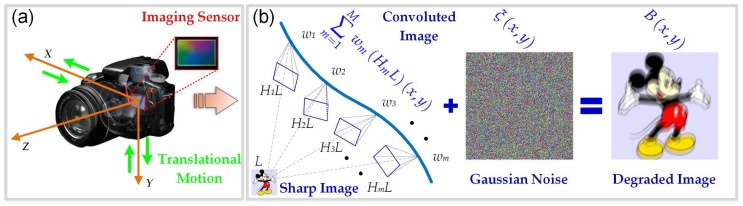
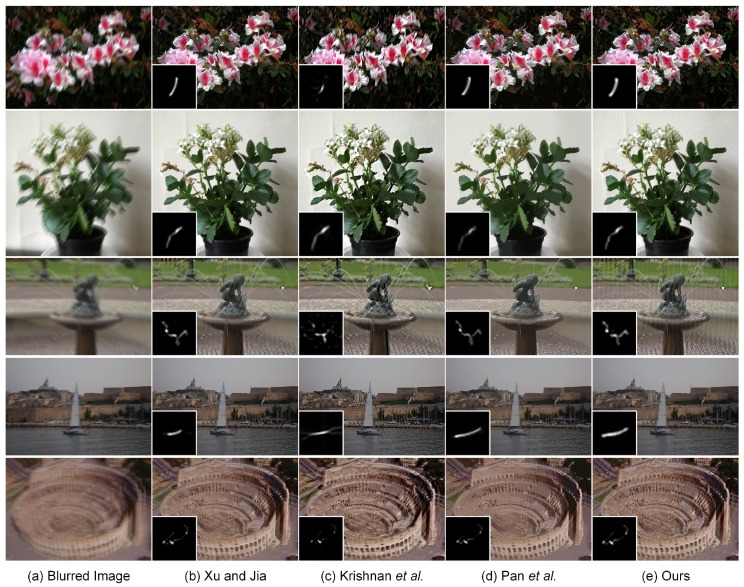
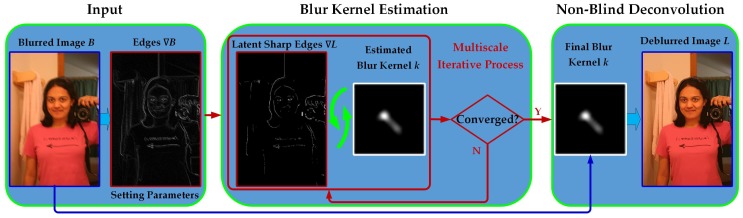
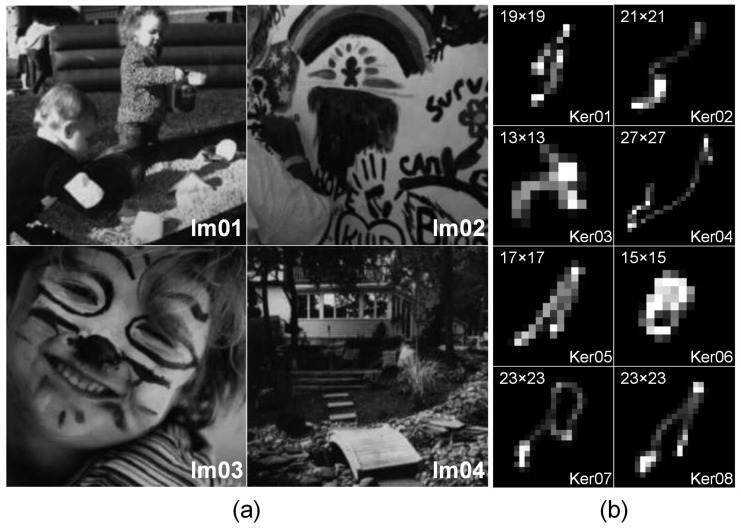
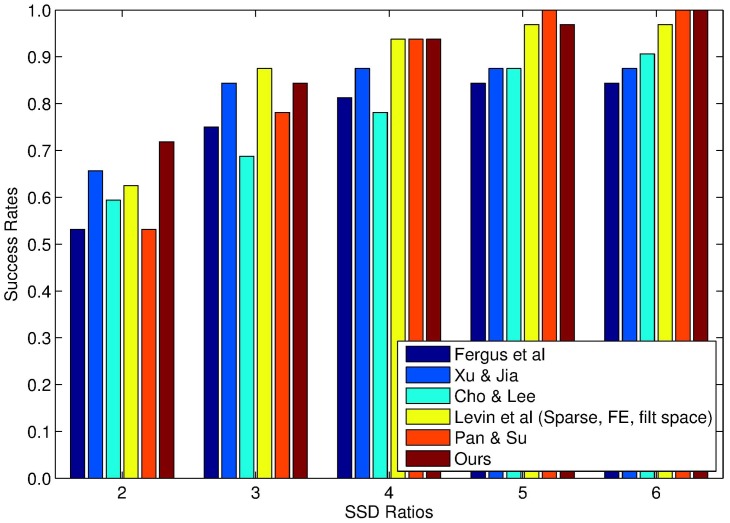
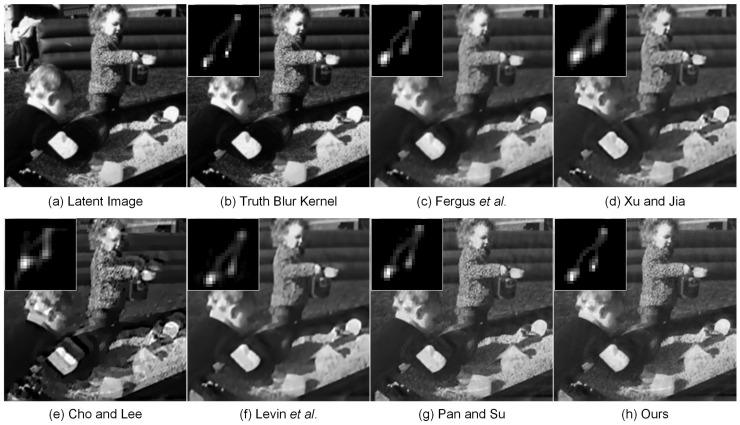
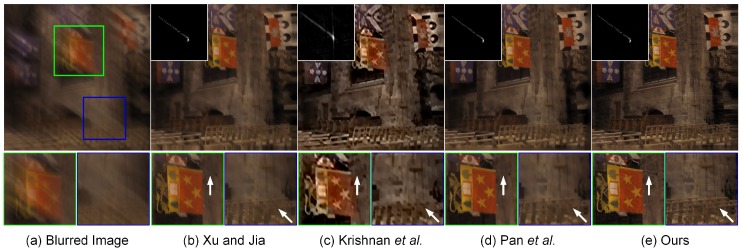
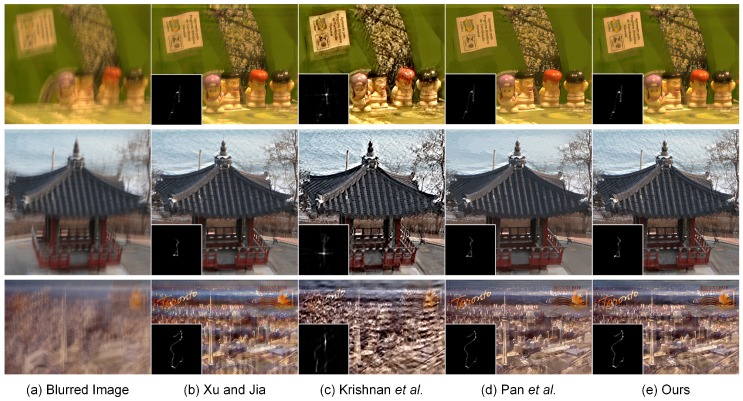
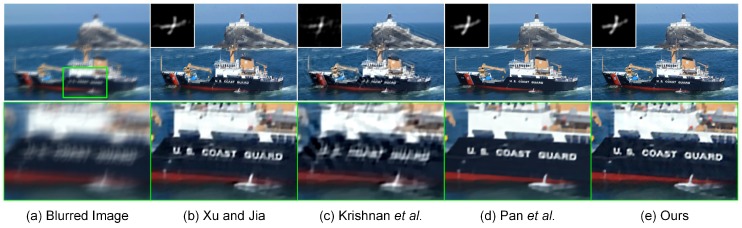
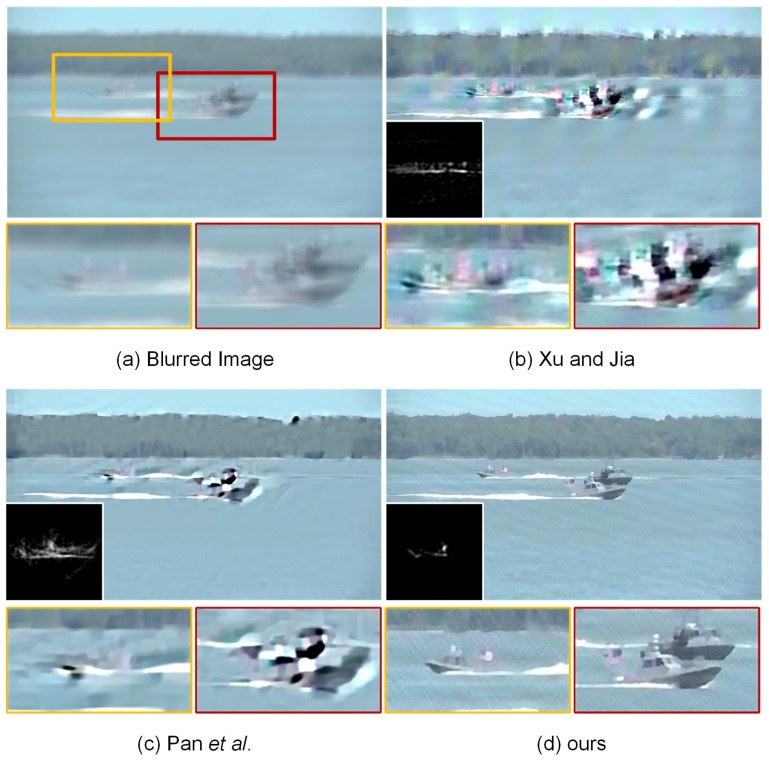
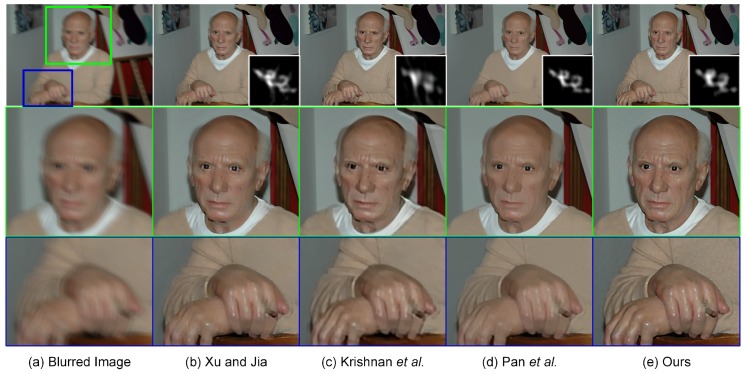
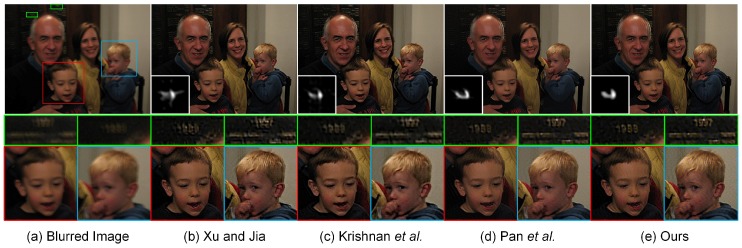
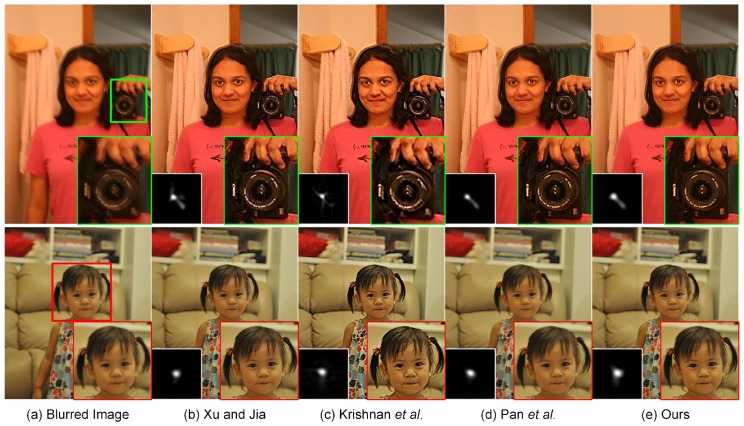
Single-image blind deblurring for imaging sensors in the Internet of Things (IoT) is a challenging ill-conditioned inverse problem, which requires regularization techniques to stabilize the image restoration process. The purpose is to recover the underlying blur kernel and latent sharp image from only one blurred image. Under many degraded imaging conditions, the blur kernel could be considered not only spatially sparse, but also piecewise smooth with the support of a continuous curve. By taking advantage of the hybrid sparse properties of the blur kernel, a hybrid regularization method is proposed in this paper to robustly and accurately estimate the blur kernel. The effectiveness of the proposed blur kernel estimation method is enhanced by incorporating both the L 1 -norm of kernel intensity and the squared L 2 -norm of the intensity derivative. Once the accurate estimation of the blur kernel is obtained, the original blind deblurring can be simplified to the direct deconvolution of blurred images. To guarantee robust non-blind deconvolution, a variational image restoration model is presented based on the L 1 -norm data-fidelity term and the total generalized variation (TGV) regularizer of second-order. All non-smooth optimization problems related to blur kernel estimation and non-blind deconvolution are effectively handled by using the alternating direction method of multipliers (ADMM)-based numerical methods. Comprehensive experiments on both synthetic and realistic datasets have been implemented to compare the proposed method with several state-of-the-art methods. The experimental comparisons have illustrated the satisfactory imaging performance of the proposed method in terms of quantitative and qualitative evaluations.
物联网(IoT)中成像传感器的单图像盲去模糊是一个具有挑战性的病态逆问题,需要正则化技术来稳定图像恢复过程。其目的是仅从一幅模糊图像中恢复潜在的模糊核和清晰图像。在许多退化成像条件下,模糊核不仅可以被认为在空间上是稀疏的,而且在连续曲线的支持下是分段光滑的。利用模糊核的混合稀疏特性,本文提出了一种混合正则化方法来稳健且准确地估计模糊核。通过结合核强度的L1范数和强度导数的平方L2范数,提高了所提出的模糊核估计方法的有效性。一旦获得了模糊核的准确估计,原始的盲去模糊就可以简化为模糊图像的直接反卷积。为了保证稳健的非盲反卷积,基于L1范数数据保真项和二阶全广义变分(TGV)正则化器提出了一种变分图像恢复模型。使用基于乘子交替方向法(ADMM)的数值方法有效地处理了与模糊核估计和非盲反卷积相关的所有非光滑优化问题。在合成数据集和真实数据集上都进行了综合实验,以将所提出的方法与几种最新方法进行比较。实验比较表明,所提出的方法在定量和定性评估方面都具有令人满意的成像性能。