Chen Min-Hua, Jenh Yi-Jhen, Wu Sheng-Kai, Chen Yo-Shen, Hanagata Nobutaka, Lin Feng-Huei
Institute of Biomedical Engineering, National Taiwan University, Taipei, 10051, Taiwan.
Nanotechnology Innovation Station, National Institute for Materials Science, Tsukuba, Ibaraki, 3050047, Japan.
Nanoscale Res Lett. 2017 Dec;12(1):62. doi: 10.1186/s11671-017-1840-3. Epub 2017 Jan 21.
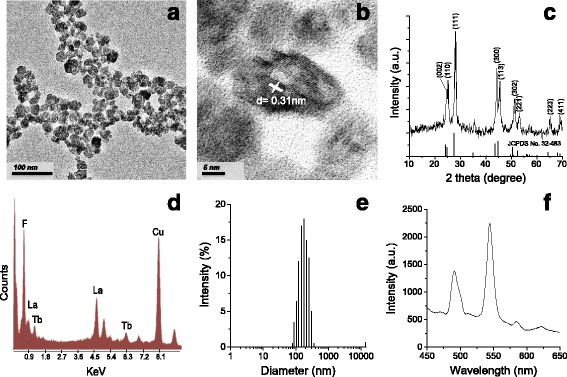
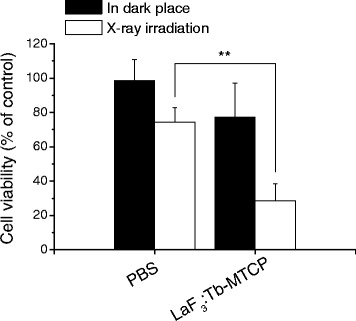
The use of photodynamic therapy (PDT) in the treatment of brain cancer has produced exciting results in clinical trials over the past decade. PDT is based on the concept that a photosensitizer exposed to a specific light wavelength produces the predominant cytotoxic agent, to destroy tumor cells. However, delivering an efficient light source to the brain tumor site is still a challenge. The light source should be delivered by placing external optical fibers into the brain at the time of surgical debulking of the tumor. Consequently, there exists the need for a minimally invasive treatment for brain cancer PDT. In this study, we investigated an attractive non-invasive option on glioma cell line by using Tb-doped LaF scintillating nanoparticles (LaF:Tb) in combination with photosensitizer, meso-tetra(4-carboxyphenyl)porphyrin (MTCP), followed by activation with soft X-ray (80 kVp). Scintillating LaF:Tb nanoparticles, with sizes of approximately 25 nm, were fabricated. The particles have a good dispersibility in aqueous solution and possess high biocompatibility. However, significant cytotoxicity was observed in the glioma cells while the LaF:Tb nanoparticles with MTCP were exposed under X-ray irradiation. The study has demonstrated a proof of concept as a non-invasive way to treat brain cancer in the future.
在过去十年的临床试验中,光动力疗法(PDT)用于治疗脑癌已产生了令人振奋的结果。PDT基于这样一个概念:暴露于特定光波长的光敏剂会产生主要的细胞毒性剂,以破坏肿瘤细胞。然而,将高效光源输送到脑肿瘤部位仍然是一项挑战。光源应在肿瘤手术减瘤时通过将外部光纤置入大脑来输送。因此,需要一种用于脑癌PDT的微创治疗方法。在本研究中,我们通过使用掺铽的氟化镧闪烁纳米颗粒(LaF:Tb)与光敏剂中-四(4-羧基苯基)卟啉(MTCP)相结合,随后用软X射线(80 kVp)激活,研究了一种对胶质瘤细胞系有吸引力的非侵入性方法。制备了尺寸约为25 nm的闪烁LaF:Tb纳米颗粒。这些颗粒在水溶液中具有良好的分散性且具有高生物相容性。然而,当掺有MTCP的LaF:Tb纳米颗粒在X射线照射下时,在胶质瘤细胞中观察到了显著的细胞毒性。该研究已证明了一种未来治疗脑癌的非侵入性方法的概念验证。