Willett Shawn M, Maenner Sarah K, Mayo J Patrick
Department of Ophthalmology, Center for the Neural Basis of Cognition, University of Pittsburgh, Pittsburgh, PA, United States.
Department of Bioengineering, University of Pittsburgh, Pittsburgh, PA, United States.
Front Syst Neurosci. 2023 Aug 16;17:1242654. doi: 10.3389/fnsys.2023.1242654. eCollection 2023.
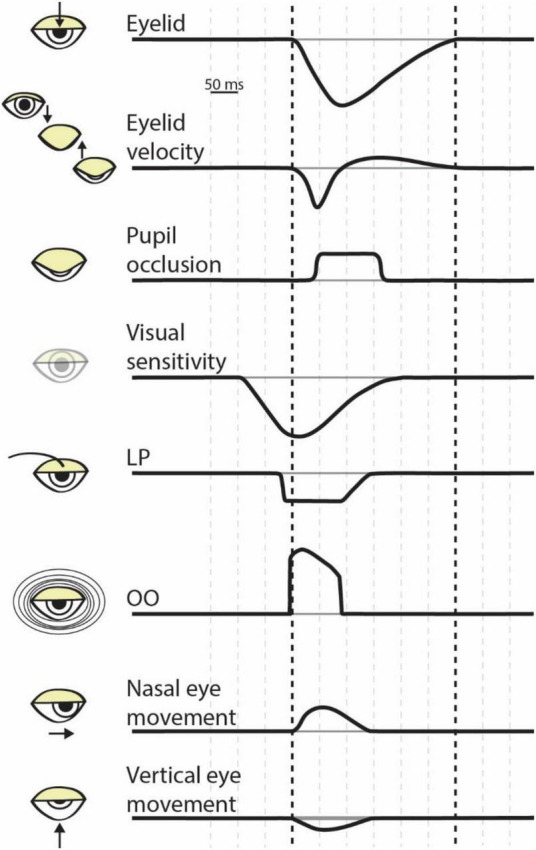
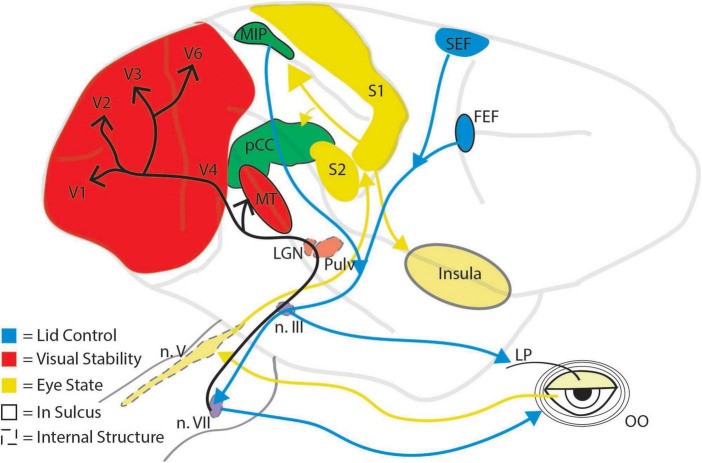
A hand passing in front of a camera produces a large and obvious disruption of a video. Yet the closure of the eyelid during a blink, which lasts for hundreds of milliseconds and occurs thousands of times per day, typically goes unnoticed. What are the neural mechanisms that mediate our uninterrupted visual experience despite frequent occlusion of the eyes? Here, we review the existing literature on the neurophysiology, perceptual consequences, and behavioral dynamics of blinks. We begin by detailing the kinematics of the eyelid that define a blink. We next discuss the ways in which blinks alter visual function by occluding the pupil, decreasing visual sensitivity, and moving the eyes. Then, to anchor our understanding, we review the similarities between blinks and other actions that lead to reductions in visual sensitivity, such as saccadic eye movements. The similarity between these two actions has led to suggestions that they share a common neural substrate. We consider the extent of overlap in their neural circuits and go on to explain how recent findings regarding saccade suppression cast doubt on the strong version of the shared mechanism hypothesis. We also evaluate alternative explanations of how blink-related processes modulate neural activity to maintain visual stability: a reverberating corticothalamic loop to maintain information in the face of lid closure; and a suppression of visual transients related to lid closure. Next, we survey the many areas throughout the brain that contribute to the execution of, regulation of, or response to blinks. Regardless of the underlying mechanisms, blinks drastically attenuate our visual abilities, yet these perturbations fail to reach awareness. We conclude by outlining opportunities for future work to better understand how the brain maintains visual perception in the face of eye blinks. Future work will likely benefit from incorporating theories of perceptual stability, neurophysiology, and novel behavior paradigms to address issues central to our understanding of natural visual behavior and for the clinical rehabilitation of active vision.
手在摄像头前挥动会对视频造成巨大且明显的干扰。然而,眨眼时眼睑的闭合持续数百毫秒,且每天会发生数千次,通常却未被注意到。尽管眼睛频繁被遮挡,介导我们不间断视觉体验的神经机制是什么呢?在这里,我们回顾了关于眨眼的神经生理学、感知后果及行为动力学的现有文献。我们首先详细阐述定义眨眼的眼睑运动学。接下来,我们讨论眨眼通过遮挡瞳孔、降低视觉敏感度和移动眼睛来改变视觉功能的方式。然后,为了加深理解,我们回顾眨眼与其他导致视觉敏感度降低的动作(如眼球快速运动)之间的相似性。这两种动作的相似性引发了它们共享共同神经基质的观点。我们考虑它们神经回路的重叠程度,并继续解释关于扫视抑制的最新发现如何对共享机制假说的强版本提出质疑。我们还评估了关于眨眼相关过程如何调节神经活动以维持视觉稳定性的其他解释:一个在眼睑闭合时维持信息的丘脑皮质回响回路;以及对与眼睑闭合相关的视觉瞬变的抑制。接下来,我们审视大脑中许多参与眨眼执行、调节或反应的区域。无论潜在机制如何,眨眼都会大幅削弱我们的视觉能力,但这些干扰却未被意识到。我们通过概述未来工作的机会来总结,以便更好地理解大脑在面对眨眼时如何维持视觉感知。未来的工作可能会受益于纳入感知稳定性理论、神经生理学和新颖的行为范式,以解决对我们理解自然视觉行为以及主动视觉临床康复至关重要的问题。