Lloyd Amanda J, Beckmann Manfred, Wilson Thomas, Tailliart Kathleen, Allaway David, Draper John
Institute of Biological Environmental and Rural Sciences, Aberystwyth University, Aberystwyth, UK.
WALTHAM Centre for Pet Nutrition, Freeby Lane, Waltham-on-the-Wolds, Melton Mowbray, Leicestershire, UK.
Metabolomics. 2017;13(2):15. doi: 10.1007/s11306-016-1152-0. Epub 2017 Jan 5.
The purpose of this study was to use high accurate mass metabolomic profiling to investigate differences within a phenotypically diverse canine population, with breed-related morphological, physiological and behavioural differences. Previously, using a broad metabolite fingerprinting approach, lipids appear to dominate inter- and intra- breed discrimination. The purpose here was to use Ultra High Performance Liquid Chromatography-High Resolution Mass Spectrometry (UHPLC-HRMS) to identify in more detail, inter-breed signatures in plasma lipidomic profiles of home-based, client-owned dogs maintained on different diets and fed according to their owners' feeding regimens.
Nine dog breeds were recruited in this study (Beagle, Chihuahua, Cocker Spaniel, Dachshund, Golden Retriever, Greyhound, German Shepherd, Labrador Retriever and Maltese: 7-12 dogs per breed). Metabolite profiling on a MTBE lipid extract of fasted plasma was performed using UHPLC-HRMS.
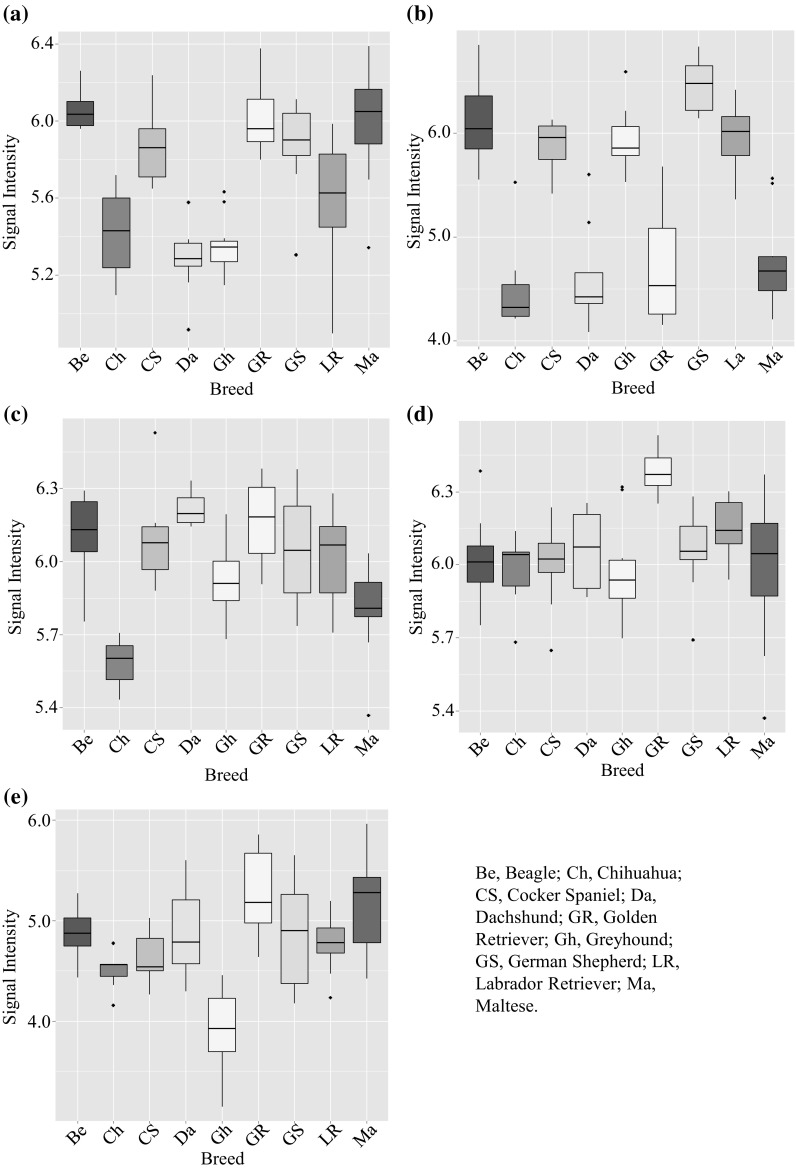
Multivariate modelling and classification indicated that the main source of lipidome variance was between the three breeds Chihuahua, Dachshund and Greyhound and the other six breeds, however some intra-breed variance was evident in Labrador Retrievers. Metabolites associated with dietary intake impacted on breed-associated variance and following filtering of these signals out of the data-set unique inter-breed lipidome differences for Chihuahua, Golden Retriever and Greyhound were identified.
By using a phenotypically diverse home-based canine population, we were able to show that high accurate mass lipidomics can enable identification of metabolites in the first pass plasma profile, capturing distinct metabolomic variability associated with genetic differences, despite environmental and dietary variability.
本研究旨在利用高精度代谢组学分析,调查具有不同形态、生理和行为特征的犬类群体之间的差异,这些差异与品种相关。此前,采用广泛的代谢物指纹图谱方法,脂质似乎在品种间和品种内的区分中占主导地位。本研究的目的是使用超高效液相色谱-高分辨率质谱法(UHPLC-HRMS)更详细地鉴定以家庭为基础、由客户拥有且按照主人喂养方案喂食不同饮食的犬只血浆脂质组图谱中的品种间特征。
本研究招募了九个犬种(比格犬、吉娃娃犬、可卡犬、腊肠犬、金毛寻回犬、灵缇犬、德国牧羊犬、拉布拉多寻回犬和马尔济斯犬:每个品种7-12只犬)。使用UHPLC-HRMS对空腹血浆中的MTBE脂质提取物进行代谢物分析。
多变量建模和分类表明,脂质组差异的主要来源在于吉娃娃犬、腊肠犬和灵缇犬这三个品种与其他六个品种之间,不过拉布拉多寻回犬中也存在一些品种内差异。与饮食摄入相关的代谢物影响了品种相关差异,在从数据集中滤除这些信号后,鉴定出了吉娃娃犬、金毛寻回犬和灵缇犬独特的品种间脂质组差异。
通过使用具有不同表型的家庭犬类群体,我们能够表明高精度脂质组学能够在首次血浆分析中鉴定代谢物,尽管存在环境和饮食差异,但仍能捕捉到与基因差异相关的独特代谢组变异性。