Franz Jason R, Francis Carrie, Allen Matt, Thelen Darryl G
IEEE Trans Neural Syst Rehabil Eng. 2017 Aug;25(8):1132-1142. doi: 10.1109/TNSRE.2016.2603340. Epub 2016 Aug 26.
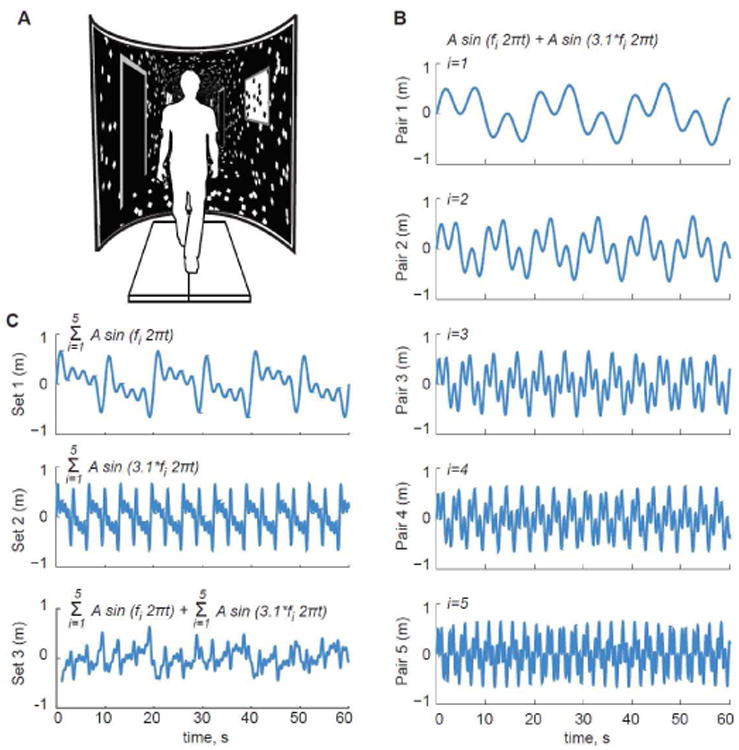
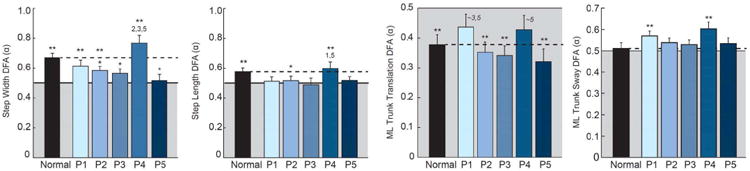
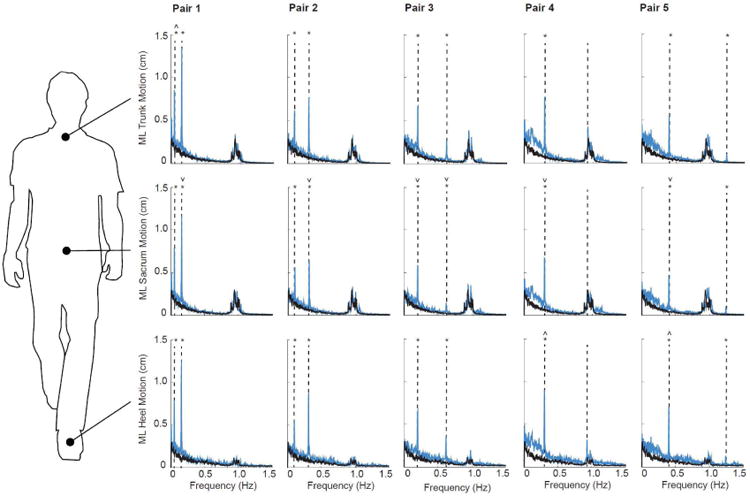
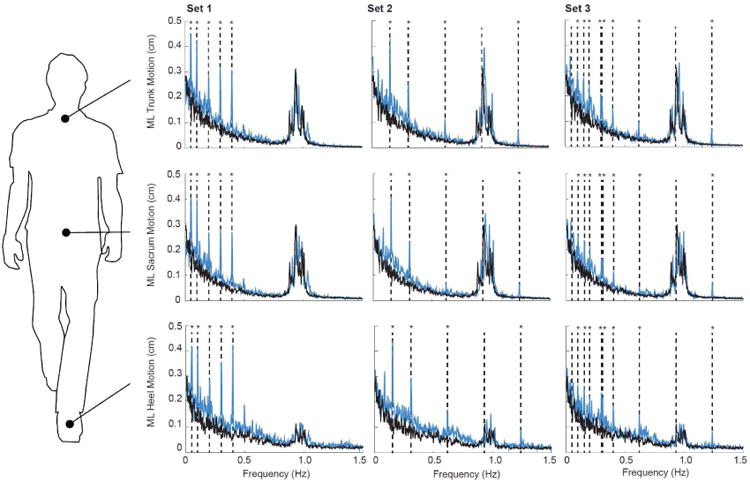
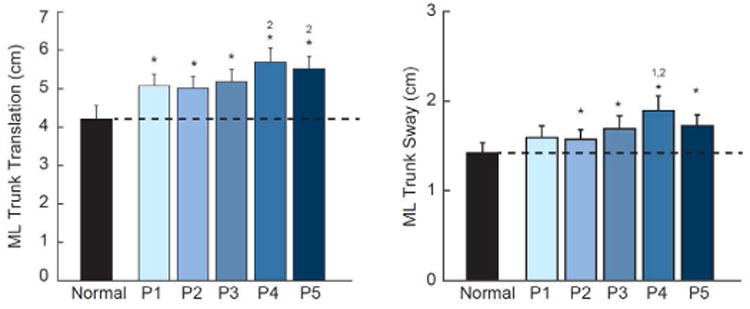
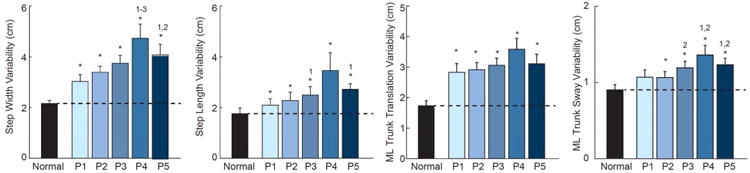
Visuomotor entrainment, or the synchronization of motor responses to visual stimuli, is a naturally emergent phenomenon in human standing. Our purpose was to investigate the prevalence and resolution of visuomotor entrainment in walking and the frequency-dependent response of walking balance to perturbations. We used a virtual reality environment to manipulate optical flow in ten healthy young adults during treadmill walking. A motion capture system recorded trunk, sacrum, and heel marker trajectories during a series of 3-min conditions in which we perturbed a virtual hallway mediolaterally with systematic changes in the driving frequencies of perceived motion. We quantified visuomotor entrainment using spectral analyses and balance deficits using trunk sway, gait variability, and detrended fluctuation analyses (DFA). ML kinematics were highly sensitive to visual perturbations, and instinctively synchronized (i.e., entrained) to a broad range of driving frequencies of perceived ML motion. However, the influence of visual perturbations on metrics of walking balance was frequency-dependent and governed by their proximity to stride frequency. Specifically, we found that a driving frequency nearest to subjects' average stride frequency uniquely compromised trunk sway, gait variability, and step-to-step correlations. We conclude that visuomotor entrainment is a robust and naturally emerging phenomenon during human walking, involving coordinated and frequency-dependent adjustments in trunk sway and foot placement to maintain balance at the whole-body level. These findings provide mechanistic insight into how the visuomotor control of walking balance is disrupted by visual perturbations and important reference values for the emergence of balance deficits due to age, injury, or disease.
视觉运动同步,即运动反应与视觉刺激的同步,是人类站立时自然出现的一种现象。我们的目的是研究步行中视觉运动同步的发生率和解决方式,以及步行平衡对扰动的频率依赖性反应。我们使用虚拟现实环境在跑步机步行过程中操纵十名健康年轻成年人的光流。在一系列3分钟的条件下,当我们以感知运动的驱动频率的系统变化对虚拟走廊进行内外侧扰动时,运动捕捉系统记录了躯干、骶骨和脚跟标记的轨迹。我们使用频谱分析量化视觉运动同步,使用躯干摆动、步态变异性和去趋势波动分析(DFA)量化平衡缺陷。内外侧运动学对视觉扰动高度敏感,并本能地与广泛的感知内外侧运动驱动频率同步(即夹带)。然而,视觉扰动对步行平衡指标的影响是频率依赖性的,并且受其与步频的接近程度支配。具体而言,我们发现最接近受试者平均步频的驱动频率会独特地损害躯干摆动、步态变异性和步间相关性。我们得出结论,视觉运动同步是人类步行过程中一种强大且自然出现的现象,涉及躯干摆动和足部放置的协调及频率依赖性调整,以在全身水平维持平衡。这些发现为视觉扰动如何破坏步行平衡的视觉运动控制提供了机制性见解,也为因年龄、损伤或疾病导致平衡缺陷的出现提供了重要参考值。