Del Río-Chanona Rita María, Grujić Jelena, Jeldtoft Jensen Henrik
Facultad de Ciencias, Universidad Nacional Autónoma de México, Mexico City, Mexico.
Centre for Complexity Science and Department of Mathematics, Imperial College London, South Kensington Campus, SW7 2AZ, London, United Kingdom.
PLoS One. 2017 Jan 26;12(1):e0170817. doi: 10.1371/journal.pone.0170817. eCollection 2017.
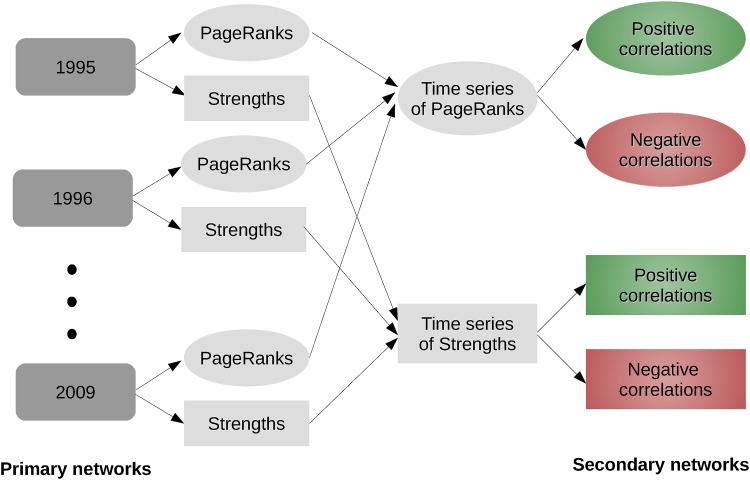
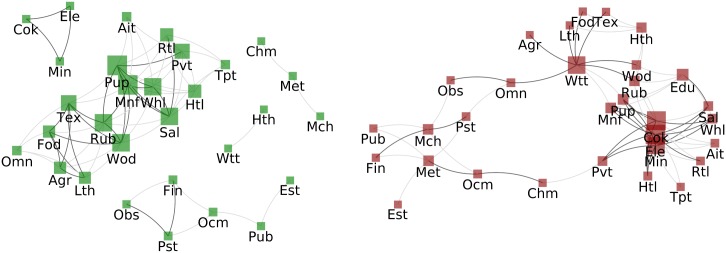
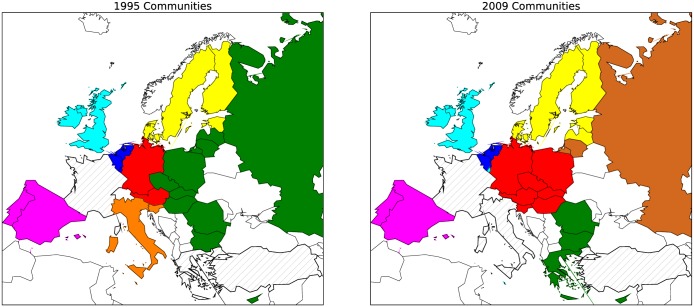
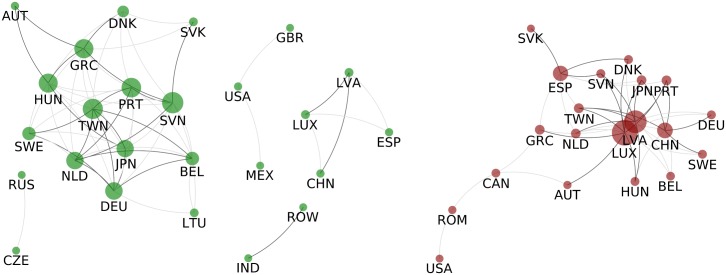
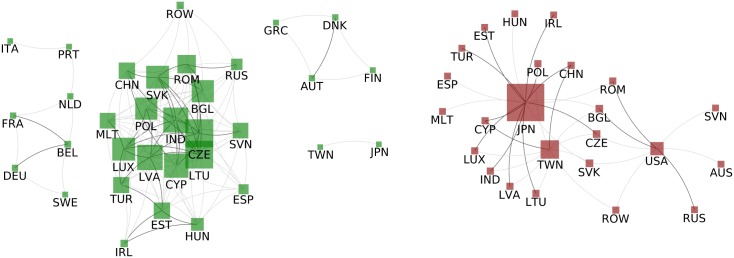
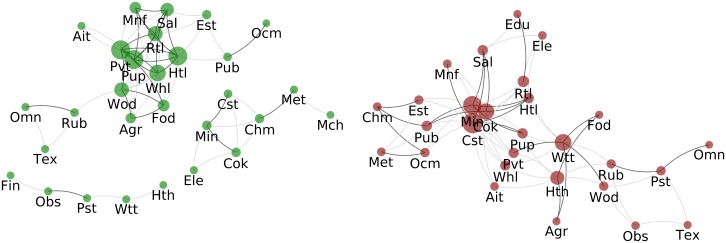
The international trade naturally maps onto a complex networks. Theoretical analysis of this network gives valuable insights about the global economic system. Although different economic data sets have been investigated from the network perspective, little attention has been paid to its dynamical behaviour. Here we take the World Input Output Data set, which has values of the annual transactions between 40 different countries of 35 different sectors for the period of 15 years, and infer the time interdependence between countries and sectors. As a measure of interdependence we use correlations between various time series of the network characteristics. First we form 15 primary networks for each year of the data we have, where nodes are countries and links are annual exports from one country to the other. Then we calculate the strengths (weighted degree) and PageRank of each country in each of the 15 networks for 15 different years. This leads to sets of time series and by calculating the correlations between these we form a secondary network where the links are the positive correlations between different countries or sectors. Furthermore, we also form a secondary network where the links are negative correlations in order to study the competition between countries and sectors. By analysing this secondary network we obtain a clearer picture of the mutual influences between countries. As one might expect, we find that political and geographical circumstances play an important role. However, the derived correlation network reveals surprising aspects which are hidden in the primary network. Sometimes countries which belong to the same community in the original network are found to be competitors in the secondary networks. E.g. Spain and Portugal are always in the same trade flow community, nevertheless secondary network analysis reveal that they exhibit contrary time evolution.
国际贸易自然地映射到一个复杂网络上。对这个网络的理论分析为全球经济系统提供了有价值的见解。尽管已经从网络角度研究了不同的经济数据集,但对其动态行为却很少关注。在这里,我们采用世界投入产出数据集,该数据集包含了15年间35个不同部门在40个不同国家之间的年度交易价值,并推断国家和部门之间的时间依赖性。作为依赖性的一种度量,我们使用网络特征的各种时间序列之间的相关性。首先,对于我们所拥有数据的每一年,我们构建15个初级网络,其中节点是国家,边是一个国家对另一个国家的年度出口。然后,我们计算15个不同年份中每个网络里每个国家的强度(加权度)和网页排名。这产生了一系列时间序列,通过计算这些序列之间的相关性,我们构建了一个次级网络,其中边是不同国家或部门之间的正相关关系。此外,我们还构建了一个边为负相关关系的次级网络,以便研究国家和部门之间的竞争。通过分析这个次级网络,我们对国家之间的相互影响有了更清晰的认识。正如人们可能预期的那样,我们发现政治和地理环境起着重要作用。然而,导出的相关网络揭示了隐藏在初级网络中的惊人方面。有时在原始网络中属于同一群落的国家在次级网络中却是竞争对手。例如,西班牙和葡萄牙总是处于相同的贸易流群落中,然而次级网络分析表明它们呈现出相反的时间演变。