Jacka Felice N, O'Neil Adrienne, Opie Rachelle, Itsiopoulos Catherine, Cotton Sue, Mohebbi Mohammedreza, Castle David, Dash Sarah, Mihalopoulos Cathrine, Chatterton Mary Lou, Brazionis Laima, Dean Olivia M, Hodge Allison M, Berk Michael
IMPACT Strategic Research Centre, Deakin University, Geelong, VIC, Australia.
Department of Psychiatry, University of Melbourne, Melbourne, VIC, Australia.
BMC Med. 2017 Jan 30;15(1):23. doi: 10.1186/s12916-017-0791-y.
The possible therapeutic impact of dietary changes on existing mental illness is largely unknown. Using a randomised controlled trial design, we aimed to investigate the efficacy of a dietary improvement program for the treatment of major depressive episodes.
'SMILES' was a 12-week, parallel-group, single blind, randomised controlled trial of an adjunctive dietary intervention in the treatment of moderate to severe depression. The intervention consisted of seven individual nutritional consulting sessions delivered by a clinical dietician. The control condition comprised a social support protocol to the same visit schedule and length. Depression symptomatology was the primary endpoint, assessed using the Montgomery-Åsberg Depression Rating Scale (MADRS) at 12 weeks. Secondary outcomes included remission and change of symptoms, mood and anxiety. Analyses utilised a likelihood-based mixed-effects model repeated measures (MMRM) approach. The robustness of estimates was investigated through sensitivity analyses.
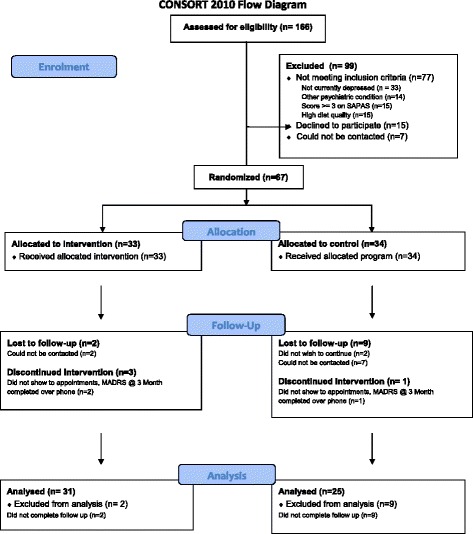
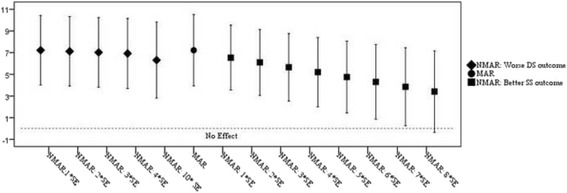
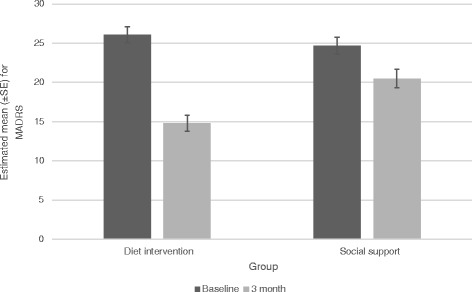
We assessed 166 individuals for eligibility, of whom 67 were enrolled (diet intervention, n = 33; control, n = 34). Of these, 55 were utilising some form of therapy: 21 were using psychotherapy and pharmacotherapy combined; 9 were using exclusively psychotherapy; and 25 were using only pharmacotherapy. There were 31 in the diet support group and 25 in the social support control group who had complete data at 12 weeks. The dietary support group demonstrated significantly greater improvement between baseline and 12 weeks on the MADRS than the social support control group, t(60.7) = 4.38, p < 0.001, Cohen's d = -1.16. Remission, defined as a MADRS score <10, was achieved for 32.3% (n = 10) and 8.0% (n = 2) of the intervention and control groups, respectively (χ (1) = 4.84, p = 0.028); number needed to treat (NNT) based on remission scores was 4.1 (95% CI of NNT 2.3-27.8). A sensitivity analysis, testing departures from the missing at random (MAR) assumption for dropouts, indicated that the impact of the intervention was robust to violations of MAR assumptions.
These results indicate that dietary improvement may provide an efficacious and accessible treatment strategy for the management of this highly prevalent mental disorder, the benefits of which could extend to the management of common co-morbidities.
Australia and New Zealand Clinical Trials Register (ANZCTR): ACTRN12612000251820 . Registered on 29 February 2012.
饮食改变对现有精神疾病可能产生的治疗影响在很大程度上尚不清楚。我们采用随机对照试验设计,旨在研究饮食改善计划对治疗重度抑郁发作的疗效。
“SMILES”是一项为期12周的平行组单盲随机对照试验,研究辅助饮食干预对中重度抑郁症的治疗效果。干预措施包括由临床营养师提供的七次个人营养咨询服务。对照条件包括按照相同的就诊时间表和时长提供社会支持方案。抑郁症状是主要终点,在12周时使用蒙哥马利-阿斯伯格抑郁评定量表(MADRS)进行评估。次要结局包括症状缓解以及症状、情绪和焦虑的变化。分析采用基于似然的混合效应模型重复测量(MMRM)方法。通过敏感性分析研究估计值的稳健性。
我们评估了166人的资格,其中67人被纳入研究(饮食干预组,n = 33;对照组,n = 34)。其中,55人正在使用某种形式的治疗:21人同时使用心理治疗和药物治疗;9人仅使用心理治疗;25人仅使用药物治疗。饮食支持组中有31人,社会支持对照组中有25人在12周时有完整数据。饮食支持组在MADRS量表上从基线到12周的改善程度显著大于社会支持对照组,t(60.7) = 4.38,p < 0.001,科恩d值 = -1.16。干预组和对照组分别有32.3%(n = 10)和8.0%(n = 2)达到缓解,定义为MADRS评分<10(χ²(1) = 4.84,p = 0.028);基于缓解评分的治疗所需人数(NNT)为4.1(NNT的95%置信区间为2.3 - 27.8)。一项敏感性分析测试了对失访随机缺失(MAR)假设的偏离情况,结果表明干预的影响对违反MAR假设具有稳健性。
这些结果表明,饮食改善可能为管理这种高度常见的精神障碍提供一种有效且可及的治疗策略,其益处可能扩展到常见共病的管理。
澳大利亚和新西兰临床试验注册中心(ANZCTR):ACTRN12612000251820。于2012年2月29日注册。