Melzer Anne C, Ghassemieh Bijan J, Gillespie Suzanne E, Lindenauer Peter K, McBurnie Mary Ann, Mularski Richard A, Naureckas Edward T, Vollmer William M, Au David H
Division of Pulmonary and Critical Care, University of Washington, USA; Center of Innovation for Veteran-Centered and Value-Driven Care, VA Puget Sound, USA; VA Puget Sound Health Care System, 1660 S. Columbian Way, Mailstop S-152, Seattle, WA, 98108, USA.
Division of Pulmonary and Critical Care, University of Washington, USA.
Respir Med. 2017 Feb;123:124-130. doi: 10.1016/j.rmed.2016.12.011. Epub 2016 Dec 20.
Inhaled therapies are the cornerstone of pharmacologic management for COPD. Each device requires a unique series of steps to be most effective, making appropriate instruction in inhaler technique a key part of the management of COPD.
Examine characteristics of patients and devices associated with poor technique among patients with COPD.
Cross-sectional study of subjects with COPD using at least one of: metered dose inhaler, Advair Diskus, Spiriva Handihaler, identified from the COPD Outcomes-based Network for Clinical Effectiveness and Research Translation (CONCERT) registry. Technique was assessed face-to-face using manufacturer-provided dummy inhalers, with standardized checklists for each device. We used logistic regression to model associations with poor inhaler technique, defined as an error in ≥20% of the steps, as a function of patient characteristics, with educational attainment the primary predictor.
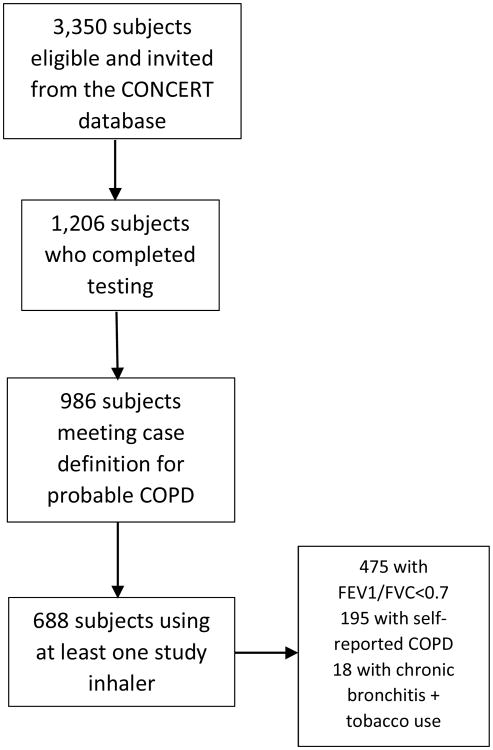
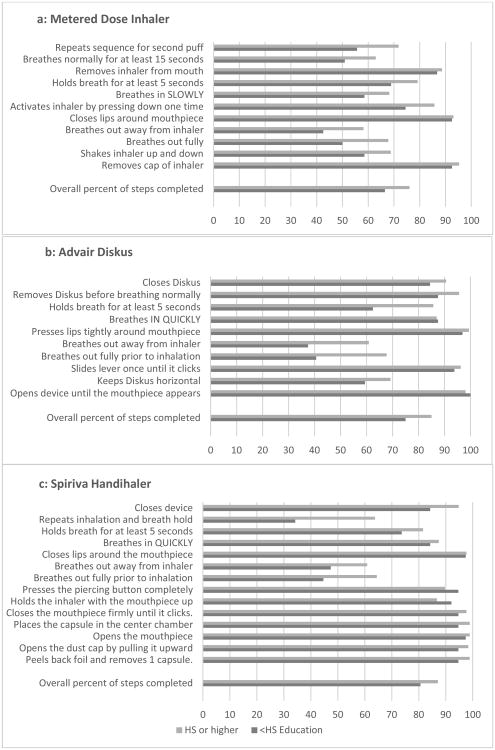
688 individuals meet eligibility criteria, 65.5% had poor technique for at least one device. In adjusted analyses, Black race was associated with poor technique (OR 3.25, 95%CI 1.86-5.67) while greater than high school education was associated with decreased odds of poor technique (OR 0.35, 95%CI 0.17-0.70 for trade school/some college, OR 0.25, 95%CI 0.11-0.61 for college or more, p ≤ 0.001 for test of linear trend). The percentage of errors varied between devices, with subjects making proportionally the most errors for MDIs.
Poor inhaler technique is common among individuals with COPD, varies between devices, and is associated with race and educational attainment. Tailored educational interventions to teach inhaler technique should be part of the process of initiating and monitoring inhaled therapies.
吸入疗法是慢性阻塞性肺疾病(COPD)药物治疗的基石。每种吸入装置都需要一系列独特的步骤才能达到最佳效果,因此正确指导吸入器使用技术是COPD管理的关键部分。
研究COPD患者中与吸入技术不佳相关的患者及装置特征。
对慢性阻塞性肺疾病结局临床有效性和研究转化网络(CONCERT)登记处中使用以下至少一种吸入装置的受试者进行横断面研究:定量吸入器、舒利迭准纳器、思力华能倍乐。使用制造商提供的模拟吸入器进行面对面技术评估,并为每种装置制定标准化检查表。我们使用逻辑回归模型,将吸入技术不佳(定义为≥20%的步骤存在错误)与患者特征的关系建模,以教育程度作为主要预测因素。
688名个体符合纳入标准,65.5%的人至少有一种装置的使用技术不佳。在调整分析中,黑人种族与技术不佳相关(比值比[OR]3.25,95%置信区间[CI]1.86 - 5.67),而高中以上学历与技术不佳几率降低相关(职业学校/大专学历者的OR为0.35,95%CI为0.17 - 0.70;大学及以上学历者的OR为0.25,95%CI为0.11 - 0.61;线性趋势检验p≤0.001)。不同装置的错误百分比各不相同,定量吸入器的受试者错误比例最高。
吸入技术不佳在COPD患者中很常见,因装置而异,且与种族和教育程度有关。针对吸入器使用技术的定制教育干预应成为启动和监测吸入疗法过程的一部分。