Gharaghani Maral, Rezaei-Matehkolaei Ali, Zarei Mahmoudabadi Ali, Keikhaei Bijan
Health Research Institute, Infectious and Tropical Diseases Research Center, Ahvaz Jundishapur University of Medical Sciences, Ahvaz, Iran; Department of Medical Mycology, School of Medicine, Ahvaz Jundishapur University of Medical Sciences, Ahvaz, Iran.
Health Research Institute, Thalassemia and Hemoglobinopathy Research Center, Ahvaz Jundishapur University of Medical Sciences, Ahvaz, Iran.
Jundishapur J Microbiol. 2016 Oct 9;9(11):e41446. doi: 10.5812/jjm.41446. eCollection 2016 Nov.
Neutropenia, as a predisposing factor for invasive candidiasis, is defined as a reduction in neutrophil count to less than 1500/mm. It is a common condition in patients with hematological malignancy and cytostatic chemotherapy. Extensive chemotherapy and prophylaxis with antifungals have increased the resistance of isolates to antifungal drugs. Although, is the most common causative agent among neutropenic patients, there is an increasing rate of non- species. Extracellular enzymes activity pattern and antifungal agent sensitivity profiles are two important factors for spreading resistant strains.
The aim of the present study was to identify the strains isolated from hospitalized neutropenic patients. The patterns of antifungal susceptibility of the causative agents to antifungals and the extracellular enzymes activity of the isolates were also evaluated.
In the present study, 243 urine and 243 oral swab samples were collected from neutropenic patients and inoculated on CHROMagar Candida. In addition, 100 blood samples were also inoculated in biphasic Brain Heart Infusion medium. Several yeast isolates were isolated from samples and identified by classical and molecular techniques. The profiles of extracellular enzymes and the susceptibility of recovered agents to amphotericin B, fluconazole and caspofungin were also evaluated.
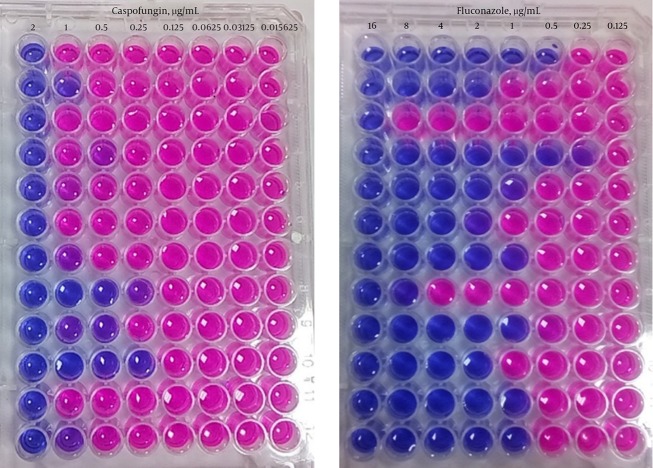
A total of 110 yeast strains isolated from urine and oral cavities were identified as (51.8%), (25.5%), (6.4%) and other yeasts (16.3%). No yeast species was isolated from blood samples. Our result showed that in 90% of the isolates, the range of secretion of extracellular enzymes was medium (2+) and high (3+), however only a few isolates were negative for this characteristic. All isolates were sensitive to caspofungin and fluconazole, whereas 54.7% of isolates were resistant to amphotericin B.
We found a marked increase in the incidence of non- species (48.2%) among neutropenic patients. Only a few strains failed to produce extracellular enzymes. Finally, in addition to fluconazole, caspofungin can be considered as the first line treatment against a species among neutropenic patients.
中性粒细胞减少作为侵袭性念珠菌病的一个易感因素,被定义为中性粒细胞计数减少至低于1500/mm³。这在血液系统恶性肿瘤和细胞毒性化疗患者中是一种常见情况。广泛的化疗以及抗真菌药物的预防使用增加了分离株对抗真菌药物的耐药性。尽管白色念珠菌是中性粒细胞减少患者中最常见的病原体,但非白色念珠菌的发生率正在上升。细胞外酶活性模式和抗真菌药物敏感性谱是耐药菌株传播的两个重要因素。
本研究的目的是鉴定从住院中性粒细胞减少患者中分离出的念珠菌菌株。还评估了病原体对抗真菌药物的抗真菌药敏模式以及分离株的细胞外酶活性。
在本研究中,从中性粒细胞减少患者中收集了243份尿液和243份口腔拭子样本,并接种在科玛嘉念珠菌显色培养基上。此外,100份血液样本也接种在双相脑心浸液培养基中。从样本中分离出几种酵母分离株,并通过经典和分子技术进行鉴定。还评估了细胞外酶谱以及分离出的病原体对两性霉素B、氟康唑和卡泊芬净的敏感性。
从尿液和口腔中分离出的110株酵母菌株被鉴定为白色念珠菌(51.8%)、热带念珠菌(25.5%)、近平滑念珠菌(6.4%)和其他酵母(16.3%)。血液样本中未分离出酵母菌种。我们的结果表明,在90%的分离株中,细胞外酶的分泌范围为中等(2+)和高(3+),然而只有少数分离株对此特征呈阴性。所有分离株对卡泊芬净和氟康唑敏感,而54.7%的分离株对两性霉素B耐药。
我们发现中性粒细胞减少患者中非白色念珠菌的发生率显著增加(48.2%)。只有少数菌株不产生细胞外酶。最后,除氟康唑外,卡泊芬净可被视为中性粒细胞减少患者中针对念珠菌的一线治疗药物。