Institute of Pathology, University of Bern, Murtenstrasse 31, 3008, Bern, Switzerland.
Institute of Pathology, Triemli City Hospital, Birmensdorferstrasse 497, 8063, Zurich, Switzerland.
Sci Rep. 2021 Jan 27;11(1):2371. doi: 10.1038/s41598-021-81352-y.
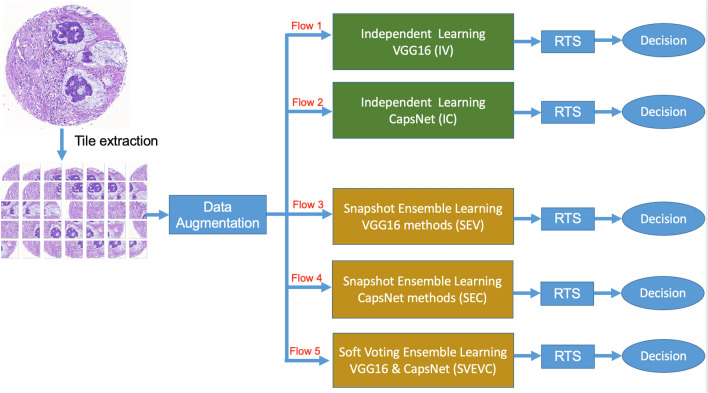
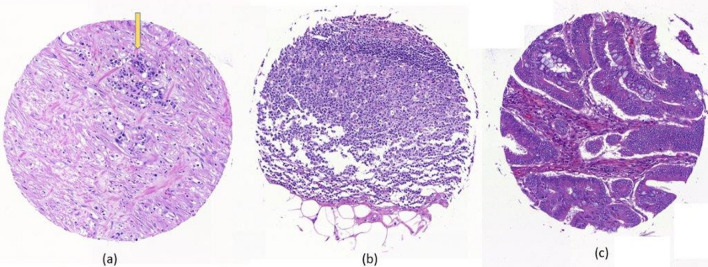
Tissue microarray (TMA) core images are a treasure trove for artificial intelligence applications. However, a common problem of TMAs is multiple sectioning, which can change the content of the intended tissue core and requires re-labelling. Here, we investigate different ensemble methods for colorectal tissue classification using high-throughput TMAs. Hematoxylin and Eosin (H&E) core images of 0.6 mm or 1.0 mm diameter from three international cohorts were extracted from 54 digital slides (n = 15,150 cores). After TMA core extraction and color enhancement, five different flows of independent and ensemble deep learning were applied. Training and testing data with 2144 and 13,006 cores included three classes: tumor, normal or "other" tissue. Ground-truth data were collected from 30 ngTMA slides (n = 8689 cores). A test augmentation is applied to reduce the uncertain prediction. Predictive accuracy of the best method, namely Soft Voting Ensemble of one VGG and one CapsNet models was 0.982, 0.947 and 0.939 for normal, "other" and tumor, which outperformed to independent or ensemble learning with one base-estimator. Our high-accuracy algorithm for colorectal tissue classification in high-throughput TMAs is amenable to images from different institutions, core sizes and stain intensity. It helps to reduce error in TMA core evaluations with previously given labels.
组织微阵列(TMA)核心图像是人工智能应用的宝库。然而,TMA 的一个常见问题是多次切片,这可能会改变预期组织核心的内容,并需要重新标记。在这里,我们研究了使用高通量 TMA 进行结直肠组织分类的不同集成方法。从三个国际队列的 54 张数字幻灯片中提取了直径为 0.6mm 或 1.0mm 的苏木精和伊红(H&E)核心图像(n=15150 个核心)。在 TMA 核心提取和颜色增强后,应用了五种不同的独立和集成深度学习流。包含三个类别的训练和测试数据:肿瘤、正常或“其他”组织,分别有 2144 个和 13006 个核心。从 30ngTMA 幻灯片(n=8689 个核心)收集了真实数据。应用测试扩充以减少不确定预测。最佳方法,即一个 VGG 和一个 CapsNet 模型的软投票集成的预测准确性分别为 0.982、0.947 和 0.939,用于正常、“其他”和肿瘤,优于具有一个基础估计器的独立或集成学习。我们用于高通量 TMA 中结直肠组织分类的高精度算法适用于来自不同机构、核心大小和染色强度的图像。它有助于减少具有给定标签的 TMA 核心评估中的错误。