Latif Iqra, Hughes Alun T L, Bendall Robert C A
Directorate of Psychology & Public Health, School of Health and Society, University of Salford, Salford, United Kingdom.
School of Natural Sciences and Psychology, Faculty of Science, Liverpool John Moores University, Liverpool, United Kingdom.
Front Psychiatry. 2019 Aug 30;10:628. doi: 10.3389/fpsyt.2019.00628. eCollection 2019.
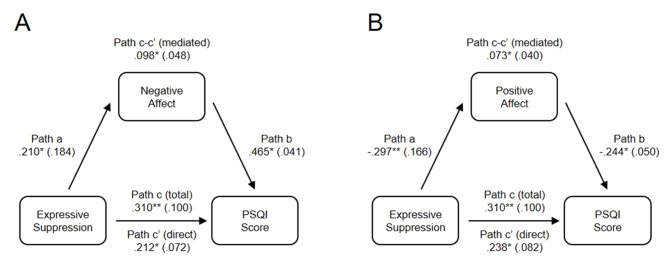
Positive affect, negative affect, and emotion regulation strategies are related to sleep quality. Emotion regulation can also act as either a protective factor against the development of psychopathologies, or as a risk factor for their development, and therefore may be one mechanism linking mental health and sleep. However, currently it is not known whether affect can mediate the impact of emotion regulation strategy use on sleep quality. An opportunity sample in a healthy population completed the Positive and Negative Affect Schedule providing measures of positive and negative affect, the Pittsburgh Sleep Quality Index providing a measure of sleep quality, and the Emotion Regulation Questionnaire to record habitual use of emotion regulation strategies. Data were analysed using regression and mediation analyses. Negative affect and expressive suppression were positively correlated with PSQI score suggesting that as negative affect and expressive suppression use increased, sleep quality decreased. Positive affect was negatively correlated with PSQI score suggesting that as positive affect increased sleep quality improved. Further, mediation analyses revealed that both positive affect and negative affect mediated the impact of expressive suppression on sleep quality. Moreover, this partial mediation provides the first description that the influences of affect and expressive suppression on sleep quality are at least partially distinct. Targeting improvements in negative affect and effective emotion regulation strategy use may improve the efficacy of interventions aimed at improving sleep quality and the reduction in symptomology in psychopathologies.
积极情绪、消极情绪和情绪调节策略与睡眠质量相关。情绪调节既可以作为预防精神疾病发展的保护因素,也可以作为精神疾病发展的风险因素,因此可能是连接心理健康和睡眠的一种机制。然而,目前尚不清楚情绪是否能介导情绪调节策略的使用对睡眠质量的影响。一个健康人群的机会样本完成了正负情绪量表以测量积极和消极情绪,匹兹堡睡眠质量指数以测量睡眠质量,以及情绪调节问卷以记录情绪调节策略的习惯性使用情况。使用回归分析和中介分析对数据进行了分析。消极情绪和表达抑制与匹兹堡睡眠质量指数得分呈正相关,这表明随着消极情绪和表达抑制的增加,睡眠质量下降。积极情绪与匹兹堡睡眠质量指数得分呈负相关,这表明随着积极情绪的增加,睡眠质量提高。此外,中介分析表明,积极情绪和消极情绪都介导了表达抑制对睡眠质量的影响。而且,这种部分中介作用首次表明,情绪和表达抑制对睡眠质量的影响至少部分是不同的。针对改善消极情绪和有效使用情绪调节策略,可能会提高旨在改善睡眠质量和减少精神疾病症状的干预措施的效果。