Medenwald Daniel, Vordermark Dirk, Dietzel Christian T
Department of Radiation Oncology, University Hospital Halle (Saale), Ernst-Grube-Str. 40, 06120, Halle (Saale), Germany.
Institute of Medical Epidemiology, Biostatistics and Informatics, Martin-Luther-University Halle-Wittenberg, Magdeburger Str. 8, 06112, Halle (Saale), Germany.
BMC Cancer. 2017 Feb 2;17(1):94. doi: 10.1186/s12885-017-3086-y.
Health and social conditions vary between West and East Germany.
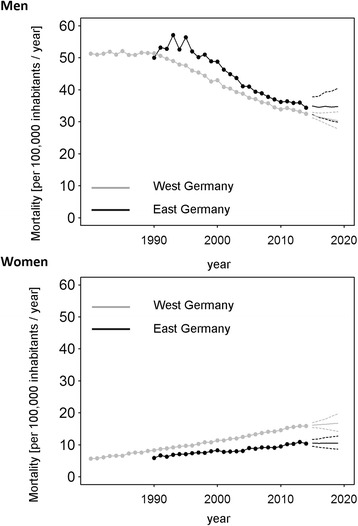
We analyzed annual mortality data of all recorded deaths caused by lung, colorectal, breast and prostate cancer in Germany as they are published by the Federal Bureau of Statistics (FBS) encompassing the period 1980-2014 for former West Germany (WG) and 1990-2014 for former East Germany (EG). To compare East and West Germany we computed the ratio of the mortality rates in both parts (mortality rate ratio, MRR, <1 indicates a lower mortality in EG). Forecasting methods of time series analyses were applied (model selection based on the Box/Jenkins approach) to predict 5-year trends until 2019.
Lung cancer: In women mortality rose in both regions (WG: +2.8%, 1991-2014, EG: +2.2%, 1990-2014). In men mortality in WG declined between -2.1% and -1.2%, and by -2.7% (1993-2009) in EG which was followed by a plateau. Colorectal cancer: A decline was found in both WG (-3.1%, 1993-2014) and EG women (-3.8%, 1993-2008 and -2.0%, 2008-2014). A decline in EG men since 1992 (-0.9%, 1992-1997 and -2.3%, 1997-2014) mirrors the development in WG (-2.6%, 1995-2014). Breast cancer: Constant mortality decline in WG after 1996. In EG a decline (-2.4%, 1992-2007) was followed by a plateau with an MRR <1 (1990-2014). Prostate cancer: In WG a decline (-3.4%) came to a hold after 2007, while there was a constant decline of 1.5% in EG. The forecast indicated that mortality of colorectal/lung cancer in men and breast cancer reaches a plateau in future years.
Courses of mortality were similar between East and West, while existing differences are likely to remain in the near future.
德国东西部的健康和社会状况存在差异。
我们分析了德国联邦统计局公布的1980 - 2014年西德(WG)以及1990 - 2014年东德(EG)所有记录在案的因肺癌、结直肠癌、乳腺癌和前列腺癌导致的年度死亡数据。为比较东德和西德,我们计算了两部分死亡率的比值(死亡率比值,MRR,<1表示东德死亡率较低)。应用时间序列分析的预测方法(基于Box/Jenkins方法进行模型选择)来预测直至2019年的5年趋势。
肺癌:在女性中,两个地区的死亡率均上升(西德:1991 - 2014年上升2.8%,东德:1990 - 2014年上升2.2%)。在男性中,西德的死亡率下降了-2.1%至-1.2%,东德在1993 - 2009年下降了2.7%,随后趋于平稳。结直肠癌:西德(1993 - 2014年下降3.1%)和东德女性(1993 - 2008年下降3.8%,2008 - 2014年下降2.0%)均有下降。自1992年以来,东德男性死亡率下降(1992 - 1997年下降0.9%,1997 - 2014年下降2.3%),与西德的情况(1995 - 2014年下降2.6%)相似。乳腺癌:1996年后西德死亡率持续下降。在东德,1992 - 2007年下降(2.4%)后趋于平稳,MRR<1(1990 - 2014年)。前列腺癌:在西德,2007年后下降(3.4%)趋势停止,而东德则持续下降1.5%。预测表明,未来几年男性结直肠癌/肺癌和乳腺癌的死亡率将趋于平稳。
东西部的死亡率变化趋势相似,而现有差异在不久的将来可能仍会存在。