de Jonge Laury P J W M, Timmerman Angelique A, Govaerts Marjan J B, Muris Jean W M, Muijtjens Arno M M, Kramer Anneke W M, van der Vleuten Cees P M
Department of Family Medicine, FHML, Maastricht University, P.O. Box 616, 6200 MD, Maastricht, The Netherlands.
Department of Educational Research and Development, FHML, Maastricht University, Maastricht, The Netherlands.
Adv Health Sci Educ Theory Pract. 2017 Dec;22(5):1213-1243. doi: 10.1007/s10459-017-9760-7. Epub 2017 Feb 2.
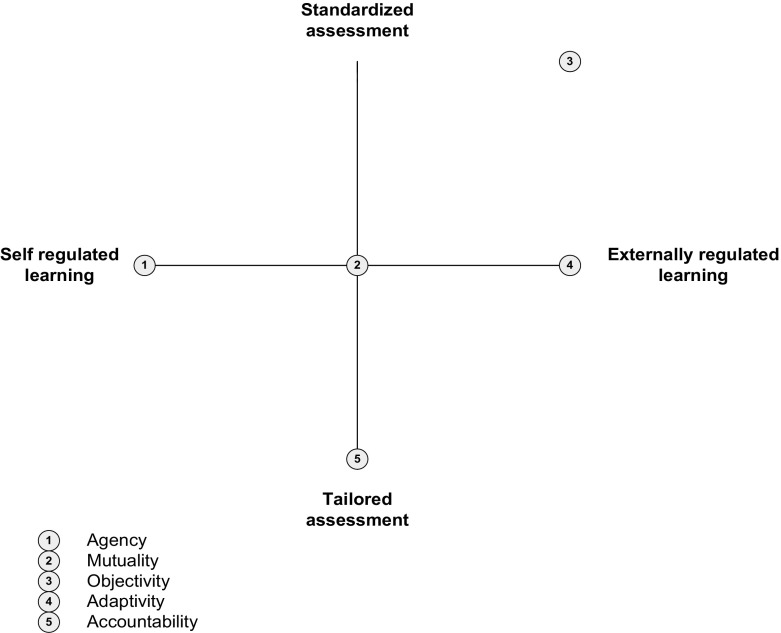
Workplace-Based Assessment (WBA) plays a pivotal role in present-day competency-based medical curricula. Validity in WBA mainly depends on how stakeholders (e.g. clinical supervisors and learners) use the assessments-rather than on the intrinsic qualities of instruments and methods. Current research on assessment in clinical contexts seems to imply that variable behaviours during performance assessment of both assessors and learners may well reflect their respective beliefs and perspectives towards WBA. We therefore performed a Q methodological study to explore perspectives underlying stakeholders' behaviours in WBA in a postgraduate medical training program. Five different perspectives on performance assessment were extracted: Agency, Mutuality, Objectivity, Adaptivity and Accountability. These perspectives reflect both differences and similarities in stakeholder perceptions and preferences regarding the utility of WBA. In comparing and contrasting the various perspectives, we identified two key areas of disagreement, specifically 'the locus of regulation of learning' (i.e., self-regulated versus externally regulated learning) and 'the extent to which assessment should be standardised' (i.e., tailored versus standardised assessment). Differing perspectives may variously affect stakeholders' acceptance, use-and, consequently, the effectiveness-of assessment programmes. Continuous interaction between all stakeholders is essential to monitor, adapt and improve assessment practices and to stimulate the development of a shared mental model. Better understanding of underlying stakeholder perspectives could be an important step in bridging the gap between psychometric and socio-constructivist approaches in WBA.
基于工作场所的评估(WBA)在当今基于能力的医学课程中起着关键作用。WBA的有效性主要取决于利益相关者(如临床督导员和学习者)如何使用评估,而非评估工具和方法的内在质量。当前关于临床环境中评估的研究似乎表明,评估者和学习者在绩效评估过程中的不同行为很可能反映了他们对WBA各自的信念和观点。因此,我们开展了一项Q方法学研究,以探究研究生医学培训项目中利益相关者在WBA中的行为背后的观点。提取了关于绩效评估的五种不同观点:能动性、相互性、客观性、适应性和问责性。这些观点反映了利益相关者在WBA效用方面的认知和偏好的差异与相似之处。在比较和对比各种观点时,我们确定了两个关键的分歧领域,具体为“学习的调控场所”(即自我调控学习与外部调控学习)和“评估应标准化的程度”(即量身定制评估与标准化评估)。不同的观点可能会以不同方式影响利益相关者对评估项目的接受度、使用情况以及评估项目的有效性。所有利益相关者之间持续的互动对于监测、调整和改进评估实践以及促进共享心智模型的发展至关重要。更好地理解利益相关者的潜在观点可能是弥合WBA中心理测量方法和社会建构主义方法之间差距的重要一步。