Department of Metabolic Medicine, Suita, Osaka, Japan.
Department of Metabolism and Atherosclerosis, Suita, Osaka, Japan.
J Diabetes Investig. 2018 Jan;9(1):162-172. doi: 10.1111/jdi.12641. Epub 2017 Mar 22.
AIMS/INTRODUCTION: It is suggested that a positive psychosocial condition has a good effect on health and glycemic control. However, there has been no research to evaluate the association between positive psychosocial factors and diabetic nephropathy (DN). The aim of the present study was to evaluate the association between psychosocial factors and DN in patients with type 2 diabetes.
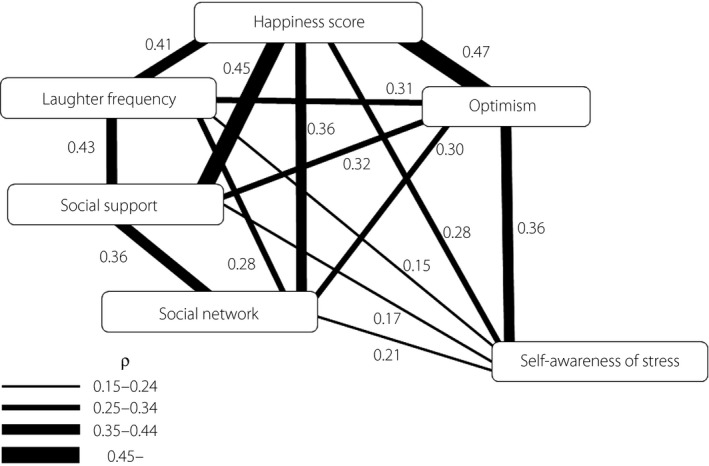
To assess psychosocial condition, six indicators (happiness score, Life Orientation Test-revised score as an indicator of dispositional optimism, laughter frequency, self-awareness of stress, social network and social support) were assessed by a self-administered questionnaire, and associations between these psychosocial indicators and the presence of DN were examined.
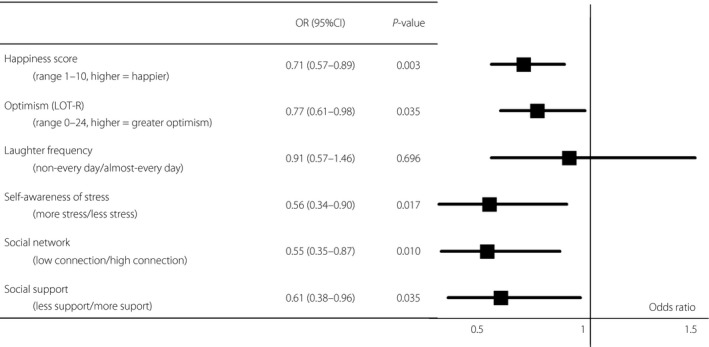
A cross-sectional analysis of patients with (n = 123) and without DN (n = 220) showed that a high score for happiness (odds ratio [OR] per 1 standard deviation 0.71, 95% confidence interval [CI] 0.57-0.89, P = 0.003), high Life Orientation Test-revised score (OR per 1 standard deviation 0.77, 95% CI: 0.61-0.98, P = 0.035), less self-awareness of stress (OR 0.56, 95% CI: 0.34-0.90, P = 0.017), high connection of social network (OR 0.55, 95% CI: 0.35-0.87, P = 0.010) and high social support (OR 0.61, 95% CI: 0.38-0.96, P = 0.035) were associated with a reduced risk of prevalence of DN. Similar results were observed even after adjustment for the following conventional risk factors of DN: age, sex, duration of diabetes, hemoglobin A1c, hypertension, dyslipidemia and current smoking.
The present study showed that five out of six prespecified indicators of psychosocial condition were significantly associated with the presence of DN in Japanese patients with type 2 diabetes.
目的/引言:有研究表明,积极的心理社会状态对健康和血糖控制有良好的影响。然而,目前还没有研究评估积极的心理社会因素与糖尿病肾病(DN)之间的关系。本研究旨在评估 2 型糖尿病患者的心理社会因素与 DN 之间的关系。
为了评估心理社会状况,通过自我管理问卷评估了六个指标(幸福感评分、作为性格乐观性指标的生活取向测试修订版评分、大笑频率、压力自我意识、社交网络和社会支持),并检查了这些心理社会指标与 DN 存在之间的关系。
对有(n=123)和无 DN(n=220)的患者进行横断面分析表明,幸福感评分较高(每标准差 0.71 的优势比 [OR],95%置信区间 [CI] 0.57-0.89,P=0.003)、生活取向测试修订版评分较高(每标准差 0.77 的 OR,95%CI:0.61-0.98,P=0.035)、压力自我意识较低(OR 0.56,95%CI:0.34-0.90,P=0.017)、社交网络连接度较高(OR 0.55,95%CI:0.35-0.87,P=0.010)和社会支持较高(OR 0.61,95%CI:0.38-0.96,P=0.035)与 DN 患病率降低的风险相关。即使在调整了 DN 的以下常规危险因素(年龄、性别、糖尿病病程、糖化血红蛋白、高血压、血脂异常和当前吸烟状况)后,也观察到了类似的结果。
本研究表明,在日本 2 型糖尿病患者中,心理社会状况的六个预设指标中有五个与 DN 的存在显著相关。