Department of Biostatistics, University of Washington, 1705 NE Pacific Street, Seattle, Washington, USA.
Public Health Sciences Division, Fred Hutchinson Cancer Research Center, 1100 Fairview Ave N, Seattle, Washington, USA.
Microbiome. 2017 Feb 8;5(1):17. doi: 10.1186/s40168-017-0239-9.
Community-level analysis of the human microbiota has culminated in the discovery of relationships between overall shifts in the microbiota and a wide range of diseases and conditions. However, existing work has primarily focused on analysis of relatively simple dichotomous or quantitative outcomes, for example, disease status or biomarker levels. Recently, there is also considerable interest in the relationship between the microbiota and censored survival outcomes, such as in clinical trials. How to conduct community-level analysis with censored survival outcomes is unclear, since standard dissimilarity-based tests cannot accommodate censored survival times and no alternative methods exist.
We develop a new approach, MiRKAT-S, for community-level analysis of microbiome data with censored survival times. MiRKAT-S uses ecologically informative distance metrics, such as the UniFrac distances, to generate matrices of pairwise distances between individuals' taxonomic profiles. The distance matrices are transformed into kernel (similarity) matrices, which are used to compare similarity in the microbiota to similarity in survival times between individuals.
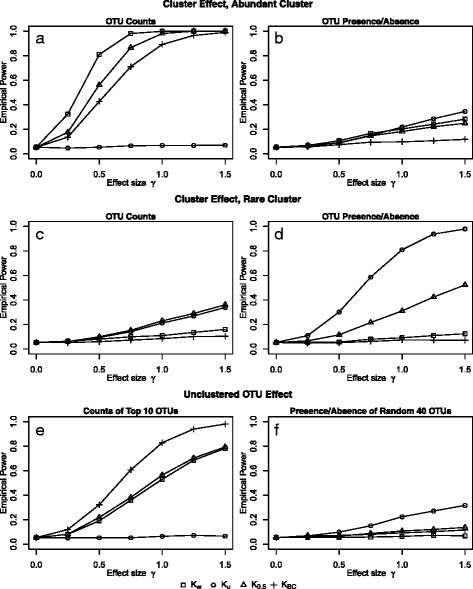
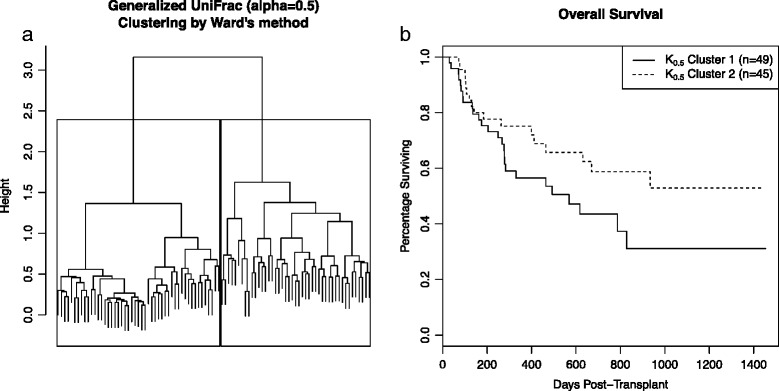
Simulation studies using synthetic microbial communities demonstrate correct control of type I error and adequate power. We also apply MiRKAT-S to examine the relationship between the gut microbiota and survival after allogeneic blood or bone marrow transplant.
We present MiRKAT-S, a method that facilitates community-level analysis of the association between the microbiota and survival outcomes and therefore provides a new approach to analysis of microbiome data arising from clinical trials.
社区层面的人类微生物组分析最终发现了微生物组的整体变化与广泛的疾病和状况之间的关系。然而,现有研究主要集中在相对简单的二分或定量结果的分析上,例如疾病状态或生物标志物水平。最近,人们也对微生物组与删失生存结果之间的关系产生了浓厚的兴趣,例如临床试验。如何对带有删失生存结果的微生物组进行社区层面的分析尚不清楚,因为标准的基于差异的检验无法处理删失生存时间,并且没有替代方法。
我们开发了一种新方法 MiRKAT-S,用于分析带有删失生存时间的微生物组数据的社区层面。MiRKAT-S 使用生态信息距离度量(如 UniFrac 距离)生成个体分类群谱之间的成对距离矩阵。距离矩阵被转换为核(相似性)矩阵,用于比较个体之间的微生物组相似性与生存时间相似性。
使用合成微生物群落进行的模拟研究表明,正确控制了Ⅰ型错误并具有足够的功效。我们还应用 MiRKAT-S 来检查肠道微生物组与异基因血液或骨髓移植后生存之间的关系。
我们提出了 MiRKAT-S,这是一种促进微生物组与生存结果之间关联的社区层面分析的方法,因此为分析来自临床试验的微生物组数据提供了一种新方法。