Guerrero-López Carlos M, Unar-Munguía Mishel, Colchero M Arantxa
Center for Health Systems Research, Instituto Nacional de Salud Pública, Universidad No. 655 Colonia Santa María Ahuacatitlán, Cerrada Los Pinos y Caminera, Cuernavaca, Morelos, C.P. 62100, Mexico.
Nutrition and Health Research Center, Instituto Nacional de Salud Pública, Universidad No. 655 Colonia Santa María Ahuacatitlán, Cerrada Los Pinos y Caminera, Cuernavaca, Morelos, C.P. 62100, Mexico.
BMC Public Health. 2017 Feb 10;17(1):180. doi: 10.1186/s12889-017-4098-x.
Chile is the second world's largest per capita consumer of caloric beverages. Caloric beverages are associated with overweight, obesity and other chronic diseases. The objective of this study is to estimate the price elasticity of demand for soft drinks, other sugar-sweetened beverages and high-energy dense foods in urban areas in Chile in order to evaluate the potential response of households' consumption to changes in prices.
We used microdata from the VII Family Budget Survey 2012-2013, which collects information on expenditures made by Chilean urban households on items such as beverages and foods. We estimated a Linear Approximation of an Almost Ideal Demand System Model to derive own and cross price elasticities of milk, coffee, tea and other infusions, plain water, soft drinks, other flavored beverages, sweet snacks, sugar and honey, and desserts. We considered the censored nature of the data and included the Inverse Mills Ratio in each equation of the demand system. We estimated a Quadratic Almost Ideal Demand System and a two-part model as sensitivity analysis.
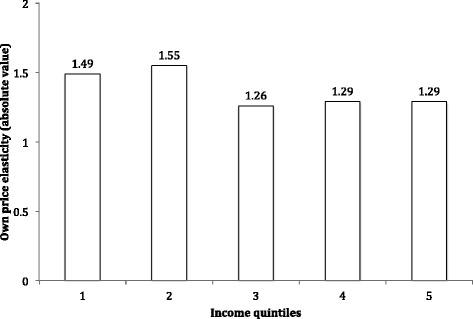
We found an own price-elasticity of -1.37 for soft drinks. This implies that a price increase of 10% is associated with a reduction in consumption of 13.7%. We found that the rest of food and beverages included in the demand system behave as substitutes for soft drinks. For instance, plain water showed a cross-price elasticity of 0.63: a 10% increase in price of soft drinks could lead to an increase of 6.3% of plain water. Own and cross price elasticities were similar between models.
The demand of soft drinks is price sensitive among Chilean households. An incentive system such as subsidies to non-sweetened beverages and tax to soft drinks could lead to increases in the substitutions for other healthier beverages.
智利是世界上人均热量饮料消费量第二高的国家。热量饮料与超重、肥胖及其他慢性疾病有关。本研究的目的是估计智利城市地区软饮料、其他含糖饮料和高能量密度食品的需求价格弹性,以评估家庭消费对价格变化的潜在反应。
我们使用了2012 - 2013年第七次家庭预算调查的微观数据,该调查收集了智利城市家庭在饮料和食品等项目上的支出信息。我们估计了一个几乎理想需求系统模型的线性近似,以得出牛奶、咖啡、茶及其他冲泡饮品、白水、软饮料、其他调味饮料、甜点心、糖和蜂蜜以及甜点的自身价格弹性和交叉价格弹性。我们考虑了数据的截尾性质,并在需求系统的每个方程中纳入了逆米尔斯比率。作为敏感性分析,我们估计了二次几乎理想需求系统和两部分模型。
我们发现软饮料的自身价格弹性为-1.37。这意味着价格上涨10%会导致消费量减少13.7%。我们发现需求系统中包含的其他食品和饮料可作为软饮料的替代品。例如,白水的交叉价格弹性为0.63:软饮料价格上涨10%可能导致白水消费量增加6.3%。各模型之间的自身价格弹性和交叉价格弹性相似。
智利家庭对软饮料的需求对价格敏感。诸如对无糖饮料补贴和对软饮料征税等激励制度可能会导致对其他更健康饮料的替代增加。