Rosella Laura C, Calzavara Andrew, Frank John W, Fitzpatrick Tiffany, Donnelly Peter D, Henry David
Public Health Ontario, Toronto, Ontario, Canada.
Institute for Clinical Evaluative Sciences, Toronto, Ontario, Canada.
BMJ Open. 2016 Nov 14;6(11):e012564. doi: 10.1136/bmjopen-2016-012564.
Historically, women have lower all-cause mortality than men. It is less understood that sex differences have been converging, particularly among certain subgroups and causes. This has implications for public health and health system planning. Our objective was to analyse contemporary sex differences over a 20-year period.
We analysed data from a population-based death registry, the Ontario Registrar's General Death file, which includes all deaths recorded in Canada's most populous province, from 1992 to 2012 (N=1 710 080 deaths). We calculated absolute and relative mortality sex differences for all-cause and cause-specific mortality, age-adjusted and age-specific, including the following causes: circulatory, cancers, respiratory and injuries. We used negative-binomial regression of mortality on socioeconomic status with direct age adjustment for the overall population.
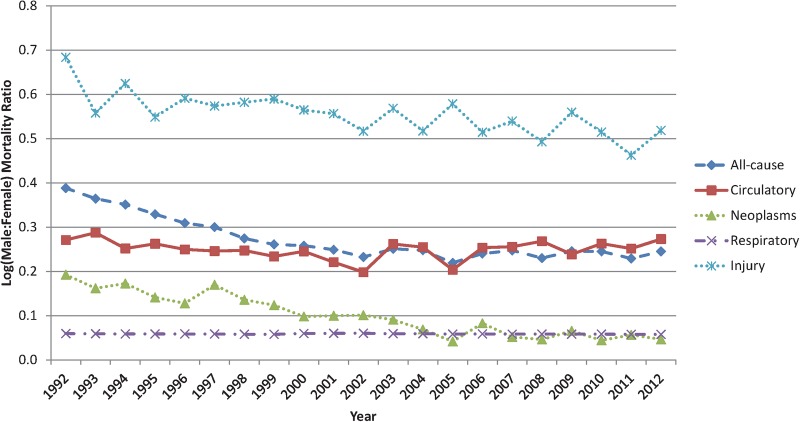
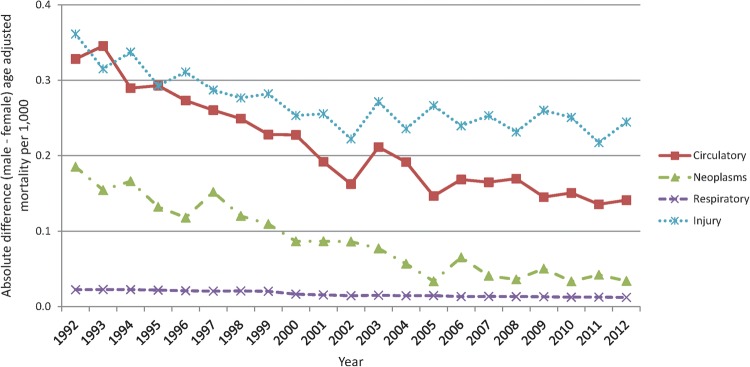
In the 20-year period, age-adjusted mortality dropped 39.2% and 29.8%, respectively, among men and women. The age-adjusted male-to-female mortality ratio dropped 41.4%, falling from 1.47 to 1.28. From 2000 onwards, all-cause mortality rates of high-income men were lower than those seen among low-income women. Relative mortality declines were greater among men than women for cancer, respiratory and injury-related deaths. The absolute decline in circulatory deaths was greater among men, although relative deciles were similar to women. The largest absolute mortality gains were seen among men over the age of 85 years.
The large decline in mortality sex ratios in a Canadian province with universal healthcare over two decades signals an important population shift. These narrowing trends varied according to cause of death and age. In addition, persistent social inequalities in mortality exist and differentially affect men and women. The observed change in sex ratios has implications for healthcare and social systems.
从历史上看,女性的全因死亡率低于男性。人们对性别差异正在趋同这一现象的了解较少,尤其是在某些亚组和死因中。这对公共卫生和卫生系统规划具有重要意义。我们的目标是分析20年间当代的性别差异。
我们分析了基于人群的死亡登记数据,即安大略省总登记官死亡档案,其中包括1992年至2012年加拿大人口最多的省份记录的所有死亡情况(N = 1710080例死亡)。我们计算了全因死亡率和特定病因死亡率的绝对和相对性别差异,包括年龄调整和特定年龄的差异,病因包括:循环系统疾病、癌症、呼吸系统疾病和损伤。我们使用负二项式回归分析死亡率与社会经济地位的关系,并对总体人群进行直接年龄调整。
在这20年期间,男性和女性的年龄调整死亡率分别下降了39.2%和29.8%。年龄调整后的男女死亡率之比下降了41.4%,从1.47降至1.28。从2000年起,高收入男性的全因死亡率低于低收入女性。男性在癌症、呼吸系统疾病和与损伤相关的死亡方面的相对死亡率下降幅度大于女性。男性循环系统疾病死亡的绝对下降幅度更大,尽管相对十分位数与女性相似。85岁以上男性的绝对死亡率增幅最大。
在一个拥有全民医疗保健的加拿大省份,二十年来死亡率性别比大幅下降标志着一个重要的人口转变。这些缩小趋势因死因和年龄而异。此外,死亡率方面持续存在的社会不平等现象存在,且对男性和女性的影响不同。观察到的性别比变化对医疗保健和社会系统具有重要意义。