
转诊至肾脏病科的进展缓慢的老年慢性肾脏病患者肾替代治疗发生率较低:一项观察性研究。
Low renal replacement therapy incidence among slowly progressing elderly chronic kidney disease patients referred to nephrology care: an observational study.
作者信息
Lundström Ulrika Hahn, Gasparini Alessandro, Bellocco Rino, Qureshi Abdul Rashid, Carrero Juan-Jesus, Evans Marie
机构信息
Division of Renal Medicine, Department CLINTEC, Karolinska Institutet and Karolinska University Hospital, Stockholm, Sweden.
Department of Statistics and Quantitative Methods, University Milano-Bicocca, Milan, Italy.
出版信息
BMC Nephrol. 2017 Feb 10;18(1):59. doi: 10.1186/s12882-017-0473-1.
BACKGROUND
Elderly patients with advanced chronic kidney disease (CKD) have a high risk of death before reaching end-stage kidney disease. In order to allocate resources, such as advanced care nephrology where it is most needed, it is essential to know which patients have the highest absolute risk of advancing to renal replacement therapy (RRT).
METHODS
We included all nephrology-referred CKD stage 3b-5 patients in Sweden 2005-2011 included in the Swedish renal registry (SRR-CKD) who had at least two serum creatinine measurements one year apart (+/- 6 months). We followed these patients to either initiation of RRT, death, or September 30, 2013. Decline in estimated glomerular filtration rate (eGFR) (%) was estimated during the one-year baseline period. The patients in the highest tertile of progression (>18.7% decline in eGFR) during the initial year of follow-up were classified as "fast progressors". We estimated the cumulative incidence of RRT and death before RRT by age, eGFR and progression status using competing risk models.
RESULTS
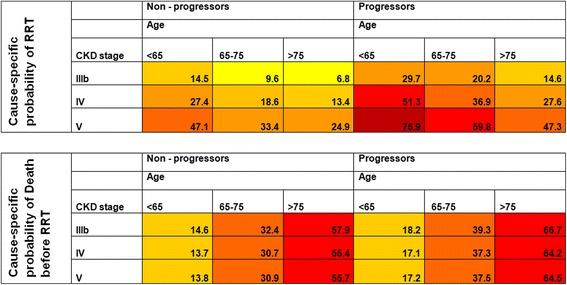
There were 2119 RRT initiations (24.2%) and 2060 deaths (23.5%) before RRT started. The median progression rate estimated during the initial year was -8.8% (Interquartile range [IQR] - 24.5-6.5%). A fast initial progression rate was associated with a higher risk of RRT initiation (Sub Hazard Ratio [SHR] 2.24 (95% confidence interval [CI] 2.00-2.51) and also a higher risk of death before RRT initiation (SHR 1.27 (95% CI 1.13-1.43). The five year probability of RRT was highest in younger patients (<65 years) with fast initial progression rate (51% in CKD stage 4 and 76% in stage 5), low overall in patients >75 years with a slow progression rate (7, 13, and 25% for CKD stages 3b, 4 and 5 respectively), and slightly higher in elderly patients with a fast initial progression rate (28% in CKD stage 4 and 47% in CKD stage 5) or with diabetic kidney disease.
CONCLUSIONS
The 5-year probability of RRT was low among referred slowly progressing CKD patients >75 years of age because of the competing risk of death.
背景
晚期慢性肾脏病(CKD)老年患者在进入终末期肾病之前有很高的死亡风险。为了分配资源,比如在最需要的地方提供高级护理肾脏病学服务,了解哪些患者进展到肾脏替代治疗(RRT)的绝对风险最高至关重要。
方法
我们纳入了2005年至2011年瑞典肾脏登记处(SRR-CKD)中所有转诊的CKD 3b-5期患者,这些患者每年至少有两次血清肌酐测量值(±6个月)。我们对这些患者进行随访,直至开始RRT、死亡或2013年9月30日。在一年的基线期内估计估算肾小球滤过率(eGFR)的下降百分比(%)。在随访的第一年中,eGFR下降处于最高三分位数(>18.7%)的患者被归类为“快速进展者”。我们使用竞争风险模型按年龄、eGFR和进展状态估计RRT和RRT前死亡的累积发生率。
结果
在开始RRT之前,有2119例开始RRT(24.2%)和2060例死亡(23.5%)。在最初一年中估计的中位进展率为-8.8%(四分位间距[IQR]-24.5-6.5%)。快速的初始进展率与开始RRT的较高风险相关(亚风险比[SHR]2.24(95%置信区间[CI]2.00-2.51)),也与RRT开始前死亡的较高风险相关(SHR 1.27(95%CI 1.13-1.43))。初始进展快的年轻患者(<65岁)RRT的五年概率最高(CKD 4期为51%,5期为76%),进展缓慢的7 > 5岁患者总体概率较低(CKD 3b、4和5期分别为7%、13%和25%),初始进展快的老年患者(CKD 4期为28%,CKD 5期为47%)或患有糖尿病肾病的患者概率略高。
结论
由于存在死亡的竞争风险,年龄>75岁的转诊进展缓慢的CKD患者RRT的5年概率较低。


 Zotero 插件