Nahlen Bose Catarina, Bjorling Gunilla, Elfstrom Magnus L, Persson Hans, Saboonchi Fredrik
The Swedish Red Cross University College, Stockholm, Sweden; Karolinska Institutet Department of Clinical Sciences Danderyd Hospital, Stockholm, Sweden.
Malardalen University, Academy of Health, Care and Social Welfare, Eskilstuna/Vasteras, Sweden.
Cardiol Res. 2015 Apr;6(2):239-248. doi: 10.14740/cr385w. Epub 2015 Apr 6.
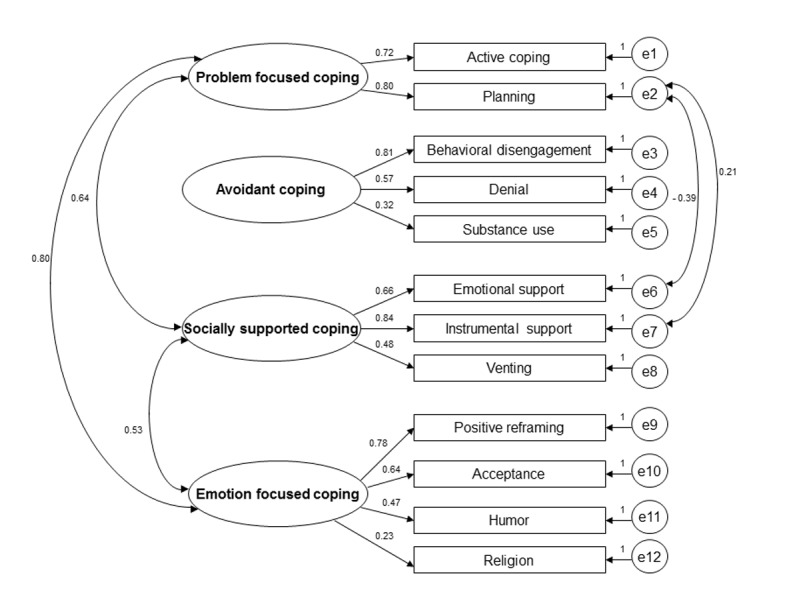
Individuals with chronic heart failure (CHF) need to cope with both the physical limitations and the psychological impacts of the disease. Since some coping strategies are beneficial and others are linked to increased mortality and worse health-related quality of life (HRQoL), it is important to have a reliable and valid instrument to detect different coping styles. Brief COPE, a self-reporting questionnaire, has been previously used in the context of CHF. There is, however, currently a lack of consensus about the theoretical or empirical foundations for grouping the multiple coping strategies assessed by Brief COPE into higher order categories of coping. The main purpose of this study was to examine the structure of Brief COPE, founded on the higher order grouping of its subscales in order to establish an assessment model supported by theoretical considerations. Furthermore, the associations between these higher order categories of coping and HRQoL were examined to establish the predictive validity of the selected model in the context of CHF.
One hundred eighty-three patients diagnosed with CHF were recruited at a heart failure outpatient clinic or at a cardiac ward. Self-reported questionnaires were filled in to measure coping strategies and HRQoL. Confirmatory factor analyses were performed to investigate different hierarchical structures of Brief COPE found in the literature to assess coping strategies in patients with CHF. Regression analyses explored associations of aggregated coping strategies with HRQoL.
A four factorial structure of Brief COPE displayed the most adequate psychometric properties, consisting of problem focused coping, avoidant coping, socially supported coping and emotion focused coping. Avoidant coping was associated with worse HRQoL in CHF.
This study provides support for a four-factor model of coping strategies in patients with CHF. This could facilitate assessment of coping both in clinical and research settings.
慢性心力衰竭(CHF)患者需要应对疾病带来的身体限制和心理影响。由于一些应对策略有益,而另一些则与死亡率增加和健康相关生活质量(HRQoL)恶化有关,因此拥有一种可靠且有效的工具来检测不同的应对方式非常重要。简短应对方式问卷(Brief COPE)是一种自我报告问卷,此前已在CHF背景下使用。然而,目前对于将Brief COPE评估的多种应对策略分组为更高层次的应对类别,在理论或实证基础方面缺乏共识。本研究的主要目的是检验Brief COPE的结构,该结构基于其子量表的更高层次分组,以便建立一个有理论依据支持的评估模型。此外,还研究了这些更高层次的应对类别与HRQoL之间的关联,以确定所选模型在CHF背景下的预测效度。
在心力衰竭门诊或心脏病房招募了183名被诊断为CHF的患者。填写自我报告问卷以测量应对策略和HRQoL。进行验证性因素分析,以研究文献中发现的Brief COPE的不同层次结构,以评估CHF患者的应对策略。回归分析探讨了综合应对策略与HRQoL之间的关联。
Brief COPE的四因素结构显示出最适当的心理测量特性,包括问题聚焦应对、回避应对、社会支持应对和情绪聚焦应对。回避应对与CHF患者较差的HRQoL相关。
本研究为CHF患者应对策略的四因素模型提供了支持。这有助于在临床和研究环境中评估应对情况。