Navegantes Kely Campos, de Souza Gomes Rafaelli, Pereira Priscilla Aparecida Tártari, Czaikoski Paula Giselle, Azevedo Carolina Heitmann Mares, Monteiro Marta Chagas
Pharmaceutical Science Post-Graduation Program, Health Science Institute, Federal University of Pará/UFPA, Belém, PA, 66075900, Brazil.
Department of Clinical, Bromatological and Toxicological Analysis, Ribeirão Preto Pharmaceutical Sciences School, USP-SP, Ribeirão Preto, SP, Brazil.
J Transl Med. 2017 Feb 15;15(1):36. doi: 10.1186/s12967-017-1141-8.
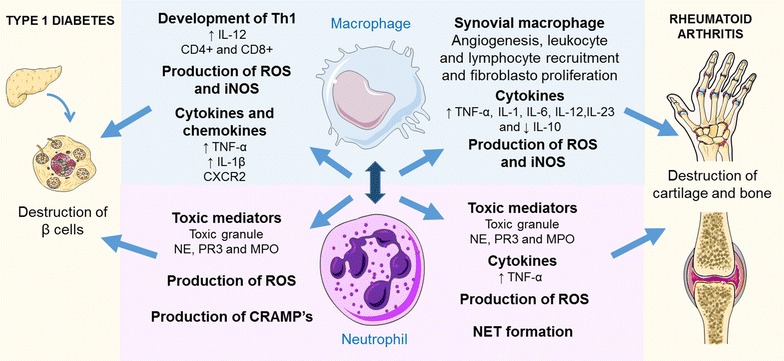
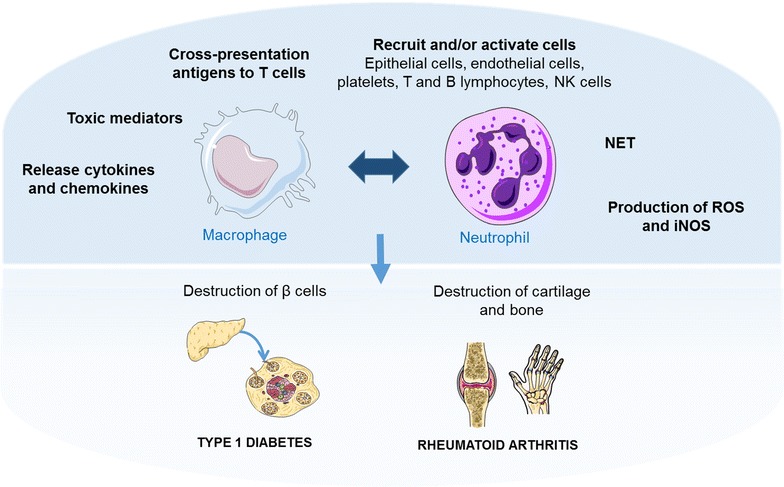
Macrophages and neutrophils are key components involved in the regulation of numerous chronic inflammatory diseases, infectious disorders, and especially certain autoimmune disease. However, little is known regarding the contribution of these cells to the pathogenesis of autoimmune disorders. Recent studies have aimed to clarify certain important factors affecting the immunogenicity of these cells, including the type and dose of antigen, the microenvironment of the cell-antigen encounter, and the number, subset, and phenotype of these cells, which can prevent or induce autoimmune responses. This review highlights the role of macrophage subsets and neutrophils in injured tissues, supporting their cooperation during the pathogenesis of certain autoimmune diseases.
巨噬细胞和中性粒细胞是参与多种慢性炎症性疾病、感染性疾病,尤其是某些自身免疫性疾病调节的关键成分。然而,关于这些细胞在自身免疫性疾病发病机制中的作用却知之甚少。最近的研究旨在阐明影响这些细胞免疫原性的某些重要因素,包括抗原的类型和剂量、细胞与抗原相遇的微环境,以及这些细胞的数量、亚群和表型,这些因素可以预防或诱导自身免疫反应。本综述强调了巨噬细胞亚群和中性粒细胞在受损组织中的作用,支持它们在某些自身免疫性疾病发病过程中的协同作用。