Barban Francesco, Annicchiarico Roberta, Melideo Matteo, Federici Alessia, Lombardi Maria Giovanna, Giuli Simone, Ricci Claudia, Adriano Fulvia, Griffini Ivo, Silvestri Manuel, Chiusso Massimo, Neglia Sergio, Ariño-Blasco Sergio, Cuevas Perez Raquel, Dionyssiotis Yannis, Koumanakos Georgios, Kovačeić Milo, Montero-Fernández Nuria, Pino Oscar, Boye Niels, Cortés Ulises, Barrué Cristian, Cortés Atia, Levene Peter, Pantelopoulos Stelios, Rosso Roberto, Serra-Rexach José Antonio, Sabatini Angelo Maria, Caltagirone Carlo
Clinical and Behavioral Neurology Laboratory, IRCCS Fondazione Santa Lucia, Rome 00179, Italy.
Berlin School of Mind and Brain, Humboldt-Universität zu Berlin, Berlin 10117, Germany.
Brain Sci. 2017 Feb 10;7(2):19. doi: 10.3390/brainsci7020019.
Falling is a major clinical problem in elderly people, demanding effective solutions. At present, the only effective intervention is motor training of balance and strength. Executive function-based training (EFt) might be effective at preventing falls according to evidence showing a relationship between executive functions and gait abnormalities. The aim was to assess the effectiveness of a motor and a cognitive treatment developed within the EU co-funded project I-DONT-FALL.
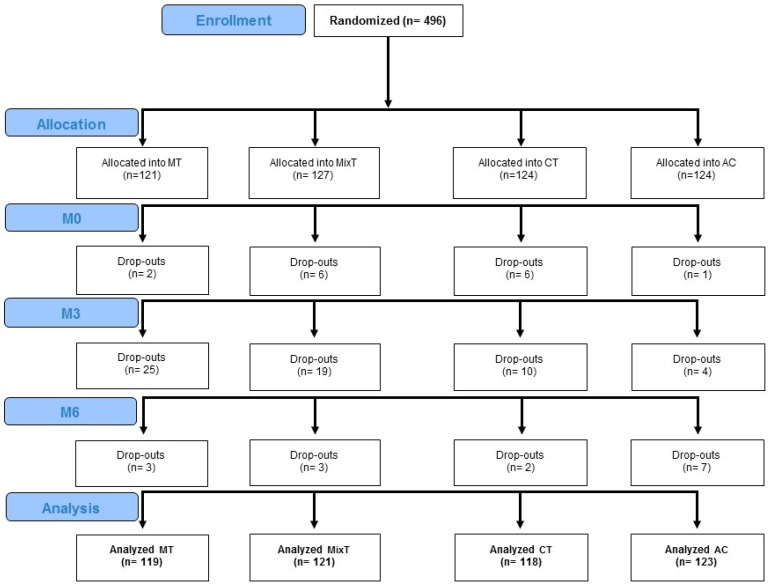
In a sample of 481 elderly people at risk of falls recruited in this multicenter randomised controlled trial, the effectiveness of a motor treatment (pure motor or mixed with EFt) of 24 one-hour sessions delivered through an -Walker with a non-motor treatment (pure EFt or control condition) was evaluated. Similarly, a 24 one-hour session cognitive treatment (pure EFt or mixed with motor training), delivered through a touch-screen computer was compared with a non-cognitive treatment (pure motor or control condition).
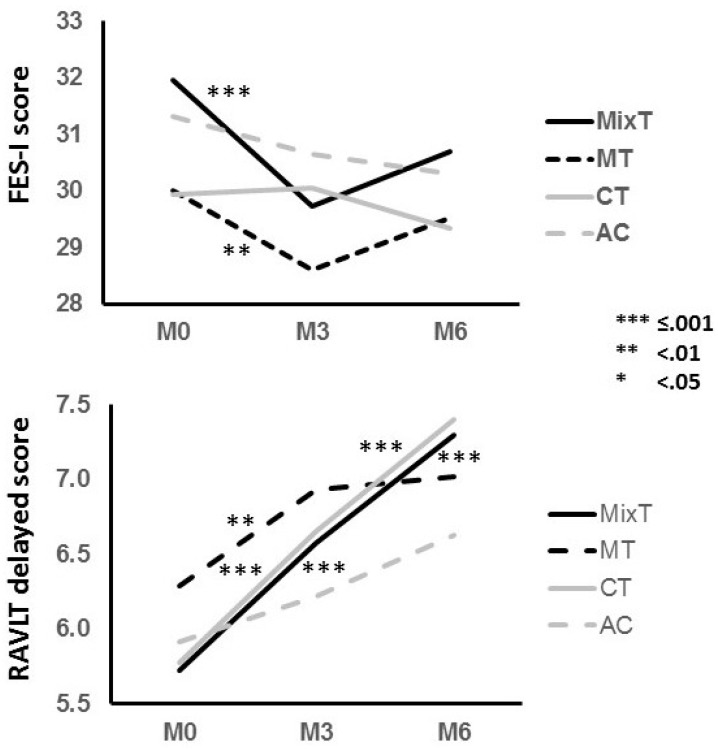
Motor treatment, particularly when mixed with EFt, reduced significantly fear of falling (F(1,478) = 6.786, = 0.009) although to a limited extent (ES -0.25) restricted to the period after intervention.
This study suggests the effectiveness of motor treatment empowered by EFt in reducing fear of falling.
跌倒在老年人中是一个重大临床问题,需要有效的解决办法。目前,唯一有效的干预措施是平衡和力量的运动训练。根据显示执行功能与步态异常之间存在关联的证据,基于执行功能的训练(EFt)可能在预防跌倒方面有效。目的是评估在欧盟共同资助的“我不会跌倒”项目中开发的运动治疗和认知治疗的有效性。
在这项多中心随机对照试验招募的481名有跌倒风险的老年人样本中,评估了通过 -Walker进行的24次一小时运动治疗(纯运动或与EFt混合)与非运动治疗(纯EFt或对照条件)的有效性。同样,将通过触摸屏电脑进行的24次一小时认知治疗(纯EFt或与运动训练混合)与非认知治疗(纯运动或对照条件)进行了比较。
运动治疗,特别是与EFt混合时,显著降低了跌倒恐惧(F(1,478) = 6.786, = 0.009),尽管程度有限(效应量 -0.25),且仅限于干预后的时期。
本研究表明,EFt增强的运动治疗在降低跌倒恐惧方面是有效的。