Vanhoutte Ilse, De Mets Laura, De Boevre Marthe, Uka Valdet, Di Mavungu José Diana, De Saeger Sarah, De Gelder Leen, Audenaert Kris
Laboratory of Environmental Biotechnology, Department of Applied Biosciences, Faculty of Bioscience Engineering, Ghent University, 9000 Ghent, Belgium.
Laboratory of Food Analysis, Department of Bioanalysis, Faculty of Pharmaceutical Sciences, Ghent University, 9000 Ghent, Belgium.
Toxins (Basel). 2017 Feb 13;9(2):63. doi: 10.3390/toxins9020063.
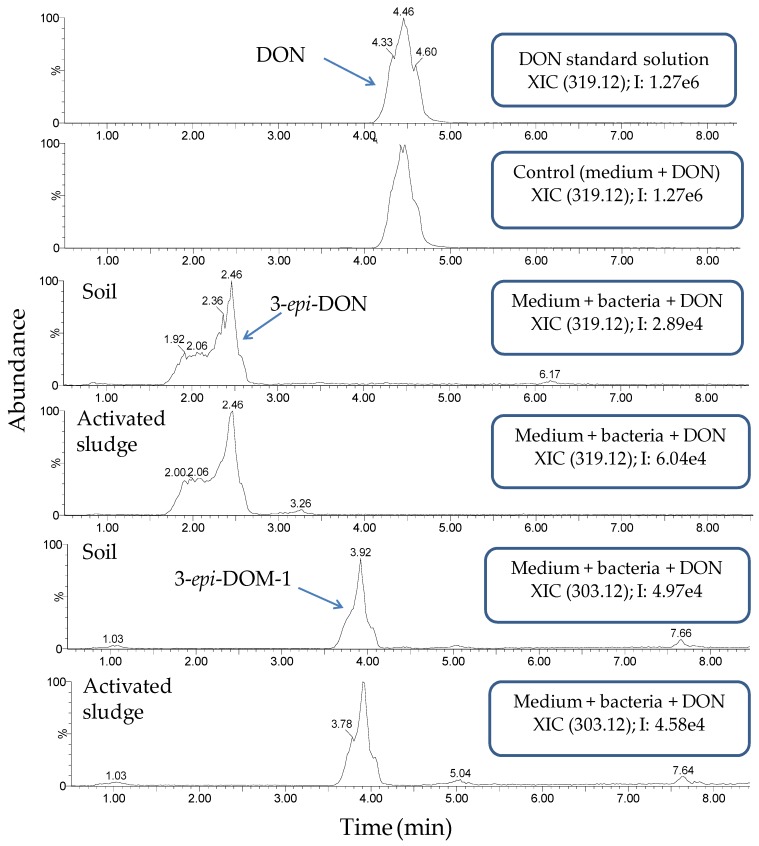
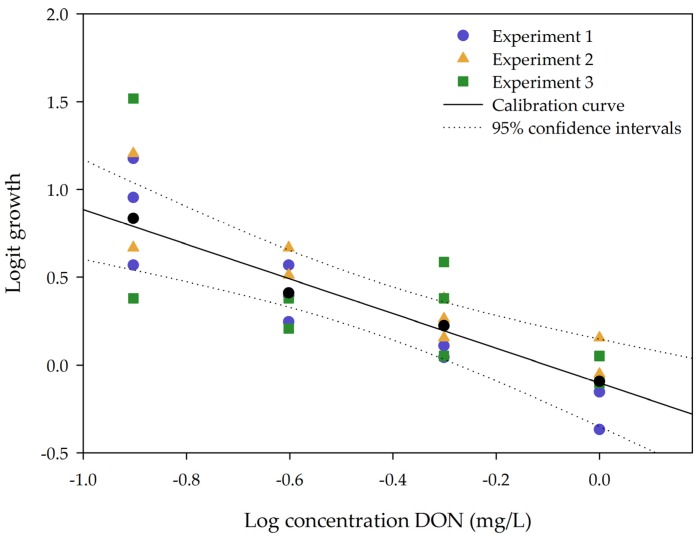
Mycotoxins are toxic metabolites produced by fungi. To mitigate mycotoxins in food or feed, biotransformation is an emerging technology in which microorganisms degrade toxins into non-toxic metabolites. To monitor deoxynivalenol (DON) biotransformation, analytical tools such as ELISA and liquid chromatography coupled to tandem mass spectrometry (LC-MS/MS) are typically used. However, these techniques do not give a decisive answer about the remaining toxicity of possible biotransformation products. Hence, a bioassay using L. was developed. A dose-response analysis revealed significant inhibition in the growth of exposed to DON concentrations of 0.25 mg/L and higher. Concentrations above 1 mg/L were lethal for the plant. This bioassay is far more sensitive than previously described systems. The bioassay was implemented to screen microbial enrichment cultures, originating from rumen fluid, soil, digestate and activated sludge, on their biotransformation and detoxification capability of DON. The enrichment cultures originating from soil and activated sludge were capable of detoxifying and degrading 5 and 50 mg/L DON. In addition, the metabolites 3-epi-DON and the epimer of de-epoxy-DON (3-epi-DOM-1) were found as biotransformation products of both consortia. Our work provides a new valuable tool to screen microbial cultures for their detoxification capacity.
霉菌毒素是由真菌产生的有毒代谢产物。为了减轻食品或饲料中的霉菌毒素,生物转化是一项新兴技术,其中微生物将毒素降解为无毒代谢产物。为了监测脱氧雪腐镰刀菌烯醇(DON)的生物转化,通常使用酶联免疫吸附测定(ELISA)和液相色谱-串联质谱联用(LC-MS/MS)等分析工具。然而,这些技术并不能对可能的生物转化产物的剩余毒性给出决定性答案。因此,开发了一种使用L.的生物测定法。剂量反应分析表明,暴露于浓度为0.25mg/L及更高的DON中的L.的生长受到显著抑制。浓度高于1mg/L对该植物具有致死性。这种生物测定法比先前描述的系统灵敏得多。该生物测定法用于筛选源自瘤胃液、土壤、沼渣和活性污泥的微生物富集培养物对DON的生物转化和解毒能力。源自土壤和活性污泥的富集培养物能够对5mg/L和50mg/L的DON进行解毒和降解。此外,发现两种菌群的生物转化产物均为3-表-DON和脱环氧-DON的差向异构体(3-表-DOM-1)。我们的工作提供了一种新的有价值的工具,用于筛选微生物培养物的解毒能力。